Informopedia Explains: an Airbus A380 can weigh more than 550 tonnes at takeoff — the weight of about 100 elephants — and it stays in the air on nothing but moving air. Everybody who has looked out of a plane window has wondered how. The surprising part is that physicists and pilots have argued about the answer for a century, and both sides of the argument are right.
Four forces, one balance
Anything flying is caught in a tug of war between four forces. Weight pulls the plane down. Thrust, from the engines, pushes it forward. Drag — air resistance — pushes back. And lift, produced by the wings, pushes up. In steady, level flight, lift exactly balances weight and thrust exactly balances drag. The plane is not defying gravity; it is paying for the privilege, in speed, every second it stays up.
Lift is the interesting one, because it comes from the shape of the wing and the angle at which it meets the air. Engineers write it as an equation: lift equals half the air density, times the speed squared, times the wing area, times a number called the lift coefficient. The squared term is the one that matters most — double the speed and you get four times the lift. That is why planes need long runways: they cannot fly until they are going fast enough, usually around 250 to 300 kilometres per hour for a big airliner, for the wings to generate enough lift to carry the weight.
Bernoulli vs Newton: the argument
Ask a pilot how a wing makes lift and you will probably hear about Bernoulli’s principle, discovered by the Swiss physicist Daniel Bernoulli in the 1700s: when a fluid speeds up, its pressure drops. A wing is curved more on top than underneath, so air flowing over the top speeds up, its pressure falls, and the higher pressure below pushes the wing up. That is true — and it is also incomplete.
Ask a physicist and you may hear about Newton instead. A wing is tilted slightly into the oncoming air — its angle of attack — so it deflects air downward. Newton’s third law says every action has an equal and opposite reaction: the wing pushes the air down, so the air pushes the wing up. That is also true. NASA’s own beginner’s guide to aeronautics says plainly that the two descriptions are the same physics seen from different angles. The pressure difference is what physically pushes on the wing; the downward deflection of air is the result of those pressures acting around it.
One popular version of the story is simply wrong, though, and it is still taught in schools. It says the air going over the curved top of the wing has further to travel, so it must speed up to rejoin its partner underneath at the trailing edge — “equal transit time”. Air molecules do not keep appointments. The air over the top speeds up because the wing’s shape and angle turn and constrict the flow, not because of any reunion at the back. The equal-transit story would also imply that a flat wing, or a wing flying upside down, could never produce lift. Aerobatic planes fly upside down all the time.
Why wings stall
The angle of attack is the key to everything, including the thing pilots fear most. Tilt the wing a little more into the airflow and lift increases — up to a point. At a critical angle, usually around 15 to 18 degrees, the smooth airflow over the top of the wing breaks away from the surface. Lift collapses and drag soars. The wing has stalled. A stall is not about speed, though it usually happens at low speed, when the wing needs a big angle of attack to generate enough lift. It is about angle, and it is why takeoff and landing — the slow, high-angle parts of a flight — are when pilots watch the angle of attack most carefully.
That is also why wings have flaps and slats, the panels that extend from the trailing and leading edges on approach. They change the wing’s shape, letting it produce more lift at slower speeds — the same reason a bird spreads its wings wide to land.
Why planes fly so high
There is one more piece of the puzzle: the air itself. Air density falls with altitude, and lift depends on density — so at 35,000 feet, a plane’s wings generate less lift than they would at sea level at the same speed. But thin air also means less drag, so the engines can push the plane faster, and the speed-squared term more than compensates. Cruising high is a bargain: the plane goes faster, burns less fuel per kilometre, and flies above most of the weather. The price is that the margin between flying and stalling gets thinner, which is one more reason pilots treat the high-altitude cruise with respect.
The same physics shows up everywhere once you know to look for it. Hypersonic missiles push the same physics to its limits, at speeds where the air itself starts to behave differently. Submarines play the same game in water, a fluid nearly 800 times denser than air, where buoyancy does the work that lift does in the sky. And every time a plane banks into a turn, the wing has to produce more lift than the plane’s weight, because some of that lift is now spent turning the aircraft instead of holding it up — which is why the stall speed rises in a turn, and why pilots never bank hard when they are slow.
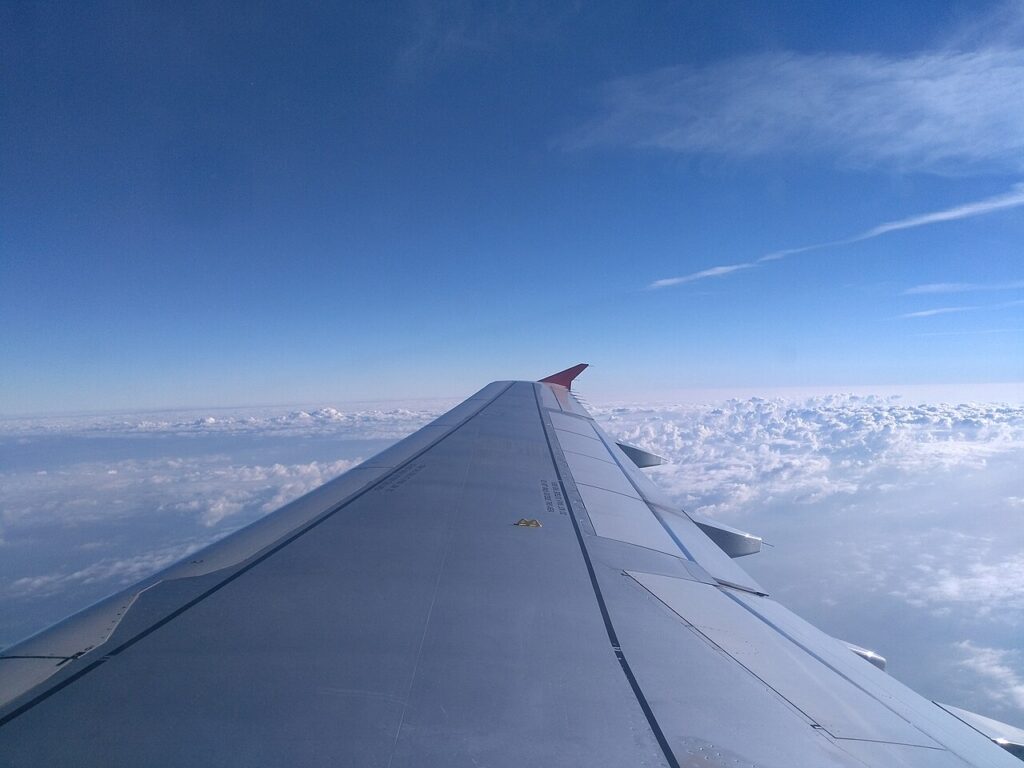
So the next time you watch a wing from a window seat, notice the slight tilt, the curve, the flaps sliding out on approach. That is the whole trick: a shape that turns air downward, a pressure difference that follows, and enough speed to make the numbers work. One hundred elephants, held up by nothing but air going the other way.