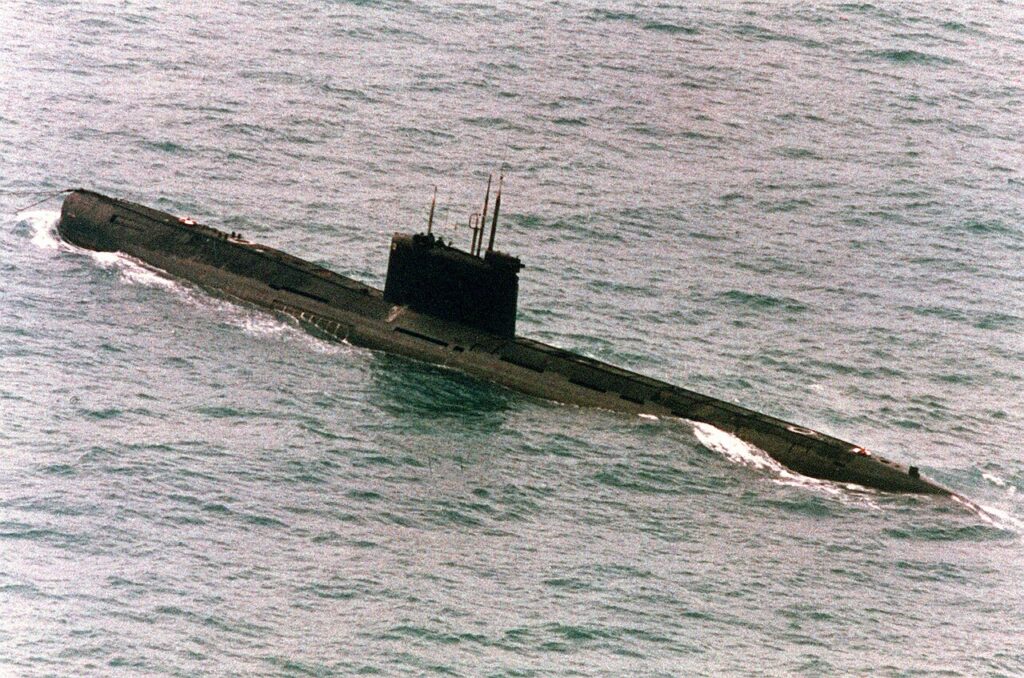
Informopedia Explains: In 1960, the American submarine USS Triton slipped beneath the waves off New London, Connecticut, and did not surface again for 60 days and 21 hours. In that time it travelled 26,723 nautical miles — nearly 50,000 kilometres — completing the first submerged circumnavigation of the globe. No one aboard breathed outside air for two months. No one saw the sky. The boat made its own oxygen, cleaned its own air, and distilled its own drinking water from the sea around it. The question is how — and why, 65 years later, the answer still has a limit.
First, the engine that doesn’t need air
The trick starts with the reactor. A diesel submarine is, in the end, an ordinary engine that happens to work underwater: it burns fuel, and burning needs oxygen, so the boat must regularly poke a snorkel above the surface or run on batteries that go flat in hours. A nuclear submarine has no such problem. Its reactor produces heat through fission — splitting uranium atoms — and fission needs no air at all. The heat boils water into steam, the steam drives turbines for propulsion and electricity, and the steam condenses back into water in a closed loop. A Virginia-class boat’s reactor core holds enough fuel to run for 33 years, the entire service life of the ship, without refuelling. The engine is, for practical purposes, endless. Everything else on board is built around that fact.
Making oxygen out of seawater
The crew still has to breathe, and a sealed steel tube 100 metres below the surface has no atmosphere to draw on. So the boat makes its own. Electrolysis cells pass a strong electric current through purified freshwater, splitting H2O into oxygen and hydrogen. The oxygen goes into the ventilation system; the hydrogen is vented overboard. A crew of 135 needs about 113 kilograms of oxygen a day, and the reactor happily supplies the electricity to generate all of it. Seawater has to be distilled first — electrolysing salt water would produce chlorine gas, which nobody wants in a submarine — so freshwater production comes first in the chain. If the electrolysis plant fails, backup oxygen candles — cartridges of sodium chlorate that release oxygen when heated — are stored throughout the boat.
Scrubbing the air clean
Supplying oxygen is only half the job. A hundred-plus people exhaling in a sealed tube will poison themselves with their own carbon dioxide long before the oxygen runs out. Monoethanolamine scrubbers absorb CO2 from the air and release it overboard; simpler soda-lime scrubbers trap it chemically. Catalytic burners destroy trace carbon monoxide and hydrogen. The whole atmosphere is monitored constantly by a central system, and the air a submariner breathes on day 60 is, chemically speaking, as good as the air on day one. The International Space Station solves the same problem the same way — the two machines are cousins, one in orbit and one under the sea.
Water, food, and the real limit
Fresh water is the easiest problem: distillation plants use the reactor’s waste heat to turn seawater into as much as 40,000 gallons of drinking water a day. Power is unlimited. Air is manufactured. Water is distilled. Which leaves exactly one consumable the reactor cannot replenish: food. A typical patrol lasts around 60 to 80 days submerged, and the US Navy describes food as the primary limit on patrol length — an Ohio-class boat carries roughly 60 days of provisions. When the pantry runs out, the boat comes home, no matter how much fuel or oxygen remains. The crew’s endurance matters too: months without sunlight, living by the boat’s own clock — on many American boats the working day is 18 hours, not 24 — in bunks shared in rotation, with families months away. The machine can stay down indefinitely. The people cannot.
Why this matters
Submarines are often described as the ultimate stealth weapon, and the current arms race — three of Britain’s four nuclear submarines were at sea at once in October, a rarity that made headlines — is really a race in endurance: who can stay hidden longest. But the deeper story is not military. A nuclear submarine is one of the few machines humans have built that is a complete, self-contained world — it makes its own air, water and power from the sea around it, and asks nothing from the surface except food. It is a proof of concept for living anywhere hostile: under the ocean, in orbit, and one day, perhaps, on another planet. The irony is that the most advanced life-support system ever built is ultimately defeated by the oldest problem in human history — keeping a hundred people fed. The missiles they carry get the headlines. The pantry sets the schedule.
Further reading: ScienceABC — https://www.scienceabc.com/innovation/why-do-submarines-have-to-resurface-can-they-remain-submerged-indefinitely