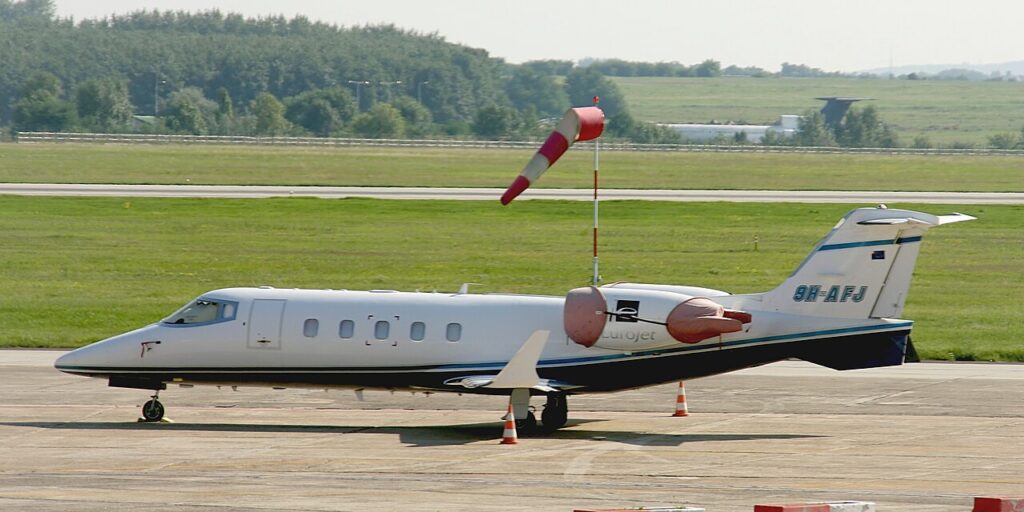
VERDICT: FALSE — The aircraft that crashed in Palm Beach County, Florida, on November 1 was a Learjet 60, not a missile or a drone. Flight data, the crew’s radio calls and the recovered wreckage all confirm it.
The claim
After nine people died when a Learjet 60 came down in Palm Beach County, Florida, posts on Facebook and X began claiming the crash was a cover-up: the object plunging into a road in viral dashcam footage was a missile or a drone, not a passenger jet. One widely shared video argues the aircraft looks too small next to the power poles lining the road — a Learjet is about 13 to 14 metres long, the poster says, while the poles are only seven to nine metres — so “it can’t be a Learjet. It is a drone or a missile.” Others doubt the crash happened at all. One Facebook video pushing the theory has been viewed more than 920,000 times.
The facts
1. The flight is a matter of public record. Flight-tracking data shows the aircraft was N722BD, a Learjet 60 flying from Austin, Texas, to North Eleuthera in the Bahamas. It left Austin at 15:37 UTC, dropped to 35,000 feet near Naples, Florida, then briefly climbed before a steep, right-hand descent. The last data point was 8,750 feet at 17:49:22 UTC, falling at more than 32,000 feet per minute. The raw tracking data is published for anyone to check. No missile or drone files a flight plan from Austin to the Bahamas.
2. The crew’s own words are on tape. In air-traffic-control audio, the crew reported icing and moderate turbulence, asked for a “better ride” and to climb to 37,000 feet. Moments later, they reported descending at a high rate in an overspeed condition. Co-pilot Nathalia Filgueiras, 20, can be heard telling controllers the plane was rapidly losing altitude and was going to hit the ground.
3. The wreckage is a Learjet’s wreckage. The US National Transportation Safety Board (NTSB), leading the investigation (case ERA27MA026), says the aircraft began breaking up before impact. Its left elevator was found in three pieces between 1.3 and 3.8 miles from the crash site. An engine portion was excavated from the crater; debris turned up on nearby roofs. By November 8, parts from both wings, both engines, the flight deck and the tail were recovered and identified. On November 9, investigators recovered the cockpit voice recorder. The NTSB has never suggested the object was anything other than a Learjet 60.
4. The victims are real, named people. Nine people died: two crew and seven passengers. The families issued a joint statement on November 2 naming all seven passengers, and the Palm Beach County Sheriff’s Office formally identified all nine on November 4: captain Jeff Gregory, 55; co-pilot Filgueiras, 20; and passengers including Adam Robinson and his wife Helen Sharp, and their children Emma, 4, and Charles, 2. A real flight carrying real people — as we reported.
5. The “too small” argument gets the geometry wrong. The dashcam was filming an aircraft diving from altitude at a steep angle, far from the camera. Objects far from a wide-angle dashcam lens look small next to nearby objects — that is perspective, not proof of a different aircraft. Still frames show an aircraft matching the Learjet 60’s profile — cockpit shape, rear fuselage-mounted engines. The jet was already coming apart in the air, so parts miles from the crater — and a damaged look in single frames — are expected, not suspicious.
What is still unknown is why the jet went down. The NTSB has not determined a probable cause; its preliminary report is expected in about 30 days. Icing and turbulence are part of the investigation, not a conclusion. That uncertainty is not evidence of a cover-up; it is how air-crash investigations work.
Verdict
FALSE. The aircraft that crashed in Palm Beach County on November 1 was a Learjet 60, registration N722BD, on a flight from Austin, Texas, to the Bahamas. Flight data, the crew’s radio calls, the wreckage and the named victims all point to the same conclusion. There is no credible evidence that a missile or a drone was involved.
Why it matters
This kind of theory does damage twice over. First, it turns a tragedy that killed nine people — including two small children — into a puzzle for strangers, while the families are still grieving. Second, it teaches audiences to distrust crash investigators, so that when the NTSB publishes its findings, a ready-made audience is primed to dismiss them. The flight data is public, the wreckage catalogued, the victims named. A claim that ignores all of that is not scepticism. It is noise.