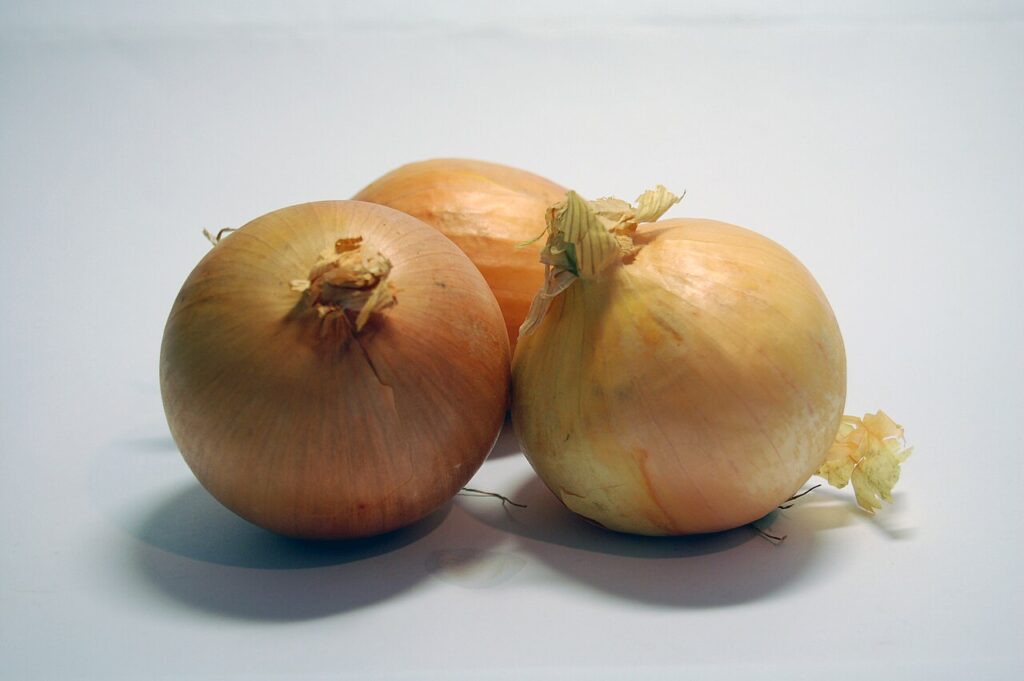
Informopedia Explains: The onion does not want to be eaten. That is not a metaphor. Long before humans started cooking with it, the onion evolved a chemical defence system so effective that it turns your own eyes against you — a tiny, on-demand tear-gas factory that sits quietly in the vegetable drawer until a knife sets it off.
Here is the elegant part: an intact onion contains none of the irritant at all. The weapon does not exist until you create it.
Two ingredients, kept apart
Inside every onion cell, the ingredients for tears are stored in separate compartments, like the two halves of a glow stick. In the cytoplasm — the cell’s main fluid — sit odourless sulphur-containing molecules called cysteine sulfoxides. In the vacuole, the cell’s internal storage sac, waits an enzyme called alliinase. As long as the cell is whole, the two never meet, and the onion is harmless.
The knife changes that. Cut through the onion and thousands of cells rupture at once. Alliinase floods out of the vacuoles and meets the sulfoxides, slicing them into an unstable compound called a sulfenic acid. Then a second enzyme takes over — lachrymatory factor synthase, or LFS — and rearranges that acid into the culprit itself: syn-propanethial-S-oxide, known to chemists as the lachrymatory factor, from the Latin lacrima, tear. It is a gas at room temperature. Within seconds it is rising off the chopping board and drifting towards your face.
The missing step that won an Ig Nobel
For decades, textbooks got this story slightly wrong. Chemists assumed the lachrymatory factor was simply a by-product of the alliinase reaction — a side effect, not a product. In 2002, a team led by S. Imai at House Foods in Japan proved otherwise: in a short paper in Nature, they showed that a separate, previously unknown enzyme was required to make it. Without LFS, there is no tear gas. The discovery was so delightfully odd that it later won the 2013 Ig Nobel Prize in Chemistry — the prize for research that first makes you laugh, then makes you think. A 2017 crystal-structure study from Case Western Reserve University later mapped LFS in atomic detail: a small protein of just 169 amino acids, doing one job with ruthless efficiency.
What happens at your eye
The gas dissolves in the moisture coating your cornea, where it reacts with water to form a dilute acid — essentially a whisper of sulphuric acid, right on the surface of your eye. Corneal nerves fire, and your lacrimal glands flood the eye with tears to dilute and flush the irritant away. The burning, the watering, the urge to step back from the board: all of it is a reflex, and it works. Peak irritation arrives about 30 seconds after the cut, and the chemistry runs its course over roughly five minutes. Your eyes are not overreacting. They are doing exactly what the onion designed them to do — leave it alone.
Why some onions are worse than others
Not all onions fight back equally. Yellow and white onions are typically highest in the sulphur compounds that feed the reaction; sweet varieties such as Vidalia or Walla Walla are lower in sulphur, which is part of why they taste milder and sting less. Onions grown in high-sulphur soils absorb more sulphur into their tissue. And the root end — the tufted base of the bulb — carries the highest concentration of enzyme and sulphur compounds, which is why cutting into it last, or cutting it off first and discarding it, genuinely helps.
What actually works
Chilling the onion for 30 minutes before cutting slows the enzymes down — cold is the enemy of almost every chemical reaction in the kitchen. A sharp knife matters too: it slices cleanly through fewer cells than a dull blade crushing its way through, and a recent Cornell study that filmed onions being cut in a free-fall rig found that sharp, slow cuts produced far fewer droplets. Cutting under running water, or with a fan blowing across the board, keeps the gas away from your face. Swimming goggles work, undignified as they look. What does not work, according to poison control centres, is any foolproof trick at all — there is not one. The honest hierarchy is: chill it, sharpen the knife, cut the root end last, and accept a few tears as the price of dinner.
Why this matters
The onion’s defence is a reminder that the kitchen is a chemistry lab we never signed up for — and that plants have been running chemical warfare for hundreds of millions of years longer than we have. Garlic, the onion’s cousin, uses the same starting materials to make a different weapon, allicin, which is why it stings your tongue rather than your eyes. The same sulphur chemistry that makes you cry is also what gives alliums their flavour, their bite, and their reputation in folk medicine. Food is never just food: it is the outcome of an evolutionary argument between plants that do not want to be eaten and animals that eat them anyway. We won the argument — we eat onions by the billion — but every time we chop one, the onion gets the last word. And like the scientists racing to save chocolate, the chemists who mapped this little gas did it by taking something ordinary seriously — which is how most of science starts: not in a laboratory, but at a chopping board, wondering why your eyes are watering.