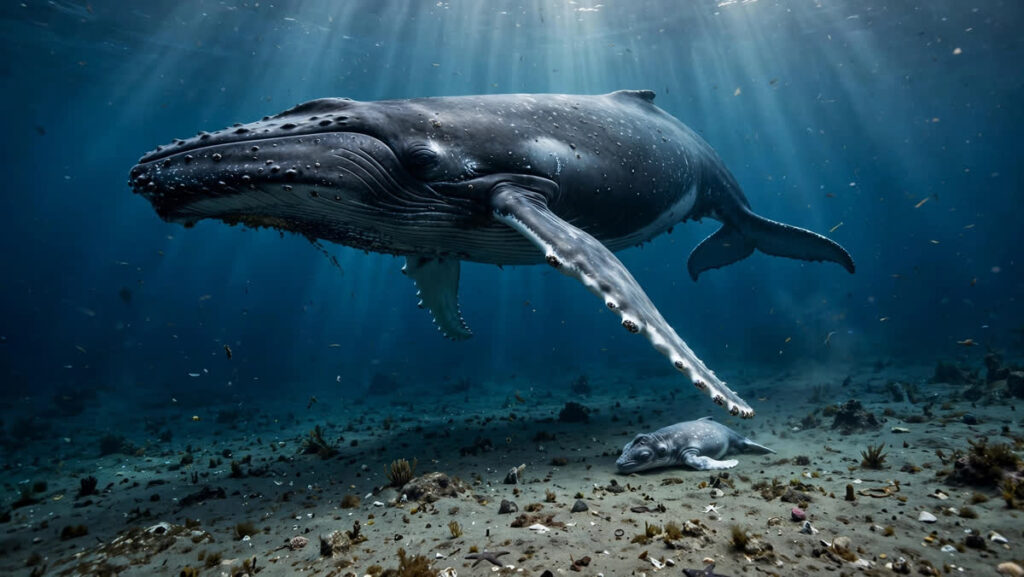
Informopedia Explains: this is the footage that forced the question out into the open — a humpback whale mother off Australia’s Gold Coast, refusing to leave her dead newborn. In July 2025, a Sea World Foundation rescue boat crew led by captain Andrew Mulville noticed two whales behaving oddly at the surface. As they moved closer with a GoPro, the scene resolved into something nobody on the boat expected: a mother humpback hovering beside the body of her stillborn calf on the seafloor, returning to it again and again, positioning herself alongside it, holding what the researchers would later describe as eye contact — for hours, possibly days. It was the first filmed record of anything like it in a baleen whale. And the question hanging over the footage is the one science has dodged for a century: is this grief?
For most of the 20th century, the official answer in biology was a hard no — or at least, you were not allowed to ask. Calling animal behavior “grief” was anthropomorphism, the cardinal sin of animal science: projecting human feelings onto creatures that couldn’t confirm them. The field treated emotions as untestable, so it ignored them. Then the observations started piling up, and the pile got too tall to step around.
The whales: carrying the dead through the sea
The humpback footage, published this September in the journal Discover Animals by researchers including Dr. Olaf Meynecke of Griffith University’s Whales and Climate Research Programme, landed precisely because it was new for its kind. Toothed whales — orcas, dolphins, pilot whales — have been caught on camera in death vigils before. Back in 2016, biologist Melissa Reggente of the University of Milano-Bicocca and colleagues catalogued 14 responses to death across seven species of whales and dolphins: bottlenose dolphins nudging and pushing dead juveniles, killer whales carrying bodies, sperm whales and pilot whales circling corpses as if standing guard. But baleen whales, the filter-feeding giants, had never been documented doing it — partly because dead baleen calves sink fast, out of sight of cameras.
The most famous case remains Tahlequah, the Southern Resident orca known to researchers as J35. In July 2018, her calf died about half an hour after birth. Tahlequah carried the body on her head and back for 17 days across more than 1,000 miles of the Salish Sea — diving each time it slipped off to retrieve it, accompanied by other orcas from her pod. The press called it a “tour of grief.” She did it again in late 2024, after another calf died within days of birth, carrying the body for more than 11 days. The Center for Whale Research, which monitors the endangered population, watched both ordeals unfold. Nobody watching seriously proposed the behavior was cheap or automatic. The energetic cost alone — a nursing mother refusing to forage while hauling a corpse for over two weeks — rules out a casual explanation.
The elephants: funerals on the tea estates
If whales carry their dead, elephants bury theirs. In 2024, researchers Parveen Kaswan and Akashdeep Roy published a study in the Journal of Threatened Taxa documenting five calf burials by Asian elephants in northern Bengal, India, across 2022 and 2023. In each case, the herd had carried the dead calf — by trunk and legs — to an irrigation canal on a tea estate, laid it in the mud legs-up, and covered it with earth. The calves, aged three months to a year, had all died of multiple organ failure; the authors found no human involvement in any of the deaths. Around the burial sites they found the clear footprints of 15 to 20 elephants pressed into the soil over the bodies, and in one case the herd had roared and trumpeted around the grave.
Only calves get this treatment — adults are simply too heavy to move. But the burial behavior fits a wider pattern: elephants on two continents have long been observed visiting the carcasses and even the bones of dead herd members at various stages of decomposition, touching skulls and tusks with their trunks, standing vigil in ways that look less like curiosity and more like recognition.
What the evidence actually shows
Strip away the storytelling and the science says something careful. Researchers can’t ask an elephant how it feels, so they measure what they can: behavior and physiology. After a death, the documented pattern across species is strikingly consistent — altered vocalizations, loss of appetite, disrupted sleep, social withdrawal, reduced activity, and sustained physical proximity to the body or the place of death. Chimpanzee mothers have been observed carrying dead infants for days or weeks. As chimp researcher André Gonçalves of Kyoto University puts it, grief can be parsed into these smaller, measurable pieces — and when an animal shows them together, after a loss, “mourning” stops being a poetic word and starts being a descriptive one.
There is also a philosophical cut worth making, sharpened by ethicist Susana Monsó of Spain’s National Distance Education University in her work on how animals understand death. Grief and understanding death, she argues, are two different things. Grief is an intense feeling of missing a particular individual — which is why we can grieve a breakup or an exile where nobody died. Understanding death is the recognition that a body has stopped working and won’t start again. An animal might grieve without the second, or grasp the second without the first. Conflating them, she warns, is why the debate keeps going in circles: skeptics demand proof that animals understand mortality, but grief never required that proof.
What the skeptics say — and why they have a point
The skeptics are not cranks. Some philosophers have argued that real grief demands abilities that may be human-only: a fine-grained sense of who exactly is gone, the capacity to project into past and future, a concept of death itself. And the empirical caution is real, because death-related behavior does not always mean mourning. Ants drag corpses to colony graveyards — but the trigger is oleic acid, a chemical corpses release; paint oleic acid on a living ant and its nestmates will bury it alive. Nobody thinks the ants are grieving. So the hard question for every case is: is this an emotional response to loss, or an automatic response to a stimulus?
Even the most heartbreaking footage carries ambiguity. A mother whale carrying a dead calf might be mourning — or she might simply not have registered that the calf is dead, holding on in confusion rather than grief. A chimpanzee carrying a dead infant for weeks might be doing something similar. The skeptic’s version is less cinematic, but it is not nothing: it forces the science to be precise about what “grief” means before claiming to have found it.
Why this matters
The reason to take the question seriously is not sentimentality. If grief-like responses are widespread — in whales, elephants, primates, and very likely many other social species — then the roots of our own mourning run far deeper than human culture. Grief starts to look like ancient machinery: the emotional price of the strong social bonds that keep herds and pods alive. Bonds are useful — they protect calves, coordinate hunts, share knowledge across generations. A brain wired to form them needs a way to register when they break. Grief may be that registration.
There are practical stakes as well. Conservation policy, zoo standards, even livestock regulations all rest on assumptions about what animals can feel. A science that documents mourning in elephants and whales gives those assumptions evidence instead of vibes — and makes it harder to treat social animals as interchangeable units.
What happens next
The field is shifting from anecdotes to measurement. Researchers are pushing for systematic documentation of death responses — standardized observations, physiological data like stress hormones and heart-rate changes, long-term tracking of bereaved individuals — so that the next Tahlequah or the next humpback vigil adds data, not just headlines. The humpback study’s authors say it plainly: rare neonatal deaths need to be recorded carefully, because each one is a window into the emotional lives of animals we barely understand.
The honest answer to “do animals grieve,” for now, is that the question itself has changed. A decade ago it was whether animals could feel anything like grief at all. Today, with elephants digging graves and a whale mother holding her dead calf’s gaze, the sharper question is how grief works in minds built nothing like ours — and what that tells us about the minds we carry around ourselves.