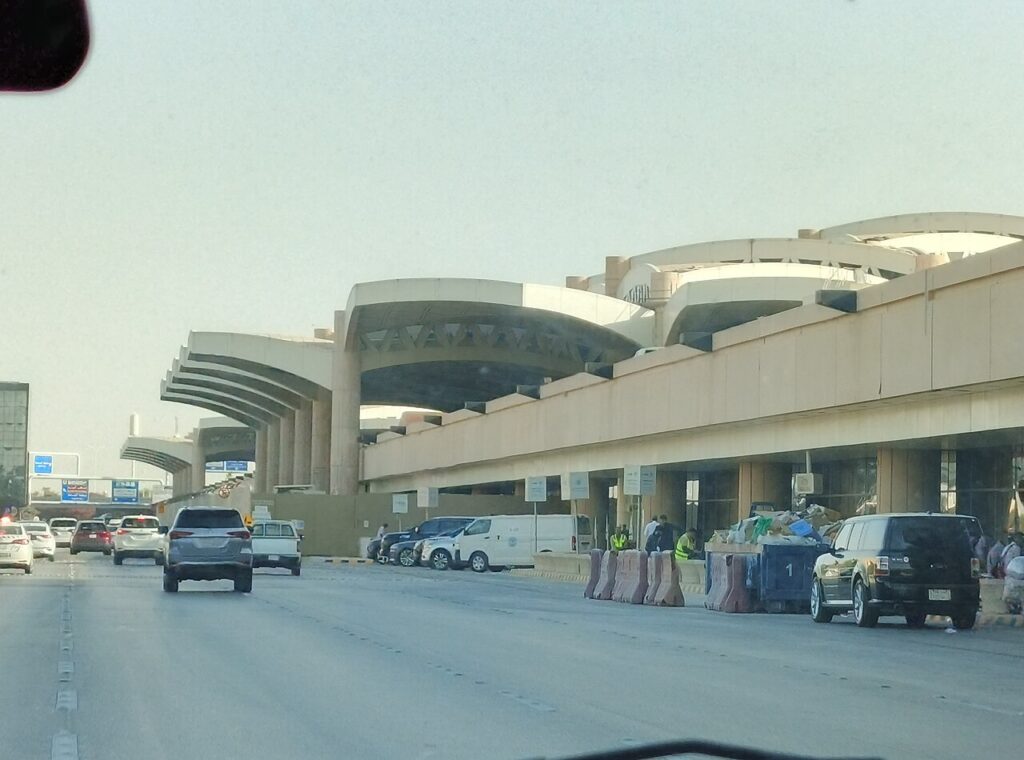
The airport had barely reopened — in fact, it hadn’t. On Sunday evening, less than 24 hours after the deadliest attack on Saudi soil in more than a decade, a projectile struck Terminal 4 of Riyadh’s King Khalid International Airport and set part of it on fire.
Saudi Arabia’s General Authority of Civil Aviation said the attack killed a Pakistani resident and wounded 11 other people, all of whom were taken to hospitals. The authority said the extent of the property damage was still being assessed.
The spokesman for the Saudi-led coalition fighting the Houthis in Yemen said an “unidentified projectile” had targeted the airport’s Terminal 4. Earlier on Sunday, the coalition said Saudi air defences had intercepted a cruise missile in the airport’s vicinity. It later added that a drone had been intercepted and destroyed over the kingdom’s Eastern Province, and that a ballistic missile launched toward Khamis Mushait in the south had also been intercepted.
The Houthis claimed responsibility. Yahya Saree, the group’s military spokesman, said its forces had carried out four operations over the previous 24 hours using ballistic and cruise missiles and drones, in response to what he called Saudi aggression. The group has declared the kingdom’s airports “a theatre of operations for our forces” and threatened to keep hitting them.
“We urge everyone to take our warnings seriously, and Saudi Arabia bears responsibility for any failed interceptions,” the Houthi-run foreign ministry said in a statement carried by Reuters.
Riyadh was not the only target on Sunday. The Houthis also claimed to have hit King Fahd International Airport in Dammam, on the Gulf coast. Saudi civil aviation authorities later confirmed that the Dammam airport had come under attack on Sunday evening and said damage and safety inspections were underway.
The Sunday strike landed on a country still counting the dead from Saturday. That attack on King Khalid airport killed 12 people — four Saudis, two Bangladeshis, and one national each from the United States, Egypt, Jordan, Syria, Palestine and Sudan — and wounded more than 300. On Sunday, the Indian Embassy in Riyadh said an Indian citizen injured in the strike had died of his wounds, raising the toll to 13. More than 600 flights were cancelled as the airport shut down. Footage released by Saudi state television showed pilgrims lined up at a departure gate, preparing to travel to Islam’s holiest sites, scattering in panic as a bright flash tore through the terminal.
The fallout kept spreading on Sunday night. Authorities extended the airport’s closure by another 24 hours, until 2100 GMT on Monday, according to flight-tracking data. All in-person classes in Riyadh were shifted to remote learning through Thursday. The British government advised its citizens against non-essential travel to Jeddah, Dammam and all Saudi airports except Medina, and urged Britons to consider leaving the kingdom overland. The US Federal Aviation Administration told American airlines to exercise caution flying into or over parts of Saudi Arabia “at all altitudes.” And early on Monday, Saudi civil defence issued emergency alerts for the southern city of Abha, lifting them minutes later when the danger passed.
The Houthis say their campaign is retaliation for an intensified Saudi air offensive in Yemen, claiming Saudi warplanes launched 124 airstrikes in the previous 24 hours alone — a figure that could not be independently verified. Riyadh, which has long backed Yemen’s internationally recognised government against the Iran-aligned group, has not confirmed a casualty count from its own operations.
Why this matters: A single strike can be called a lapse. Two strikes on the same airport in two days — with a cruise missile intercepted near the perimeter in between — looks like a pattern, and patterns are what air-defence planners fear most. The back-to-back attacks expose exactly the vulnerability Saudi Arabia privately admitted last week, when it asked France, Britain, Pakistan and Egypt for help replenishing its interceptor stocks: the kingdom can shoot down plenty of incoming fire, but it cannot seal the sky. The Houthis have noticed, and they are now deliberately testing the same target twice — a tactic designed to force Riyadh to spread its defences thin. With Washington openly weighing whether to join the Saudi air campaign, each new strike raises the stakes of that decision, and with oil tankers already burning in the Strait of Hormuz, the region’s two most dangerous flashpoints are now feeding each other.
The victims are also becoming a story of their own. Saturday’s dead came from nine countries; Sunday’s from a tenth — Pakistan — and the wounded include South Asian workers who keep the Gulf’s airports running. The first attack was the deadliest on Saudi soil in over a decade. The second makes clear it may not be the last.


3 Comments