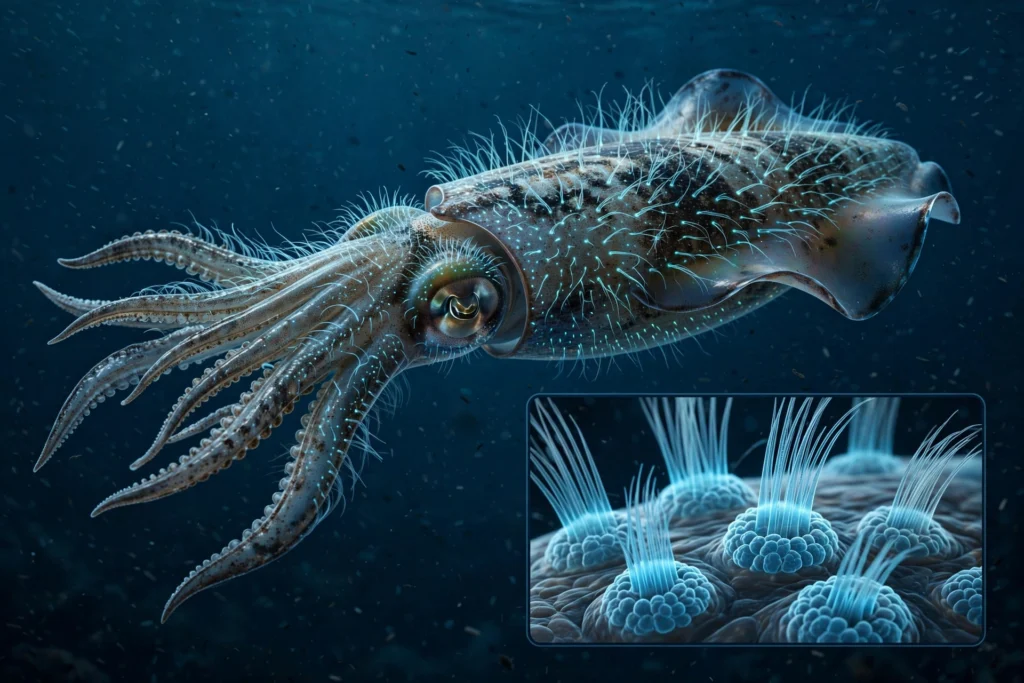
Key takeaways:
- Scientists have produced the first complete body-wide map of the squid lateral line, finding hundreds of previously unknown hair cells across the animal’s entire skin.
- The squid’s hair cells are tuned to different frequencies by varying the length of their bristle bundles — strikingly similar to the architecture of the human inner ear.
- In humans, damaged hair bundles are a leading cause of permanent hearing loss, and the squid’s open, accessible system offers a new model for studying how those structures form and fail.
A squid may look like an unlikely hearing specialist. But scientists have now mapped a sensory system covering the animal’s entire body that works remarkably like the human inner ear — and it could change how researchers understand deafness.
The first complete body-wide map of squid lateral lines has revealed hundreds of previously unknown hair cells spread across the animal’s skin — not just around the head and arms, where scientists had previously looked. The findings were published on September 21 in the journal Current Biology.
An ear spread across the body
The work was led by Brian McDermott, an associate professor at Case Western Reserve University’s School of Medicine. In a paper titled “An anatomical map of squid lateral lines,” McDermott, Haoming Wang and colleagues detail how the cells form a sensory network spanning the whole animal. Part of the research was carried out at the Marine Biological Laboratory in Woods Hole.
What makes the squid’s cells special is how they are tuned. Each hair cell carries a bundle of tiny bristles, and the squid varies the length of those bundles to make cells sensitive to different frequencies — much like the architecture of the human ear. Fish lateral lines, by contrast, are far more uniform, responding to water movement without that fine frequency discrimination.
A new window on hearing loss
In people, hearing depends on hair cells buried deep inside the cochlea of the inner ear — cells that cannot regenerate once they are damaged. A damaged hair bundle is one of the leading causes of permanent hearing loss, whether it strikes at birth or later in life.
“Often, when a child is born deaf or a hearing person loses their hearing, it is the hair bundle that has been damaged. So, studying the squid’s hair bundle holds promise for understanding how hearing loss occurs,” the researchers note.
The squid offers something no mammal can: a living, accessible system in which bundles of many different lengths form and function side by side, out in the open rather than locked inside a skull. By studying how the animal builds, tunes and maintains them, scientists hope to uncover the biology that goes wrong in human deafness.
For context, lateral lines are sensory organs found across fish and amphibians, detecting tiny movements and pressure changes in the water around them. What the new map shows is that the squid has taken this ancient system and refined it to an extraordinary degree — turning a simple motion detector into something approaching an ear.
From map to medicine — carefully
The researchers are clear that no treatment is around the corner. But the anatomical map gives hearing science something it has long lacked: a model organism whose sensory hair cells can be studied across an entire body surface. If the squid’s bundles can teach scientists how these delicate structures are assembled and kept working, the lessons may one day point toward ways to protect — or even restore — human hearing.
That is the tantalising part. Mammalian hair cells are tiny, hidden and stubbornly irreplaceable; the squid’s are spread out in the open and built in every imaginable tuning. Science has spent decades trying to peer inside the skull to understand deafness. It turns out a better vantage point may have been swimming in the ocean all along. For now, the humble squid has earned an unexpected place at the front of that search.