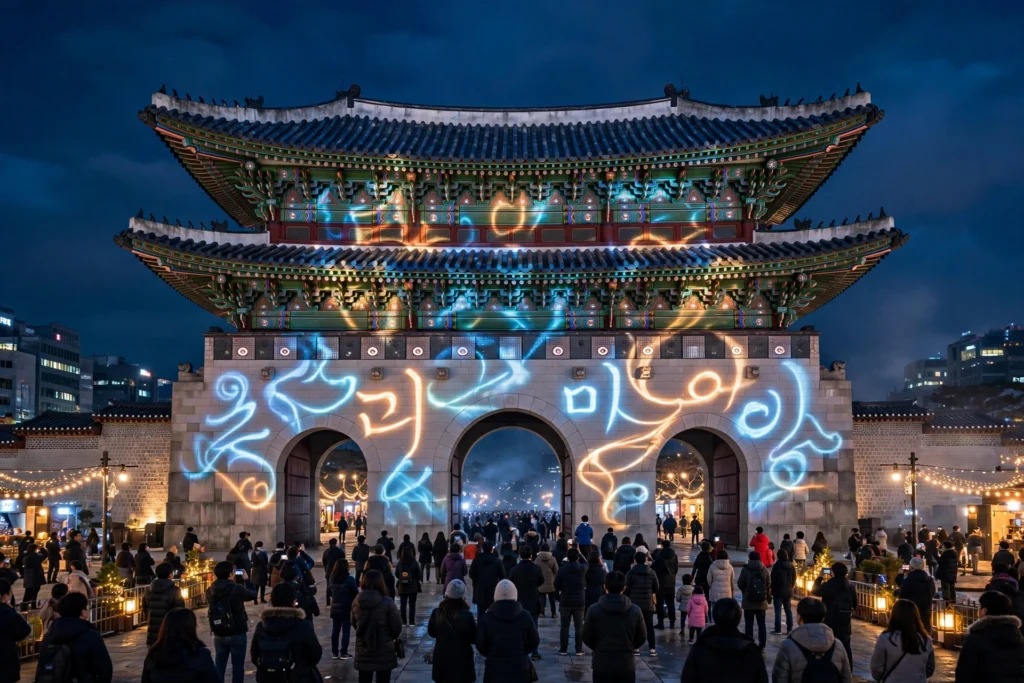
Seoul is preparing for two weeks of celebration as South Korea marks a century of Hangeul Day — the national holiday honouring the Korean alphabet — alongside the 580th anniversary of the script’s creation.
What happened?
The Ministry of Culture, Sports and Tourism announced on October 2 that this year’s Hangeul Week will run from October 6 to 17 under the theme “Hangeul by My Side.” The dates commemorate both the 100th anniversary of the holiday itself and the 580th anniversary of the promulgation of the Hunminjeongeum — the document through which King Sejong introduced the alphabet to his people.
The centrepiece is the Hangeul Hanmadang festival at Gwanghwamun Square, running October 6 to 8. The programme includes the musicals “By My Side, You in a Dopo” and “Gat-Geul,” a poetry-music-storytelling concert titled “Read, Walk, and Sing,” and performances by indie bands including Far East Asian Tigers and Yangbans.
More than 20 hands-on activities are planned across the three days, from calligraphy workshops to the Children’s Hangeul Playground and the Hangeul Garden — a space designed to let visitors experience the beauty of the script’s shapes up close. The Hangeul Cultural Industry Exhibition runs alongside the festival from October 6 to 8, showcasing how the alphabet inspires design, publishing and digital content.
The celebrations peak on the evening of October 8 with an eve ceremony at 7pm, featuring the symbolic lighting of 100 lights, performances by K-pop group AtHeart and the band Broccoli You Too, and readings by students of the King Sejong Institute, which teaches Korean language and culture around the world.
Then the historic Gwanghwamun Gate itself becomes the canvas. From October 8 to 11, between 8 and 11 each night, a media facade titled “Twenty-Four, Universe” will be projected onto the gate’s walls, transforming the alphabet’s 24 basic consonants and vowels into constellations, scenes of nature and traditional architecture. It promises to be one of the most photographed spectacles of the autumn.
Why does it matter?
Few writing systems on Earth can claim both a known inventor and a precisely dated birth — and that is exactly what the double anniversary underscores. Hangeul was created so that ordinary people, not just scholars, could read and write. A century after the holiday was first observed in 1926, and 580 years after a king set out to give his people a voice on paper, the centenary lands as a reminder of how unusual that ambition still is.
The programme also looks deliberately forward. On October 12, the National Museum of Korea hosts an academic conference on Hangeul, K-culture and artificial intelligence — a nod to the script’s remarkable suitability for the digital era, where its logical, modular design has made it a favourite among linguists and engineers alike.
What happens next?
Hangeul Day itself, October 9, remains a public holiday, giving South Koreans a day to reflect on the script at the heart of their language. The eve ceremony and the gate projections wind through October 11, the conference closes the week on October 12, and the wider Hangeul Week programming runs until October 17.
For visitors and locals alike, the fortnight offers a rare chance to see an entire city turn its attention to the letters it lives by. Five and a half centuries after its creation, this is not an alphabet being preserved in a museum — it is one being celebrated in the street, projected onto a palace gate, and debated at an AI conference. The birthday belongs to the script. The party belongs to everyone who uses it.