France braced for its worst night of unrest in weeks on Saturday — and for most of the day, the feared Halloween explosion did not come. Then dusk arrived, the Paris march reached its end point, and the day changed completely.
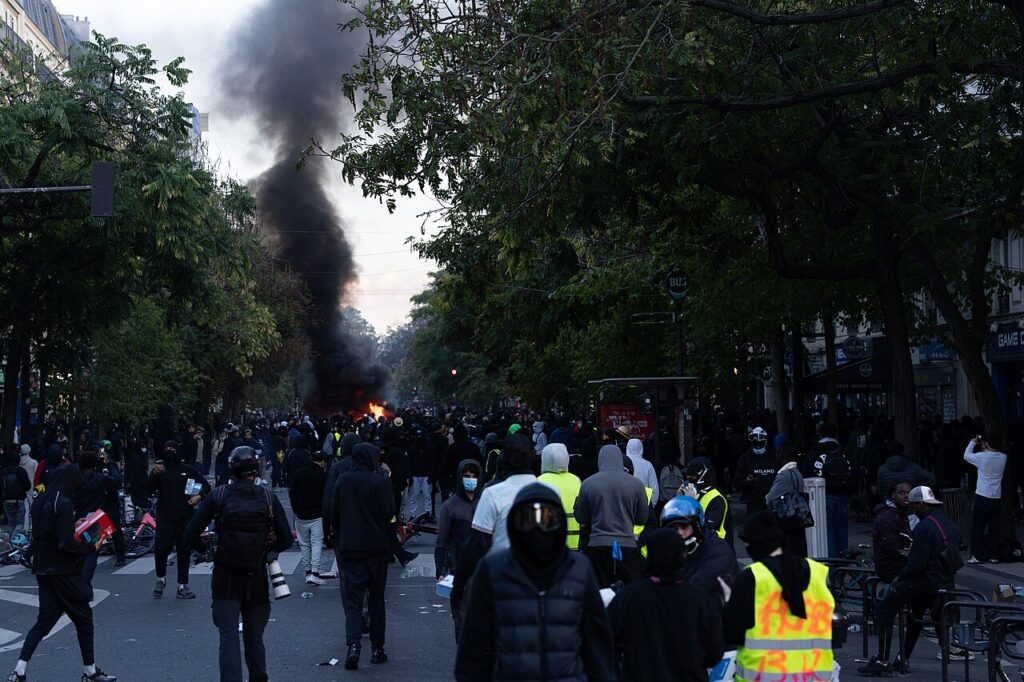
Just before 5pm Paris time, as the procession arrived at Porte de Charenton, clashes broke out between police and a hard core of demonstrators. Masked people in black prised paving stones from the street with hammers and hurled them at officers, according to reporters on the ground. At least one incendiary device was thrown at security forces. Police answered with tear gas and baton charges, and, according to the Associated Press, volleys of stun grenades as protesters threw glass bottles and fireworks back. Smoke filled the air as darkness fell.
One image from the evening summed up how fast the mood turned. A French gendarme was photographed partly on fire after a petrol bomb went over him — a Sun reporter on the scene watched the officer’s leg burn for around 30 seconds before colleagues beat the flames out. Several officers were injured by the incendiary devices and had to pull back from their position near Porte de Charenton, the local news service Flash Info reported. After the organised march officially ended, the Paris police prefecture estimated several hundred rioters and protesters were still in the area, attacking officers with projectiles.
The violence was not confined to Paris. In Lyon, France’s third-largest city, protesters threw projectiles at police, who responded with tear gas, and militants burned American and Israeli flags on the roof of a tram shelter as the march passed, according to local reports. In Toulouse, police used a water cannon against an unauthorised protest that drew several thousand people, mostly young demonstrators, some of them in costume. In Bordeaux, a crowd cheered as a piñata of President Emmanuel Macron was attacked with a sword.
The evening’s turn also rewrites the day’s numbers — and corrects our own earlier report. An early-afternoon count cited in Informopedia’s daytime article put the turnout far lower, at around 15,000. That was a partial count taken before the day was over. The Interior Ministry’s full-day tally, reported by the Associated Press, put the real figure at 320,000 people across France, including 70,000 in Paris. Youth organisations claimed nearly half a million nationwide, including 200,000 in Paris. Either way, the turnout was smaller than the two previous Saturdays — more than 550,000 marched on 17 October, and about 410,000 last Saturday — but it was not the small, fading protest the early count suggested.
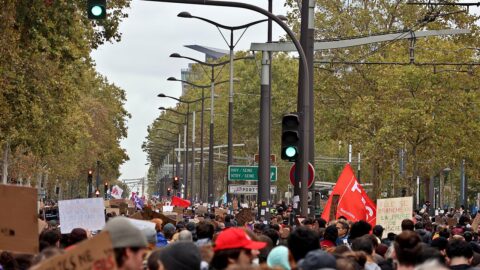
By 2pm Paris time, police had detained 27 people — a fraction of the 217 arrested by the same point last Saturday. The ministry had described the daytime marches as largely calm, and that assessment still stands for the daylight hours: thousands of people, some in Halloween costume, walked through eastern Paris in bright sunshine. The trouble began when the march ended, not while it moved.
Interior Minister Laurent Nuñez had warned of a “very high risk” of disorder, particularly after dark on Halloween, and the state had prepared: 70,000 police and gendarmes deployed nationwide, the Paris march pushed onto a single route along the outer boulevards from Porte de Bagnolet to Porte de Charenton, more than 40 metro and suburban stations closed, and face-covering masks banned. Police barred entry to Place de la République and Les Halles — both hit by rioting on 17 October — from 11pm to 6am on Saturday and Sunday nights, and imposed a 9pm curfew on unaccompanied minors around the Champs-Élysées.
What happens next matters beyond one evening. This is the third consecutive weekend of a protest movement that began in late September as a student revolt over crumbling schools, teacher shortages and an admissions system pupils call unfair, and has broadened into a wider revolt over the cost of living, drawing in trade unions, public-sector workers and the heirs of the Yellow Vest movement. President Emmanuel Macron’s minority government is in the middle of fraught talks over the 2027 budget, and the streets have become its running verdict. Saturday showed both halves of that verdict at once: a movement still able to bring hundreds of thousands out, and a fringe willing to turn a march’s final hour into a street fight. With the 11pm bans in the centre of Paris still to come into effect as night deepens, the authorities’ warning — that the real test of Halloween would come after dark — has already proved half right.
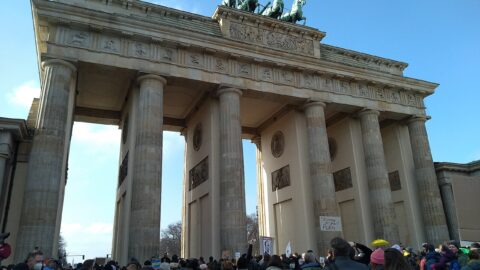
Earlier today, Informopedia reported on the daytime marches while they were still peaceful. In Germany, a parallel day of youth protest drew thousands and stayed peaceful.