Informopedia Explains: in the early hours of October 6, Moscow’s mayor reported 650 drones inbound toward the Russian capital in a single night. In the same week, drones sank a freighter off Bulgaria, struck two Saudi airports, and hit a tanker off Qatar. This is what the drone age looks like — and it arrived faster than anyone expected.
For most of military history, air power was the privilege of rich states. A fighter jet costs tens of millions of dollars; the pilot takes years to train. Then a series of small, cheap flying machines — some costing less than a used car — began doing what only air forces used to do: sinking warships, knocking out oil refineries, killing soldiers, shutting down airports. This week, all of those things happened within days of each other, on land, at sea, and in the air.
The warning shot nobody heeded
For 44 days in the autumn of 2020, Azerbaijan fought Armenia over Nagorno-Karabakh — and according to one military analysis, it became the first war in history won primarily by unmanned systems. The Turkish-built Bayraktar TB2, a medium-altitude armed drone, systematically hunted Armenian tanks, artillery, and air defenses; independent analysis counted nearly a hundred Armenian tanks destroyed by the TB2 alone. Israeli-made Harop loitering munitions — drones that circle until they find a radar to dive into — did the rest. A smaller force with better drones beat a larger entrenched army.
The factory war
Ukraine now manufactures drones the way other countries manufacture cars. Kyiv planned to build seven million drones in 2026 — up from four million in 2025, 2.2 million in 2024, and 800,000 in 2023 — with more than 500 companies involved and the private sector producing roughly nine out of ten. Most are first-person-view (FPV) drones: essentially racing quadcopters, flown by an operator wearing goggles, carrying a small warhead into a tank turret or a trench. A typical FPV costs a few hundred dollars. One of them can kill a $4.5 million tank.
The battlefield results are startling. Studies by RUSI and a French military research institute put drones’ share of Russian equipment losses and battlefield casualties at roughly 60 to 80 percent in 2024–25 — up from under 10 percent in 2022. A Ukrainian tank commander who once fought pitched armor battles told Reuters his captured T-72 now hides under camouflage netting, reduced to serving as fixed artillery, because anything that moves in the open gets “peppered by FPV drones.” Both sides have built a continuous drone “kill zone” some 20 kilometers deep behind the front line.
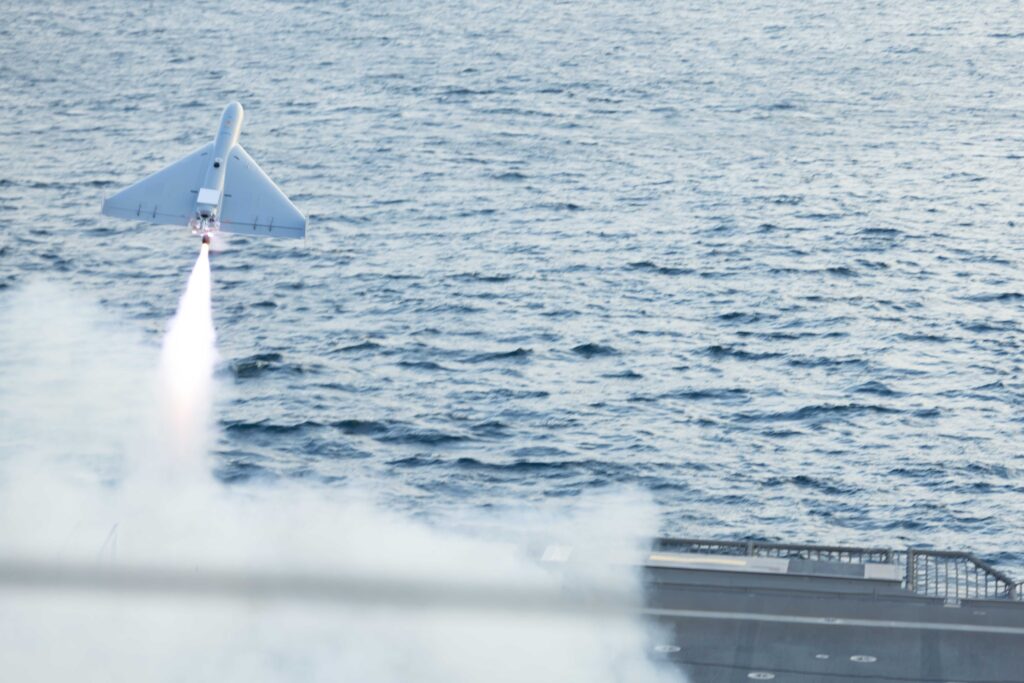
What makes this cheap is not magic. It is shopping. A Shahed-type one-way attack drone is built from a 50-horsepower piston engine, stamped-metal parts, a commercial GPS receiver, and an off-the-shelf flight controller. Russia’s cheaper variants use plywood and foam airframes with two-stroke engines. None of these components is sanctioned or exotic, which is why sanctions have barely dented production.
The arithmetic that breaks air defense
Here is the number that changed warfare: about $30,000 buys you a Shahed-type drone that can fly 2,000 kilometers and deliver 40 to 90 kilograms of explosives onto a target. Knocking it out of the sky with a Patriot interceptor costs roughly $3 to $4 million; a NASAMS round costs over a million. Fire million-dollar missiles at tens-of-thousands-dollar drones often enough and the defender goes broke first.
Saturation does the rest. Drones are slow and fly low, which makes them awkward for radar systems designed to spot fast aircraft at altitude. Attackers mix real strike drones with cheap decoys — Russia’s Gerbera is a plywood-and-foam ghost that looks like a Shahed on a radar screen just long enough to make defenders waste real interceptors. In this week’s Moscow barrage, Russia claimed 1,750 drones and 17 cruise missiles were thrown at it in 24 hours; the figures are unverified, but they show the scale the attacker can now generate from warehouses, not air bases.
The defense is adapting, but expensively. Ukraine has started mounting AI-assisted robotic gun turrets on bridges to shoot down incoming drones, and its “Sting” interceptor drone, a $2,500-to-$5,000 FPV, hunts Shaheds in the air at a fraction of a missile’s price. Fiber-optic-controlled FPVs, guided by a physical wire instead of a jammable radio link, have pushed the electronic-warfare duel into a new round. Every adaptation, though, meets a cheaper counter-adaptation within months.
War at sea, without a navy
In September 2022, Ukraine — a country with barely a navy — stood up the world’s first dedicated fleet of naval attack drones. Small, fast, nearly invisible on radar, the Magura V5 carries about 300 kilograms of explosives and costs roughly $250,000 — against warships worth hundreds of millions. A Polish study credited Magura drones with striking 14 Russian ships and destroying eight; Kyiv says its sea drones have since downed two helicopters and two fighter jets, a first in military history.
The effect was strategic, not just tactical. Russia pulled much of its Black Sea Fleet out of Sevastopol and moved it to Novorossiysk — a navy retreating from a fleet that does not formally exist. And this week the drone war at sea crossed a new line: two commercial ships were hit by combined air-and-sea drone attacks in Bulgaria’s exclusive economic zone, 70 to 80 nautical miles off the coast, the first such strike on shipping there. One vessel sank, one burned. Whoever did it, the message is the same: a few hundred thousand dollars of remote-controlled boats can now hold international shipping lanes at risk.
The Gulf’s permanent drone war
Nowhere shows the long fuse of this revolution better than the Arabian Peninsula. This week Yemen’s Houthis claimed drone and ballistic-missile strikes on Saudi Arabia’s King Khalid International Airport in Riyadh and Abha airport in the south — three people killed, 36 wounded, flights disrupted, according to Saudi aviation authorities. Houthi drones struck Abha repeatedly back in 2019, and the September 2019 attack on Aramco’s Abqaiq facility — claimed by the Houthis, attributed by Washington to Iran — briefly knocked out roughly half of the kingdom’s oil processing capacity.
The shipping war has widened with it. In the week of September 28 to October 5, at least a dozen tankers were attacked or harassed around the Strait of Hormuz, the waterway that carries a fifth of the world’s oil — the highest weekly total since the US-Iran war began in February. A Panamanian-flagged tanker, the MT On Peace, limped to Oman with 12 wounded crew; a Qatari LNG carrier was struck days earlier; and this week the British maritime agency reported yet another tanker hit by multiple projectiles 51 nautical miles off Qatar, with casualties.
Why this matters
Strip away the headlines and one fact explains everything: precision strike used to be the most expensive thing in war, and it is now the cheapest. A country — or a militia — that could never afford an air force can now build one from consumer electronics and a workshop. That is why the Houthis can threaten airports a thousand kilometers away, why Ukraine can set Moscow’s largest oil depot alight from the Ukrainian steppe, and why an unidentified attacker can shut down commercial shipping in a NATO member’s waters for the price of a boat.
It also explains why the old answer — better air defenses — keeps losing. Air defense was designed to kill scarce, expensive targets. Drones invert every assumption: they are cheap, abundant, and individually expendable. You can win every engagement and still lose the campaign, because your magazine empties before the enemy’s factory does.
What happens next
Here is the uncomfortable assessment: the attacker has a structural lead, and it is widening. Drones are getting more autonomous — AI-assisted targeting, swarms that coordinate without human pilots, fiber-optic links that ignore jamming — while defenses still depend on missiles built for a different century. The proliferation genie is out: the designs circulate, the parts are commercial, and even the Pentagon is now copying the $30,000 drone it once dismissed.
The honest response is not panic but adaptation. Navies will need drone-proof escort doctrine; airports and refineries will need cheap, layered defenses — interceptor drones, guns, lasers, electronic warfare — instead of million-dollar missiles; and governments will have to treat drone threats to shipping as a permanent condition, not a temporary crisis. Arms-control treaties were built for missiles and bombers; nobody has written the rules for a weapon you can build in a garage. The wars of the next decade will be decided less by who has the best weapons than by who can build the most of them.