The rain started on Friday night and did not stop. By Sunday morning, the first heavy storm of Gaza’s winter had turned displacement camps into lakes, collapsed a sand dune onto a row of tents, and killed six people — most of them children.
Five of the dead were sheltering beside the Al Berka reservoir, west of Deir al-Balah in central Gaza, when the sandy embankment above their tents gave way under the weight of the rain. Three were children and two were women, according to the UN aid coordination office, OCHA. An infant drowned separately at another displacement site. Local rescue workers, Gaza’s Civil Defense, reported slightly different counts in the first hours — the confusion of a night when first responders could answer only about one in ten of roughly 2,100 distress calls — but the shape of the disaster is not in doubt.
The storm hit all five of Gaza’s governorates. In some places the water rose to a metre and a half. Damaged buildings, already weakened by months of war, collapsed. At least 55 learning spaces serving some 55,000 children were flooded. By 8 November, more than 26,000 households had appealed to aid agencies for help after their shelters or belongings were damaged — and the UN says the true number is certainly higher. Gaza’s government media office put the figure more starkly: about 70,000 tents were flooded within the first hours of rain.
The numbers behind those tents explain why a rainstorm became a mass-casualty event. Around 65 per cent of Gaza’s population — about 1.4 million people — now live in tents or makeshift shelters. As of June, the UN estimated that 82 per cent of all structures in the territory had been damaged. An estimated 950,000 displaced people are living in areas at risk of flooding, nearly 400,000 of them in high-risk zones. Winter, in other words, arrived for a population with almost nothing between it and the weather.
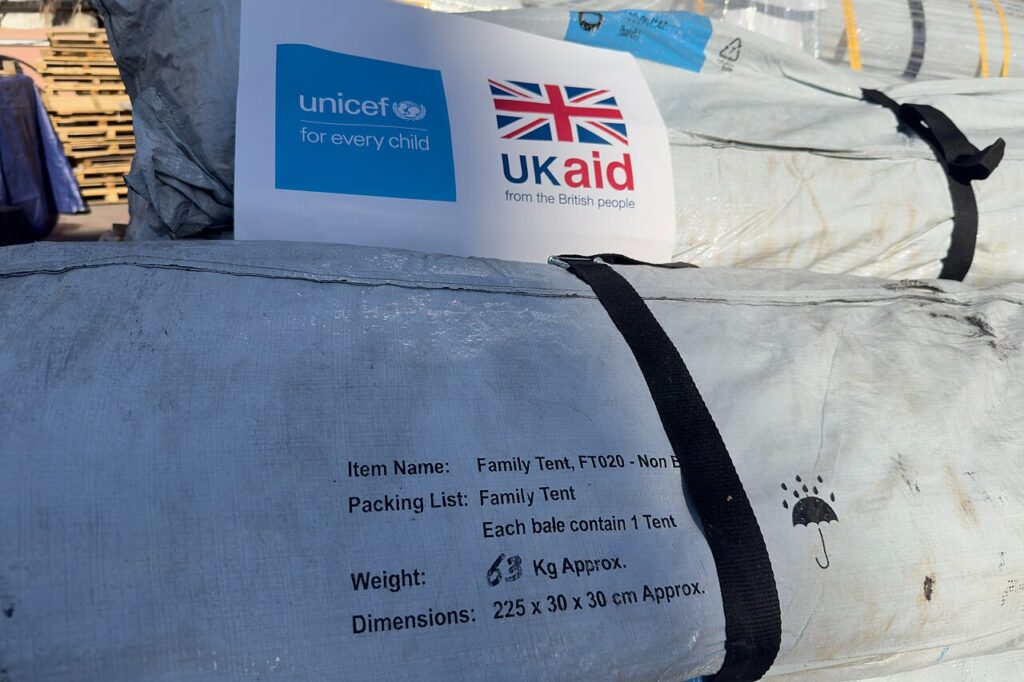
And the supplies that could change that are, in large part, sitting outside Gaza. Humanitarian stocks of tents, tarpaulins, blankets and clothes inside the territory are virtually exhausted, OCHA says. More than 150,000 tents purchased by aid agencies and donor governments are waiting to be dispatched — including about 117,000 from the Egyptian Relief Committee alone, stockpiled at Al-Arish across the border in Egypt. Getting them in requires Israeli approvals for shelter items, timber for shelter kits, engine oil, spare parts and heavy machinery — approvals OCHA says are urgently needed, and which it reported were still being restricted or delayed days before the storm. The UN’s winterisation programme faces a funding gap of $186.5 million against total needs of $267.9 million.
Speaking from Ramallah, UN Deputy Special Coordinator Ramiz Alakbarov put it plainly: the rain itself cannot be prevented, but far more must be done to protect the people it falls on. Aid agencies have been warning for weeks that this winter would be the cruellest yet for Gaza’s displaced — the first full winter since the destruction left most of the population in tents. The storm that arrived on Friday was not exceptional. That is precisely the point.
Why this matters
Six deaths in a rainstorm would be a tragedy anywhere. In Gaza they are a forecast. The same tents will face months of rain, wind and cold, and the same bottleneck — supplies waiting at the border, approvals pending, funding short — will decide how many more families lose their shelter to weather rather than war. The international rules that govern this are not ambiguous: the International Court of Justice ordered in March 2024 that shelter aid must reach Gaza at scale. The gap between that order and 70,000 flooded tents is the story of this winter, and it is only just beginning. The test now is not whether more storms come — they will — but whether the tents waiting at Al-Arish are inside Gaza before the next one does.
The same pressures are visible across the occupied Palestinian territory: the UN’s record of settler attacks in the West Bank reached 397 in a single month during the olive harvest, a reminder that the humanitarian crisis is not confined to Gaza’s borders.
Sources: UN News; OCHA situation report