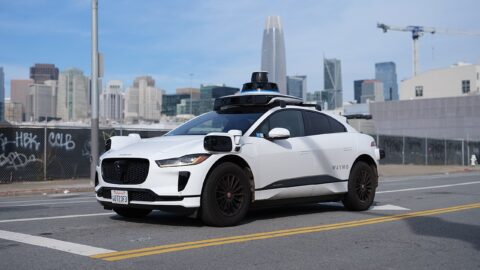
Informopedia Explains: The steering wheel spins on its own. There is nobody in the driver’s seat — there never is — and the white Jaguar merges into evening traffic in Phoenix, signaling, braking into a gap. In the back seat a passenger is filming it, half laughing, half holding her breath. Waymo, the Alphabet company, has just announced it will bring robotaxis to Toronto by 2028. This is how the machine actually drives.
It started with a robot race nobody finished
On March 13, 2004, fifteen robot vehicles lined up in the Mojave Desert for the first DARPA Grand Challenge — a 150-mile off-road course set by the Defense Advanced Research Projects Agency (DARPA). None finished. The best, Carnegie Mellon’s converted Humvee Sandstorm, went 7.3 miles before getting hung up on a rock, and the $1 million prize went unclaimed.
Eighteen months later, five vehicles completed a 132-mile desert course; Stanford’s Stanley, led by Sebastian Thrun, won in 6 hours, 53 minutes and 58 seconds. Google noticed — in January 2009 it started a self-driving car project at Google X, and in December 2016 spun it out as Waymo under Alphabet. Waymo One, the first commercial robotaxi service, opened in Phoenix in December 2018; in October 2020 Waymo became the first to carry public passengers with no safety driver aboard. Today: roughly half a million paid rides a week in 15 American cities. The October 16 announcement adds Toronto — riders in 2028, and the biggest weather test yet.
The eyes: three senses that never blink
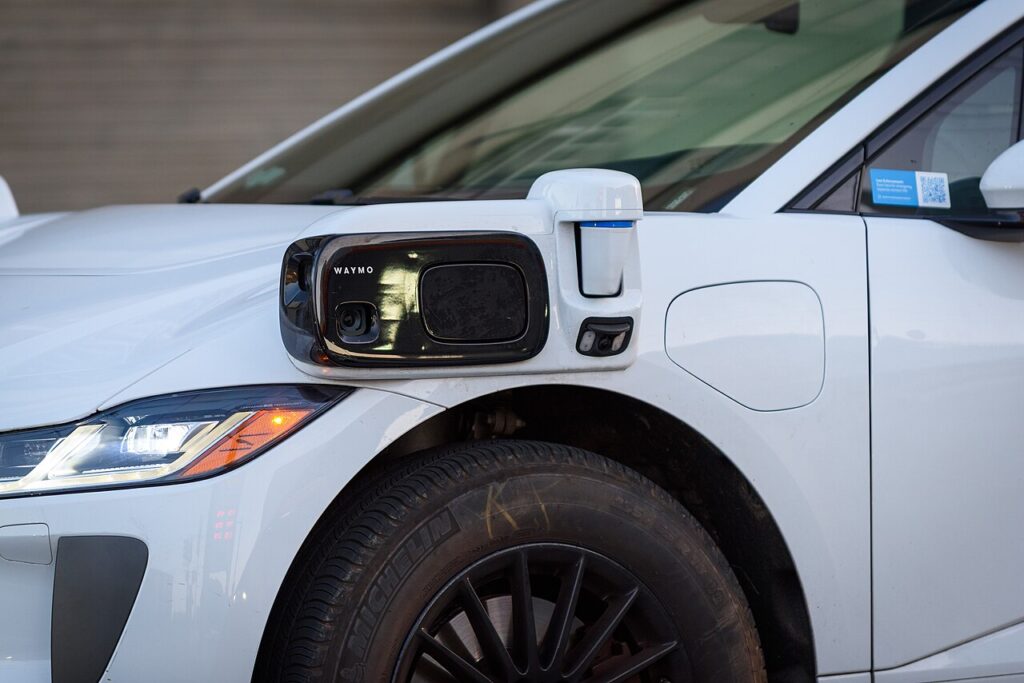
A Waymo car bristles with hardware — five lidar units, six radar units and 29 cameras for a 360-degree view:
- Lidar — light detection and ranging — fires millions of laser pulses a second and times their return, building a centimeter-accurate 3D map more than 300 meters out. It works at midnight exactly as at noon.
- Cameras supply color, text and texture — traffic lights, signs, emergency lights, hand signals — over 500 meters, with heaters and self-cleaning against ice and dirt.
- Radar measures speed directly with radio waves and keeps working through fog, dust and glare where cameras fail; it can detect a motorcyclist hundreds of meters ahead.
The point of the trio is redundancy: if one sense is fooled, the other two overrule it. It never gets tired or looks away.
The great split: cameras only, or everything at once?
Tesla has bet everything on vision. CEO Elon Musk called lidar “a fool’s errand” in 2019, dropped radar in 2021 for the camera-only Tesla Vision, and has never shipped lidar — a bet backed by economics: about $400 a car for cameras versus roughly $12,700 for Waymo’s full suite, per a 2024 analysis. Waymo’s answer was a demo: co-CEO Dmitri Dolgov showed children and dogs crossing an unlit street where cameras struggled and lidar tracked every figure. With America’s traffic-safety agency, NHTSA, investigating millions of Teslas over low-visibility crashes, Toronto’s dark, snowy winters may settle the industry’s deepest fork.
The map: why Toronto gets hand-driven first
Waymo builds a high-definition map of every city: a centimeter-accurate survey of curbs, lane paint, signs and intersections matched against sensor readings — memory beside the senses. That is why Toronto starts with humans: specialists manually drive the streets to build the maps, then supervised testing, and only then driverless rides. The mapping cars due in the coming days are the first, unglamorous step. Tesla builds no such maps and reads the world live; Waymo’s view is that a driver who remembers the streets is a safer one. Under SAE International’s standard taxonomy, that makes it Level 4 automation: fully driverless, but only inside its mapped territory.
The brain: see it, predict it, plan around it
Sensors deliver raw data; software turns the flood into driving, in a loop repeating many times a second. First, perception: it identifies and classifies everything nearby — vehicles, pedestrians, cyclists, cones, a fallen mattress — tracks each in three dimensions and reads the road geometry. Then, prediction: for every nearby road user, the system sketches several possible futures, each with a probability. A pedestrian by a crosswalk is a set of likely trajectories; a ball bouncing from between parked cars means a child is probably behind it.
Finally, planning: given the world as it is and might become, the planner picks a path — lane, speed, steering — that stays legal, keeps margins wide and doesn’t fling passengers around; a control layer executes it. Behind it all sits simulation: billions of miles of virtual scenarios, replaying the strangest things the fleet has ever seen so every car learns from each one.
The hard parts: snow is the final exam
Every self-driving company got good in fair weather first, for a reason: weather. Snow attacks all three senses — blinding cameras, piling onto lidar, deadening radar’s range. A whiteout erases the lane markings the maps depend on; slush turns the car’s reading of the road surface into fiction.
It is also a data problem: snow is under five per cent of Waymo’s driving data, per Waymo’s weather lead in 2025. Waymo has logged tens of thousands of hours in snow around Truckee, Michigan’s Upper Peninsula, upstate New York, Denver and Seattle, fitted tiny wipers to the roof lidar and heaters to every sensor, and is engineering its sixth-generation system specifically for severe winter.
Each car doubles as a weather station: hit a slippery patch and it warns the fleet. And the honest escape hatch: service may be suspended where conditions turn genuinely hazardous.
“All of the existing techniques for detection, tracking, prediction, for planning, for control — they can all be applied. You just have to know that you’re in these conditions and include that training information in the way you build the system.” — Steve Waslander, University of Toronto autonomous-vehicle researcher
Toronto — northernmost, possibly snowiest market yet — will be the exam hall. Waymo says it already operates below freezing in the US, “including with frost and hail.” Lake-effect snow, streetcars and slush will test the Driver the way Phoenix never could.
The safety record: what the numbers say — and what they don’t
Waymo publishes more safety data than anyone else in the business. The strongest evidence is a peer-reviewed study in Traffic Injury Prevention by Waymo’s own safety researchers (caveat stated upfront): across 56.7 million driverless miles, all eleven crash categories fell significantly — intersection injury crashes down 96 per cent, pedestrian-injury 92 per cent, cyclist and motorcyclist 82 per cent. In no category did the robotaxis do worse than humans.
Independent checks agree. A July 2026 Insurance Institute for Highway Safety study of nearly 50 million Waymo miles (2021–2024) found 68 per cent fewer police-reportable crashes than human drivers, with 81 per cent fewer injury crashes. Reinsurer Swiss Re, on 25.3 million Waymo miles, found 88 per cent fewer property-damage and 92 per cent fewer bodily-injury claims. Waymo’s data hub claims 82 per cent fewer injury crashes over 270 million driverless miles.
“The results show that, on a limited scale, these driverless cars are safer than human drivers, who can be impaired or drowsy or suffer lapses in attention. However, the present data collection system isn’t good enough to allow continuous monitoring of a large-scale expansion.” — David Harkey, president of the Insurance Institute for Highway Safety
The honest fine print: robotaxi firms must report nearly every scrape, while humans skip reporting an estimated half of all property-damage crashes. Waymo adjusts its benchmarks — a 32 per cent upward correction for unreported human crashes — but an adjustment is an estimate, not a measurement. And the record isn’t spotless: in January 2026, NHTSA and the National Transportation Safety Board opened investigations after Waymo cars repeatedly passed stopped school buses, and one struck a child who ran from behind a parked SUV; software fixes followed. Evidence, not a verdict — and Toronto will add 2028’s first winter to the file.
Why this matters, and what happens next
The stakes aren’t about gadgets. Road crashes kill about 1.19 million people a year, per the WHO’s 2023 global report — more than two a minute — and remain the leading killer of children and young people aged 5 to 29. Machines that never drink, text or doze off attack the problem at its root, if the numbers hold as millions of miles become billions.
That “if” gets tested now. Toronto’s 2028 target needs Ontario to write rules for commercial driverless ride-hailing first. London tests since December 2025, targeting a 2026 launch; Tokyo mapped since April 2025, targeting 2027; Singapore mapping in 2027, launch aimed at early 2028.
Sometime in 2028, on a slushy February night on King Street, a car may pull up, flash its lights and unlock its own doors — with nobody inside. Whether anyone climbs in will depend less on the lasers on the roof than on whether, over the next two winters, Toronto teaches the Driver something Phoenix never could: respect for weather.