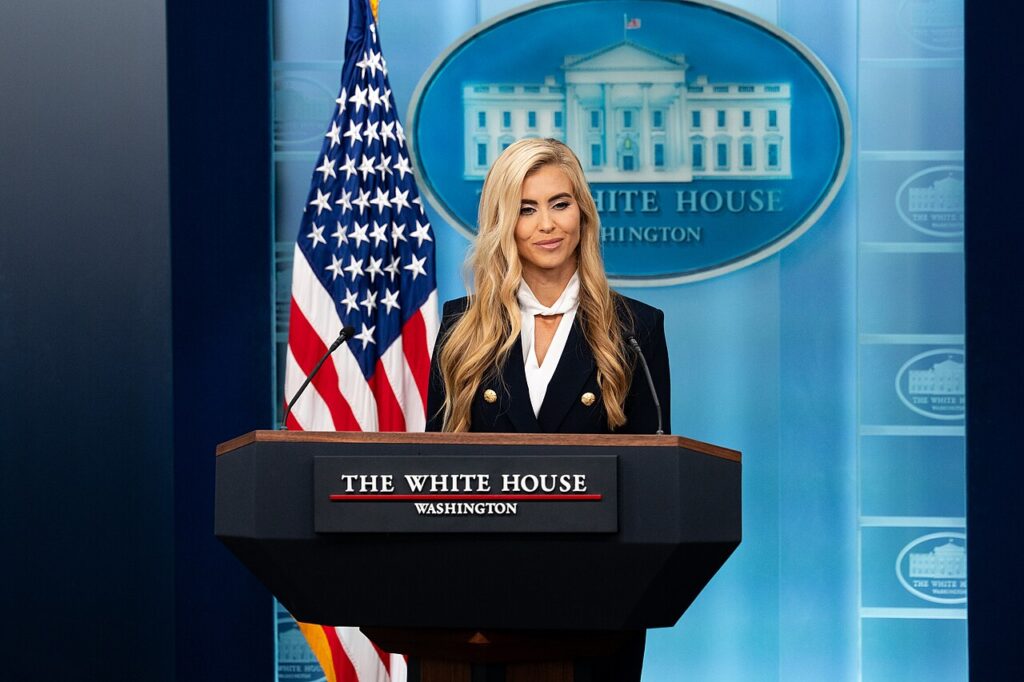
Katie Zacharia is out as White House press secretary, barely five days into the job — a tenure so short it has already entered the history books.
Five people familiar with the decision, including three senior White House officials, confirmed her ouster to USA Today on Friday, October 16. Fox News, citing unnamed officials, reported that she was “transitioning out” of the role. The White House has issued no public statement, and Zacharia herself has not commented.
Trump, for his part, told reporters he had not fired her — he had advised her to leave. “Honestly, if I were you, I’d reconsider,” he said he told her. “I think you’re better off being happy, and I’m not sure you can ever be happy in this stuff. There’s nothing easy about this stuff.” He added that she had been treated “very unfairly” and “brutalised” by the media.
However you count it — five days, or four and a half — Zacharia’s run shatters the previous benchmark for a brief Trump-era appointment: Anthony Scaramucci’s infamous ten days as White House communications director in 2017, a tenure that became shorthand for impermanence in Washington.
Scaramucci himself couldn’t resist marking the moment. “Records are made to be broken. But I take no pleasure in other people’s pain,” he wrote on X.
The job Zacharia landed was among the most visible in American government. The White House press secretary is the president’s chief spokesperson — the public face who answers the press corps’s questions daily on everything from wars to the economy. In Britain, the closest equivalent is the prime minister’s official spokesman; most governments have some version of the role, but few put it on television quite so relentlessly as the Americans do.
Zacharia’s appointment looked like a gamble from the start. A conservative television commentator and former Homeland Security spokesperson who had advised Trump’s media company, she was hired after a single phone call with the president on October 7 impressed him. She flew to Washington two days later, and within hours was announced as the successor to Karoline Leavitt, who had left the post at the end of August. Her term officially began on October 12.
Her one and only briefing, on October 13, lasted about 14 minutes. Reading heavily from a binder, she took questions from just three outlets — Breitbart News, Fox News and the Daily Mail — deflected a follow-up on intelligence sharing with Ukraine, amid fresh tension with Kyiv over US policy, and made a verbal slip, referring to “my president” when she meant her husband.
Then came the credentials row. Trump had introduced her as an attorney. Reuters found no official records of her holding a law license in any American state. She is a 2011 graduate of Pepperdine University’s law school, and in a Thursday interview she acknowledged she had never passed the bar examination. “The results of the bar exam were inconsequential because I was already moving to a foreign country that didn’t require it,” she told USA Today. On October 14, the watchdog group Campaign for Accountability filed a complaint with the California State Bar, asking it to investigate whether she had presented herself as a lawyer unlawfully.
The final blow appears to have been a Thursday-night interview with Fox News host Sean Hannity, who pressed her at length on the qualifications question. By Friday, she was gone.
Democrats seized on the exit. “The White House Press Secretary is gone. MAGA extremists continue to fall apart,” House Minority Leader Hakeem Jeffries — the top Democrat in the US House of Representatives — wrote on X.
The timing is what turns this from a staffing curiosity into a political problem. Zacharia’s departure leaves Trump without his principal public messenger less than three weeks before the November 3 midterm elections, when Americans will decide which party controls Congress. Trump has already complained that his administration does a poor job of selling its record; he now has to do that selling without the one aide whose job it is to stand at a podium and do it for him.
For the rest of the world, the revolving door matters too. Midterm elections shape US foreign policy, trade decisions and security commitments for years — and a president cycling through spokespeople in the middle of a campaign does not project the steadiness that allies and adversaries are watching for. The world has seen the Trump administration’s handling of Ukraine diplomacy before; this time, the churn set a record.