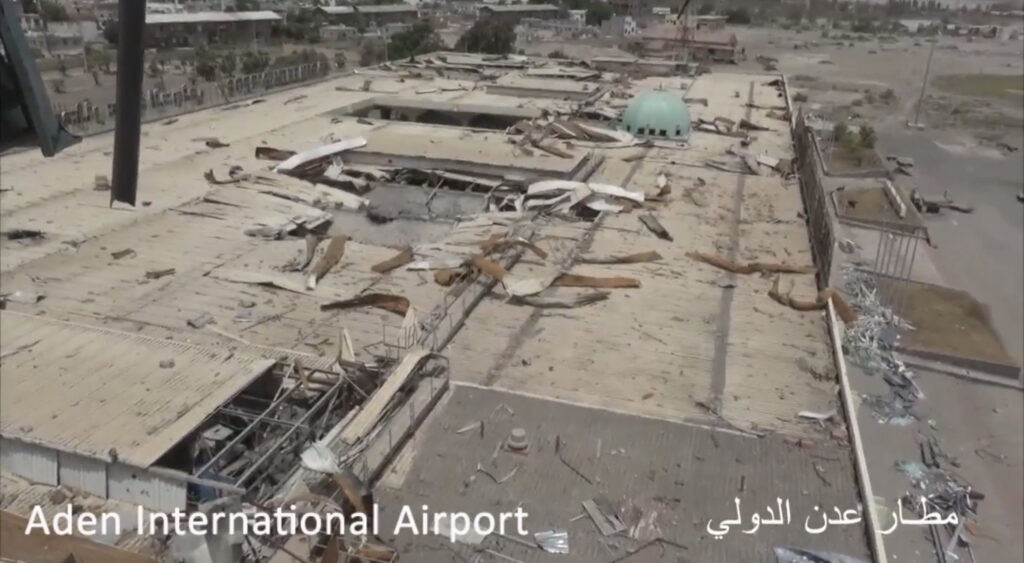
Two missiles landed inside Aden International Airport on Friday evening — the second attack on the facility in less than a week — while Saudi-led air defenses scrambled across the kingdom, intercepting a ballistic missile headed for Yanbu, two cruise missiles over the Red Sea, and three drones over the southern and Riyadh regions. No casualties were reported at the airport. A Yemenia Airways flight bound for Cairo was on the tarmac preparing for takeoff when the missiles came down.
The Aden Security Department blamed the Houthis, the Iran-aligned rebel group that has controlled Yemen’s capital Sanaa since 2014 and reignited its war against the Saudi-led coalition this year. The group did not immediately claim responsibility. The coalition’s spokesman, Maj. Gen. Turki al-Malki, announced the interceptions in a series of posts on X: “In the past hours, we intercepted and destroyed a ballistic missile launched in the direction of Yanbu,” he wrote.
Yanbu is the target that rattled the markets. The Red Sea port city is the terminus of the East-West Pipeline — a 1,200-kilometer artery that carries crude from Saudi Arabia’s eastern oilfields across the desert to the Red Sea, letting the kingdom export oil without touching the Strait of Hormuz. Since the strait was effectively closed in February, when US and Israeli strikes on Iran opened a wider regional war, Yanbu has become Riyadh’s pressure valve. Throughput on the line has been running at roughly 2.5 to 3.5 million barrels a day since operations resumed in late September, after a September 11 drone attack knocked it out. A hit on Yanbu’s export terminals would strike directly at the kingdom’s fallback route.
Oil markets reacted immediately. Brent crude briefly touched $110 a barrel on Friday — the first time since May — as traders weighed the prospect of tighter global supplies. The Saudi coalition did not identify who was behind the intercepted launches, but warnings went out to civilians earlier in the day in the Jazan region and the southwestern city of Khamis Mushait, where such alerts have become routine since the fighting resumed last month.
The attacks capped a bruising 24 hours. A day earlier, missiles slammed into the presidential palace in Aden — the interim seat of Yemen’s internationally recognized government — killing five people and wounding 16.
The escalation is drawing unusual diplomatic heat. On Thursday the UN Security Council issued a presidential statement — a format that requires all 15 members to agree, giving it more weight than a routine press note — condemning “in the strongest terms” the escalatory Houthi attacks on Saudi Arabia, including what it called “reckless strikes” on Riyadh’s King Khalid International Airport, and affirming the kingdom’s right to self-defense under international law. Saudi Arabia’s foreign ministry welcomed the statement on Friday. The coalition says Riyadh’s airport alone has been targeted 20 times this month; an October 10 attack there killed 13 people and wounded more than 300.
A spokesperson for the Houthi-run health ministry said Friday that 124 civilians had been killed and 327 wounded in Saudi strikes since the escalation began on September 3 — figures Reuters said it could not independently verify. On the ground, the war’s humanitarian shadow keeps growing: the UN says roughly 800,000 Yemenis have been cut off from humanitarian aid as the fighting spread.
Why this matters beyond the region: the Strait of Hormuz — the narrow waterway between Iran and Oman through which roughly a fifth of the world’s oil passes — is already effectively closed. Yanbu is the bypass. If the Houthis can reach the bypass too, there is no spare route left, and Friday’s $110 oil becomes the starting point, not the peak — felt at every fuel pump, shipping manifest, and inflation report on the planet.


One Comment