Eleven days before Americans vote in the midterm elections, the Trump administration has taken the extraordinary step of asking a federal court to stop a state from certifying its Senate election — but only if the Republican loses.
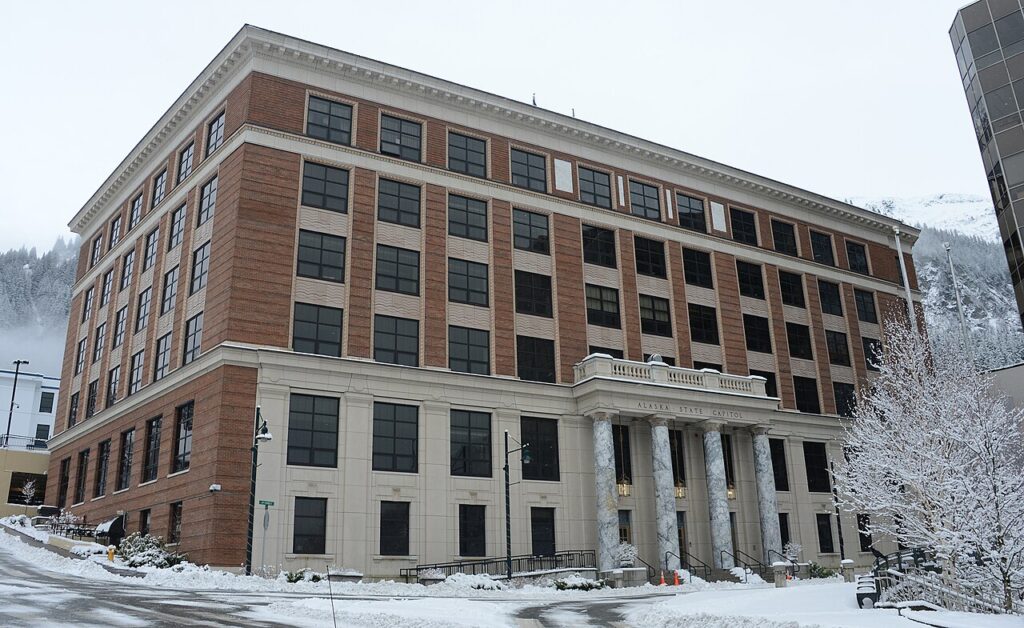
The lawsuit, filed Thursday by the Justice Department in federal court in Anchorage, Alaska, targets the state’s November 3 race for the United States Senate. The DOJ wants a judge to block Alaska’s Division of Elections from certifying “any result that may be impacted by voter confusion,” pending an investigation into whether votes cast for one candidate were actually meant for another.
The two candidates share a name. The incumbent is Republican Senator Dan S. Sullivan, seeking another six-year term. The other is Daniel J. Sullivan — a retired schoolteacher and former U.S. Forest Service worker whose name also appears on the ballot, listed without a party affiliation.
The department’s argument, in essence: voters may have confused the two men, and Alaska “will fail in its obligation to protect the integrity of its election” if it certifies results “tainted by the inclusion on the ballot of Daniel J. Sullivan.” The DOJ is leaning on the introductory language of the National Voting Rights Act — a law whose stated purpose includes protecting “the integrity of the electoral process” — to claim the state cannot legally certify a Sullivan loss.
Who is the second Dan Sullivan? He filed his candidacy on May 29 and has been running openly under the slogan “Dan Sullivan Challenges Dan Sullivan for US Senate Seat.” He has denied that his candidacy is designed to mislead anyone or to siphon votes from the incumbent. The Justice Department tells a different story: the suit describes him as “a known longtime supporter of Democratic candidates” and claims his campaign website borrows the incumbent’s “format, color scheme and overall theme.”
He changed his voter registration between the primary and the general election and is running unaffiliated. When his place on the ballot was challenged, Alaska’s state Supreme Court summarily approved keeping his name there. In the August primary, the incumbent Dan Sullivan won 68,726 votes. Daniel J. Sullivan won 4,107.
Election lawyers are having none of it. Derek Muller, a professor of election law at Notre Dame Law School, called the Justice Department’s legal theory “one of the worst ones I’ve ever seen.”
“In short, like many Department letters over the last few years, it is designed to win the press release rather than the litigation,” Muller wrote. He told CNN he had “never seen the introductory provisions of the federal voter registration law used in this way,” calling the approach “strange and unusual” — and added, “I just don’t think a court is going to buy that.”
For international readers: Peltola is a former member of the U.S. House of Representatives from Alaska, and the race has been a close one, with little reliable public polling.
It is a Senate race that matters beyond Alaska’s borders. Democrats need a net gain of four seats in November to take control of the chamber, and Alaska is one of a handful of Republican-held states they believe they can flip. A Senate majority decides which party controls confirmations, investigations — and, for the rest of the world, the direction of American foreign policy: aid to Ukraine, the posture toward Iran, tariffs, trade deals.
This is also the second time this month the Justice Department has inserted itself directly into the administration of the midterms. On October 19, federal prosecutors charged 28 green-card holders in California with illegal voting in a sweep dubbed “Operation Protect the Vote,” with 11 arrested in pre-dawn raids. That case remains politically charged: the number of allegedly illegal ballots cited amounts to a vanishing fraction of the more than 45 million votes California cast in 2024.
Bloomberg’s legal desk called the filing “a major escalation” of the administration’s involvement in the November 3 elections. The U.S. Constitution gives the executive branch only a minimal role in how elections are actually run — that power belongs to the states. A sitting administration suing, before a single ballot has been counted, to prevent a loss from being certified is the kind of move more commonly associated with countries the United States lectures about democratic norms.
Whether a judge agrees remains to be seen. Muller doubts it. But win or lose in court, the filing has already achieved something: it has told voters in Alaska that the result may not be final on November 3 — and told the rest of the world that this year’s American midterms could be decided as much in a courtroom as at a ballot box. Courts are increasingly where Trump’s second-term battles play out, on everything from press litigation to the machinery of the vote itself.