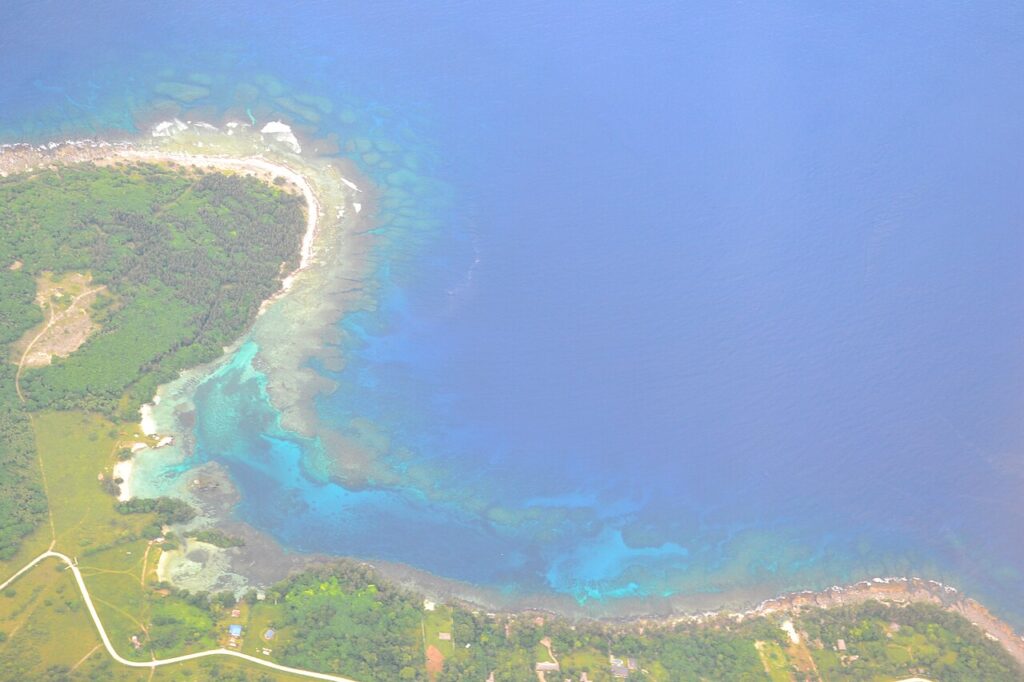
A strong earthquake has struck the waters off northern Vanuatu, shaking the Pacific island nation on Saturday afternoon and prompting a tsunami warning for coastlines across the region.
The quake hit at 1:31 p.m. local time — 0231 UTC, which is 7:31 in the morning in Pakistan — about 200 kilometres west of Sola, the main town of the Banks Islands, according to the United States Geological Survey (USGS), America’s federal earth-science agency. Germany’s GFZ research centre first measured the tremor at magnitude 7.2; the USGS later revised it down to 6.9.
It was the dangerous kind: shallow. The epicentre lay just 10 kilometres below the seafloor, roughly 14 degrees south and 166 degrees east. Shallow quakes release their energy close to the surface, which is exactly what makes seismologists watch them so carefully for tsunami potential.
Within minutes, the Hawaii-based Pacific Tsunami Warning Centre (PTWC) — the international body that monitors the Pacific for tsunami threats — issued its warning. “Based on the preliminary earthquake parameters… hazardous tsunami waves are possible for coasts located within 300km of the earthquake epicenter,” it said, in a statement carried by Agence France-Presse. That 300-kilometre zone covers parts of Vanuatu’s northern islands, including the waters off Espiritu Santo, the country’s largest island and home to its second city, Luganville.
Four minutes after the main shock, a second quake — magnitude 6.3 — struck roughly 170 kilometres northwest of Port-Olry, a village on Espiritu Santo’s northern tip. The USGS issued a green alert for that event, signalling a low likelihood of casualties or damage, and no tsunami threat was attached to it.
There were no immediate reports of damage or casualties from either quake, news agencies reported. New Zealand’s authorities said there was no tsunami threat to New Zealand.
Vanuatu is an archipelago of more than 80 islands with a population of about 330,000, sitting on the Pacific’s “Ring of Fire” — the horseshoe of tectonic fault lines around the Pacific Ocean where some of the planet’s most violent earthquakes and eruptions occur. Strong quakes are a fact of life here: less than two years ago, in December 2024, a magnitude-7.3 earthquake shook the capital, Port Vila.
Why it matters beyond the Pacific. The warning itself is the story. A tsunami threat is graded by three things — how shallow the quake is, how close to the surface it ruptures, and how near the coast it strikes. Saturday’s quake ticked all three boxes. For island nations like Vanuatu, where coastal communities sit just metres above sea level and the nearest major relief hub is a flight away, the gap between a watched warning and an ignored one is measured in lives. These alerts are built on the buoy-and-seismometer networks explained in our explainer on how tsunami warnings actually work — and every real-world event like this one is a live test of whether that system reaches the villages it is meant to protect.
The quake comes two days after a 7.0-magnitude earthquake in Tibet put Chinese and Indian monitoring agencies on alert, making this a busy week for the region’s seismic early-warning systems. Aftershocks are likely in the coming days, and the PTWC typically refines or stands down its warnings within a few hours as tide-gauge and deep-ocean buoy readings come in.