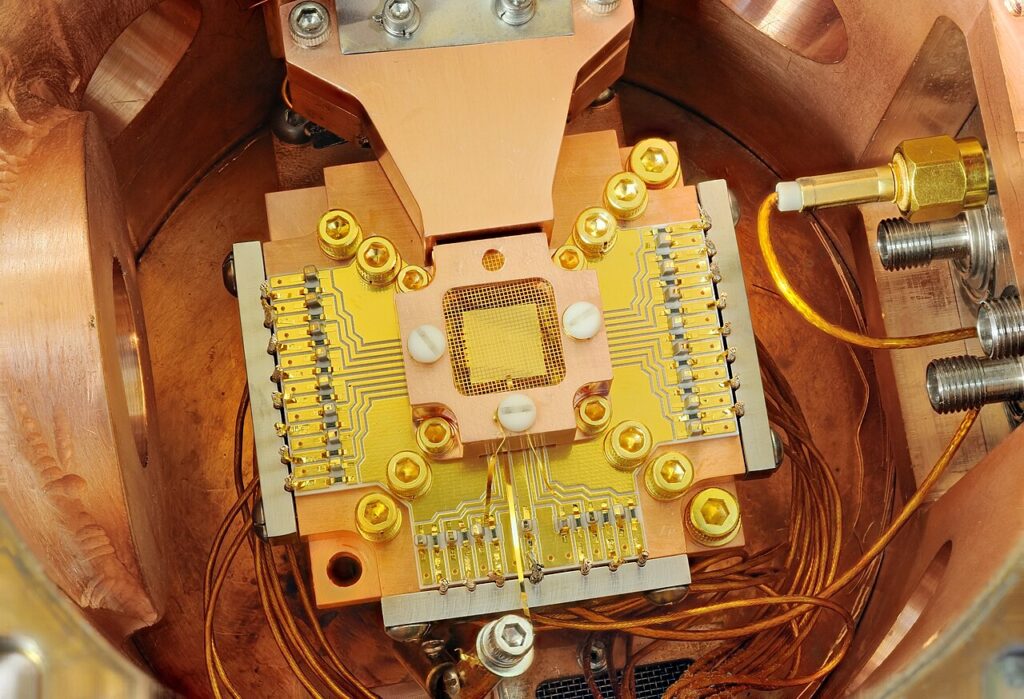
Five errors in a million operations. That is the new bar in quantum computing — and it was set last week by a machine that traps individual atoms in electric fields and nudges them with lasers.
On October 19, the quantum computing company Quantinuum announced that its Helios system had achieved 99.9995 percent logical fidelity, a world record for quantum error correction. The error rate is ten times lower than the company’s own record from September, and roughly a hundred times lower than the best published result from a competing superconducting system, reported by Google’s Quantum AI team.
The announcement matters less for the number itself than for what it signals: the industry’s long-promised era of fault-tolerant quantum computing — machines that can run long, useful calculations without errors swamping the answer — may be arriving faster than expected.
What was actually measured
A quick note on what “99.9995 percent” means, because the fine print matters. Quantinuum measured logical memory fidelity: how reliably a single error-corrected “logical qubit” — built from up to 37 physical qubits working together — holds its state through repeated rounds of error checking. The measured error probability was about five in a million per checking cycle.
That is not the same as running a full fault-tolerant computation, and the result is Quantinuum’s own measurement on its own machine — no independent group has verified it yet. But the direction of travel is hard to argue with: two record-breaking results, two months apart, on the same commercial hardware.
Two codes, one machine
Perhaps the most interesting detail is how the record was set. September’s result used a brand-new error-correcting scheme called Helix, designed by Quantinuum. October’s used a well-known textbook scheme — the color code — run at increasing levels of protection. Each step up cut the remaining errors by a factor of about twelve.
The fact that two completely different codes both delivered record performance on the same Helios processor is the point Quantinuum wants everyone to notice. “We’ve proven that we have the error-correction architecture and trapped-ion technology required to achieve universal fault-tolerance,” said CEO Dr. Rajeeb Hazra. “We’ve crossed the threshold necessary for exponential improvements in accuracy.”
Helios traps charged atoms of barium as its working qubits, with ytterbium ions alongside to keep them cool, all manipulated by visible-light lasers. Because every atom of a given element is identical, trapped-ion systems start with naturally uniform, low-noise qubits — an advantage Quantinuum is now converting into error-correction performance.
An independent voice
Quantinuum’s announcement included an unusual guest: an outside validator. Robin Blume-Kohout, co-director of Sandia National Laboratories’ Quantum Performance Lab, who was not involved in the work, said the paper “demonstrates real, serious performance gains from quantum error correction — a logical qubit nearly 100x better than its component physical qubits.”
“A scaled-up version of this system could reach the reliability required for useful fault-tolerant computation at a feasible size — less than a million physical qubits — which improves the outlook for practical quantum computing,” he added.
Why this matters
For thirty years, quantum computing’s dirty secret has been that adding qubits made machines less reliable, not more — every extra qubit was another chance for noise to corrupt the calculation. Error correction reverses that: past a certain threshold, adding qubits makes the logical result more reliable. Crossing that threshold convincingly, on commercial hardware, twice in two months, is why this announcement landed the way it did.
Quantinuum says the results put it on track for Apollo, its planned universal fault-tolerant quantum computer, “expected to be available by 2029.” The applications waiting on the other side — designing new materials and drugs by simulating molecules, modelling complex financial risk — have been “five years away” for a very long time. For the first time, the timeline is starting to look like an engineering schedule rather than a wish.
Related: Google’s recent breakthrough on a 20-year quantum problem.