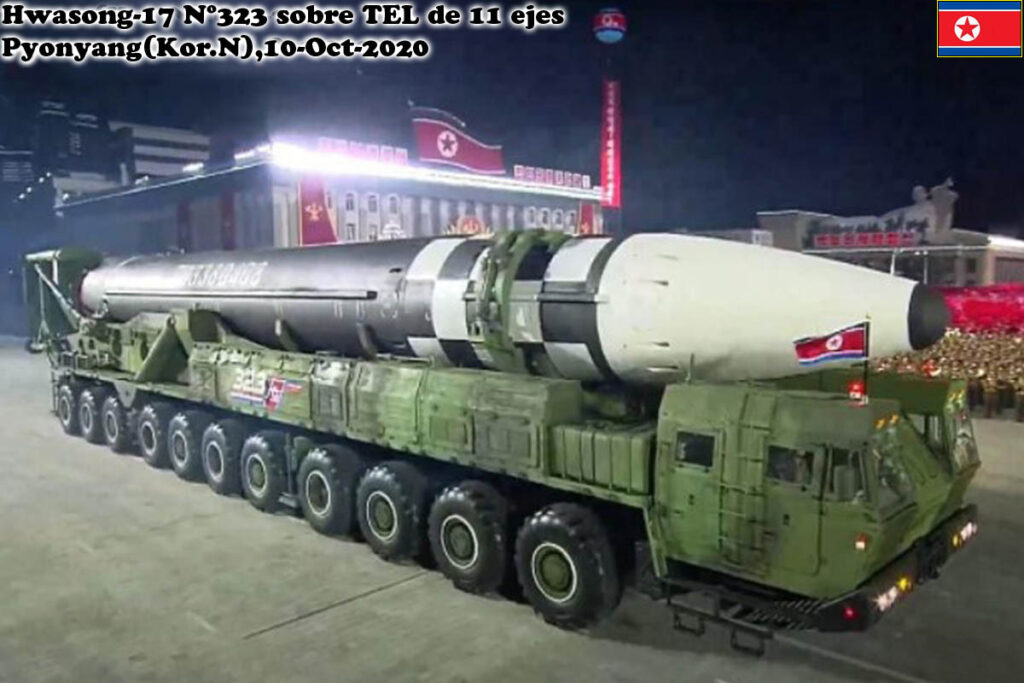
North Korea fired more than 10 short-range ballistic missiles toward the East Sea on Thursday, South Korea’s military said, ending a 17-day pause in ballistic testing with a salvo launched from the country’s eastern coast.
South Korea’s Joint Chiefs of Staff said it detected the missiles being launched from the Wonsan area at around 12:30 p.m. local time. Wonsan is a port city on North Korea’s east coast, and the East Sea is the body of water between the Korean peninsula and Japan, also known as the Sea of Japan. The military did not immediately disclose how far the missiles flew, and said it was still analysing their specifications, including their range.
Japan’s coast guard said the launched projectile could be a ballistic missile and had already fallen into the sea. Japan’s defence ministry separately said it had detected a North Korean launch of what appeared to be a ballistic weapon.
“Our military has strengthened surveillance and vigilance in preparation for possible additional launches,” the Joint Chiefs said, adding that South Korea, the United States and Japan were closely sharing information on the missiles and maintaining a readiness posture.
Thursday’s launch was North Korea’s 17th ballistic-missile launch of the year and its first in 17 days. The previous one came on 12 October, when Pyongyang fired multiple ballistic missiles from the Pyongyang area toward the East Sea, some of which flew more than 900 kilometres. That barrage was widely read as a show of force after South Korea successfully test-fired its first hypersonic weapon.
The new salvo is a different class of weapon from the test North Korea announced two weeks ago, when it said it had fired two submarine-launched strategic cruise missiles from beneath the sea off its east coast — a step toward a sea-based nuclear deterrent. Ballistic missiles, which arc high above the atmosphere before plunging back down, are the backbone of Pyongyang’s arsenal and the category of weapon United Nations resolutions explicitly ban it from testing.
The timing carries its own message. The launch came a day after South Korea, the United States and nine other countries, together with the European Union, reaffirmed their commitment to North Korea’s denuclearisation in a joint statement. That statement also welcomed recent sanctions targeting North Korea’s overseas workers, its cyber activities and its military cooperation with Russia, and urged all UN member states to fully implement sanctions resolutions against Pyongyang.
It also came less than a week after South Korea proposed talks with the North over a growing border row. A landmine explosion along the heavily fortified border between the two Koreas wounded three South Korean soldiers last month, and a joint Seoul-UN investigation earlier in October concluded that North Korea had planted the mines that exploded in the Demilitarised Zone more than a year ago — a finding Pyongyang angrily denied. Kim Yo Jong, the powerful sister of North Korean leader Kim Jong Un, has since blasted South Korea’s demand for an apology as “despicable” and separately rejected an offer of medical equipment from Seoul.
Washington’s own approach adds another layer. US President Donald Trump has recently made overtures to Pyongyang, including suggesting he might meet Kim in 2026, raising concern in Seoul — Washington’s ally — that South Korea could be sidelined in any future nuclear talks involving the North. In October, North Korea launched several short-range ballistic missiles a day after Trump floated the idea of a meeting.
Why this matters beyond the peninsula: short-range ballistic missiles cannot reach the United States mainland, but they can reach targets across South Korea and Japan, and every salvo gives Pyongyang data to refine weapons it has already shown it is willing to use as leverage. Thursday’s launch answers Seoul’s offer of talks with missiles rather than dialogue, and it tests whether the renewed international pressure of this week — the joint denuclearisation statement, the sanctions — changes Pyongyang’s calculus at all. So far, the answer is no.
What remains unknown is almost as important as what is confirmed: the exact number of missiles beyond “more than 10,” their ranges and where each one splashed down. South Korea’s military says it is watching for follow-up launches, and the picture will sharpen as its analysis, and Japan’s, comes in.



One Comment