France’s third weekend of cost-of-living protests ended the way the government had feared it might — in fire. Paris prosecutors opened an attempted-murder investigation on Sunday after a petrol bomb set a gendarme alight at the end of Saturday’s march, capping a day in which some 320,000 people demonstrated across the country and 779 were arrested, according to the Interior Ministry’s final tally.
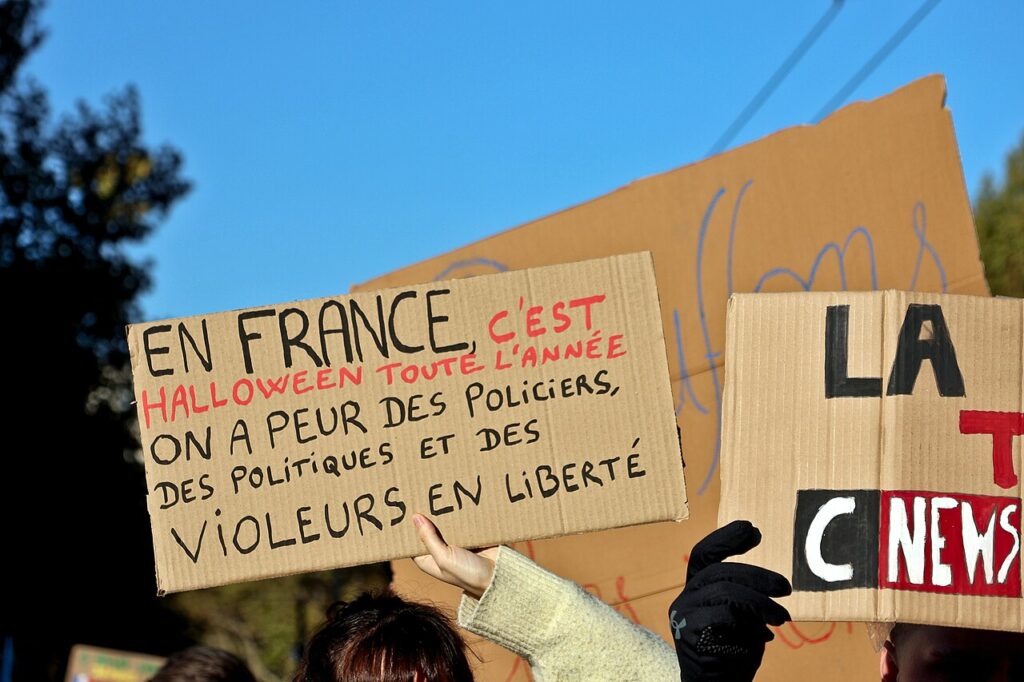
The violence came at Porte de Charenton, on Paris’s eastern edge, where the capital’s march ended. For most of the day the demonstration had been festive — some marchers in Halloween costume, techno music playing — but as it dispersed, groups of masked protesters began hurling paving stones, bottles and fireworks at police, who answered with tear gas, baton charges and stun grenades. Then the incendiary devices came: prosecutors say around 15 explosive devices were thrown at officers, and one Molotov cocktail exploded at a gendarme’s feet, setting his lower body on fire. He was treated for burns; reports put the injuries at second-degree. No suspect has yet been arrested over the firebomb attack, and investigators are still working to identify those responsible.
The final numbers replace the interim counts published during Saturday itself. An earlier count, taken in the early afternoon, had put the Paris march at 15,000 and arrests at 27; the ministry’s final tally is far larger. Nationwide, officials counted about 320,000 demonstrators at roughly 150 protests, while unions put the total closer to 500,000. In Paris alone, 70,000 marched along the outer boulevards — the route had been diverted away from the city centre — though organisers claimed 200,000. Police arrested 105 people in the capital, 88 in connection with the demonstrations and 17 during Halloween night. Le Figaro, citing emergency medical services, reported at least 60 protesters injured and 18 officers hurt, though it cautioned those figures were not final; in Marseille alone, 19 officers were injured.
Interior Minister Laurent Nuñez called the violence “extraordinary” and described the petrol-bomb attack as “attempted murder” — language the Paris prosecutor’s office adopted in opening its investigation into “attempted murder of persons vested with public authority.” The ministry also stressed that, after the clashes at Charenton, the later part of Saturday night passed without major incidents, despite the 70,000 officers deployed nationwide and bans on gatherings at Place de la République and Les Halles from 11 p.m. to 6 a.m.
Set against the two previous weekends, Saturday looks like a movement that is shrinking but not calming. On October 17, when the protests exploded into looting, 2,628 people were arrested; on October 24, the figure was 1,314. Saturday’s 779 is the lowest yet — but the petrol-bomb attack on an officer is the most serious single incident of the three weekends, and it is the one now driving the legal aftermath.
The protests began a month ago at a high school on the outskirts of Paris, over the state of schools, and have since widened into a general revolt over the cost of living, inequality and deteriorating public services, drawing in students, trade unions and veterans of the “yellow vest” movement. The same anger spilled across the border on Saturday: in Germany, around 120,000 young people marched in more than 30 cities under the banner “Gen Z regelt” — Gen Z has got this — and in Frankfurt the night ended with looted shops.
What happens next will be decided in the classroom as much as on the street. Schools reopen on Monday after the autumn break, and student groups have called new high-school and university blockades for Tuesday and Thursday, ahead of a trade-union demonstration on November 5. The government has already announced education measures — more teaching posts, infrastructure investment and changes to university admissions — but whether that defuses a movement now in its fourth week is an open question. For now, the attempted-murder probe ensures that the Halloween march will not simply fade into the statistics: someone threw a petrol bomb at a police officer in front of cameras, and the state intends to find them.
Why this matters: France’s protests are no longer a French story. The same cost-of-living anger that filled Paris on Saturday filled Frankfurt, Berlin and Hamburg the same day, and youth-led movements are borrowing each other’s slogans across Europe. How Paris handles the aftermath — a criminal probe into an attack on police, alongside concessions on schools — will be watched by governments facing identical pressures, from Berlin to Rome. The falling arrest totals suggest the state is regaining control of the streets; the petrol bomb suggests the fringe is becoming more dangerous even as the crowds thin. That combination — smaller marches, sharper violence — is the pattern to watch in the weeks ahead.
Read our earlier daytime report on Saturday’s march for the interim figures this final tally replaces.