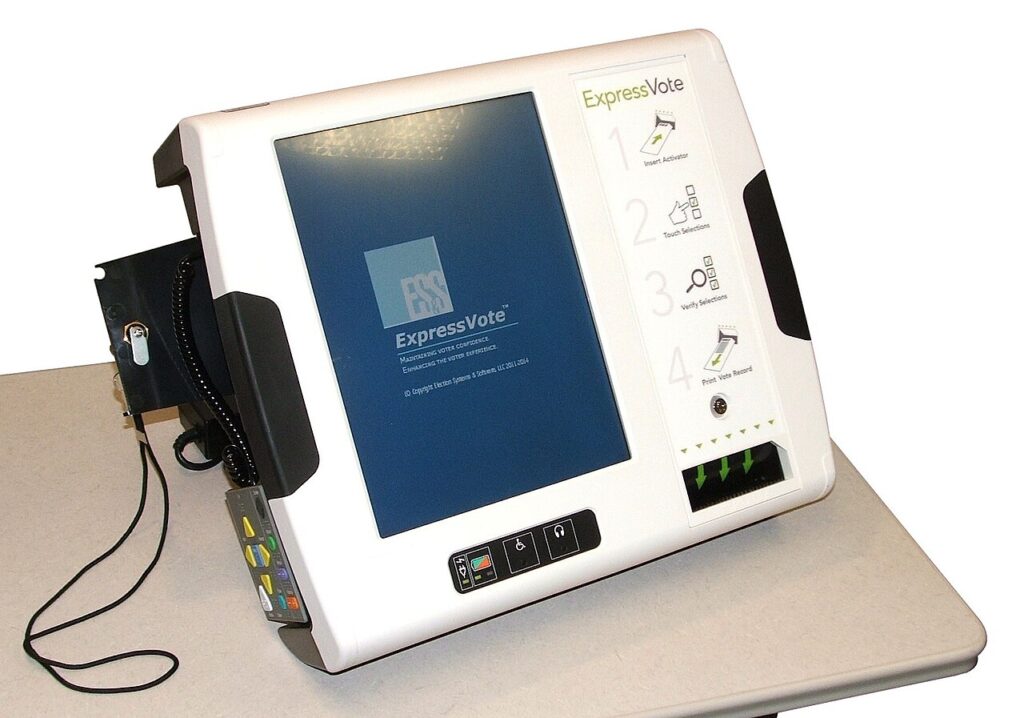
VERDICT: FALSE — The viral videos presented as proof that voting machines flipped votes in the 2026 United States midterm elections are not from 2026 at all. They date from elections held in 2014, 2018 and 2019.
The claim
As early voting went on for the US midterms — Election Day is Tuesday, 3 November 2026 — posts on Facebook, X, Threads and TikTok claimed touchscreen voting machines were switching voters’ choices. A widely copied message said voters in Texas, Florida, Tennessee and Ohio could not get machines to accept Democratic votes, and that the machines kept changing them back to Republican candidates.
Videos were shared as proof. One, posted on X on 21 October 2026, claimed a machine “will not let voter select the Republican candidate that they want to vote for and automatically selects the Democrat candidate instead.” Another clip, reshared on 22 October, showed a voter tapping one name while the screen marked another. Both were passed around as if filmed at polling stations in the current election.
The facts
1. The “national emergency” video is two old clips stitched together. The first 41 seconds show Mississippi’s Republican primary runoff on 27 August 2019, between Tate Reeves and Bill Waller Jr., competing for the Republican nomination for governor. Both men were Republicans — so the clip cannot show a vote switched from a Republican to a Democrat, as the caption claims. The final 31 seconds show a general election on 4 November 2014, for Virginia’s 2nd Congressional District, in which Democrat Suzanne Patrick challenged Republican Scott Rigell, who won.
2. The other widely shared clip is from Indiana in 2018. It shows a voter trying to select Democrat Tobi Beck, while the screen marks Republican Jim Baird — opponents in the 2018 race for Indiana’s 4th Congressional District, which Baird won. The footage was reported during the 2018 midterms, at a polling place in Tippecanoe County, where officials put the problem down to poor touch-screen calibration. A current Tippecanoe County election specialist has since called the recirculated video deceptive and the vote-switching allegations false.
3. The candidate names give the videos away. None of the people on screen is standing in the 2026 midterms: Reeves and Waller fought a 2019 primary, Patrick and Rigell a 2014 House race, Beck and Baird a 2018 House race.
4. Real 2026 touchscreen complaints are a different, smaller story. Some voters in 2026 did report screens highlighting the wrong name: voters in Williamson County, Tennessee, told a local station their selections jumped to another candidate, and three voters in Bexar County, Texas, reported machines changing or removing their choices. In every account found, the voter spotted the error and corrected it before casting a ballot.
Officials blame the screens, not deliberate switching. Tennessee’s Coordinator of Elections, Mark Goins, said the cases appeared to be voter error, possibly an unintended touch. Bexar County Elections Administrator Michele Carew said mismatched selections are “almost always due to user touchscreen sensitivity, not machine malfunction.” Tennessee’s election office reported one such complaint among around 400,000 ballots cast at that point. These counties’ machines also print a paper ballot the voter can read before casting — so a wrong highlight does not become a wrong counted vote unless the voter confirms it.
5. This is a recurring claim, not a new discovery. “Vote-flipping” allegations have surfaced in almost every US election cycle, traced back to at least 2008. The pattern is consistent: a genuine-looking clip from an old election is stripped of its date, then presented as breaking evidence from the current one.
Verdict
FALSE. The viral videos do not show voting machines flipping votes in the 2026 midterms; they show elections from 2019, 2018 and 2014. Small numbers of 2026 voters did report touchscreen mix-ups, but officials say those were calibration and touch-sensitivity problems that voters caught and corrected — and no evidence has emerged that any machine deliberately switched a vote, or that a wrongly marked ballot was counted.
Why it matters
The timing is the point. These clips spread in the final days before Election Day, when millions of Americans were already voting early. A video that appears to show a machine overriding a voter’s choice can persuade people that voting is pointless, or send them into polling stations already distrustful. Checking the date on a clip — and, at the polling station, checking the printed ballot before casting it — is the simplest defence against both the old footage and the real, fixable touchscreen glitches.
Sources: Poynter / PolitiFact and Lead Stories.
Related: No, Benjamin Netanyahu Was Not Attacked in Tel Aviv — the Video Is From Bulgaria in 2013 | No, Trump Did Not Warn India to Cut Ties With Russia — the Viral Video Is Fake