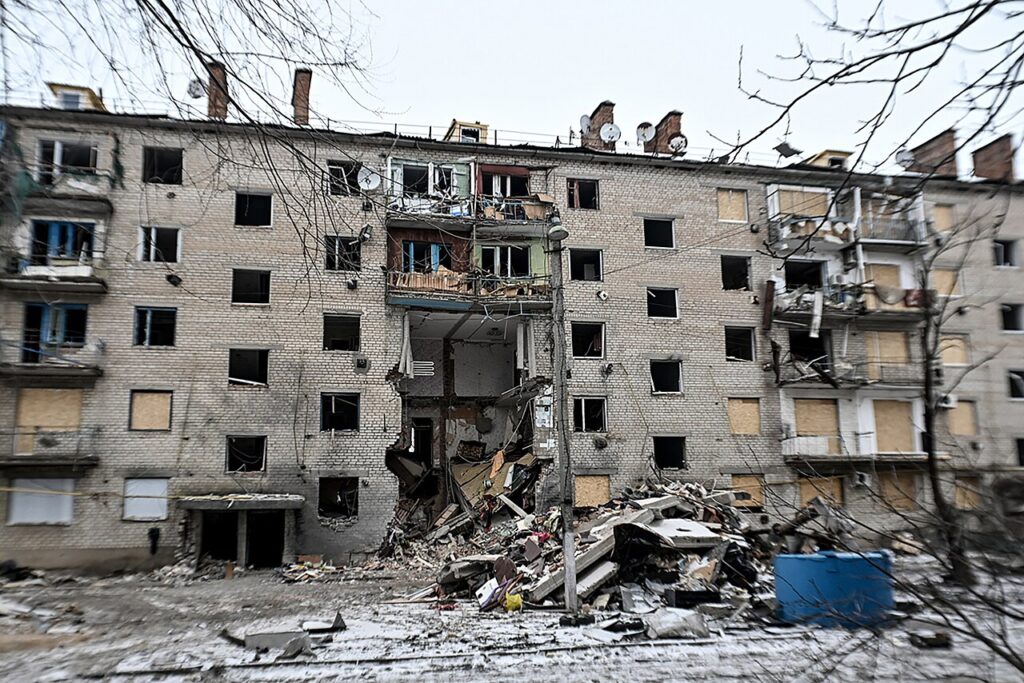
The confirmed death toll from Russia’s bombing of a humanitarian aid point in the Ukrainian village of Komyshuvakha has risen to 26, Ukrainian officials said on Monday night, up from the 18 reported when rescue crews first reached the site. Twenty-seven people remain missing, and the toll could still climb as search teams work through the rubble.
Ukraine’s State Emergency Service said the dead include two of its own rescue workers and four police officers. Five people are being treated in hospital, including two rescue workers. The emergency service named the two dead rescuers as Denis Konovalenko and Oleksiy Sushchevsky.
President Volodymyr Zelenskyy confirmed the higher toll in his nightly video address, after first reporting 18 dead earlier in the day. The count moved as the day went on — from 18 to 24 as crews reached the site, then to 26 in the president’s evening address — and officials have stressed that every figure remains provisional while people are still unaccounted for.
According to Zelenskyy and Ukrainian officials, Russian forces dropped ten guided bombs on the site in total. The first strike hit a school building in Komyshuvakha, in the southeastern Zaporizhzhia region, where residents who have stayed in the front-line village gather every Monday to collect humanitarian packages. A second strike, of nine more bombs, then hit the shelter where people had gathered — a pattern known as a double-tap strike, in which a follow-on attack targets the rescuers and civilians who rush to help after the first blast.
“The Russians could not have failed to know that every week the locals who remain in Komyshuvakha receive humanitarian aid right there,” Zelenskyy said. He called the attack “an exceptionally horrific Russian strike.”
Komyshuvakha lies about 25 kilometres east of the city of Zaporizhzhia, close to the front line. Ukrainian media reported that rescue efforts were hampered by Russian drones, shelling and heavy smoke, and that emergency responders searched through collapsed buildings by flashlight as night fell. Regional officials have announced a day of mourning.
The strike came a day after a six-day local ceasefire expired in the neighbouring Kherson region, where a truce had been arranged to bring aid into the Russian-occupied town of Oleshky and evacuate residents who wished to leave. That truce ended on Monday with aid still largely undelivered and no monitoring mechanism in place — and Komyshuvakha, in a different region to the south-east, was hit the same day.
Russia had not publicly addressed the Komyshuvakha strike in the reports available on Monday. Our earlier report on the attack, when 18 deaths had been confirmed, is here.
Why this matters beyond Ukraine: aid distribution points are among the few places where civilians in front-line villages can still get food and basic supplies, and they operate on a fixed, public weekly schedule. A strike on such a site — followed by a second strike on the shelter where survivors gathered — raises the same question that has followed attacks on hospitals, markets and evacuation corridors throughout this war: whether the laws protecting civilians in war still constrain what armies do when no one is watching. The answer matters far beyond Zaporizhzhia, because every precedent set here is one that other wars will cite.