Informopedia Explains: next week, American, Ukrainian and Russian negotiators are due to sit down in Abu Dhabi to discuss, among other things, post-war security arrangements. Whenever a war ends — or pauses — someone eventually asks the question that sounds simple and turns out not to be: who actually enforces the deal? The usual answer is a stabilization force. Here is what that means, and why it is so much harder than it sounds.
First, what is it?
A stabilization force is an international military deployment sent into a conflict zone after — or sometimes before — a political agreement, with a mandate to keep the peace by force if necessary. That last clause is the difference. Traditional peacekeepers, the blue helmets most people picture, traditionally deploy only with the consent of the parties, stay neutral and use force only in self-defence. A stabilization force is authorized to impose security: protect civilians, secure borders, disarm fighters and stop one side from restarting the war. It is peacekeeping’s tougher cousin, and the distinction matters because it changes who is willing to send troops.
Who authorizes it?
Usually the UN Security Council, and that is where the politics starts. A resolution needs at least nine of the Council’s fifteen votes and no veto from any of the five permanent members — the US, Britain, France, Russia and China. One veto kills it, which is why rival drafts regularly cancel each other out: last month, the UN mission in Western Sahara was left without a mandate after the US and Russia vetoed each other’s plans. A force can also be authorized by a regional body or a coalition of willing states, but without a Council mandate it lacks the legal authority — and the legitimacy — that persuades cautious governments to contribute soldiers.
Who sends the troops, and who pays?
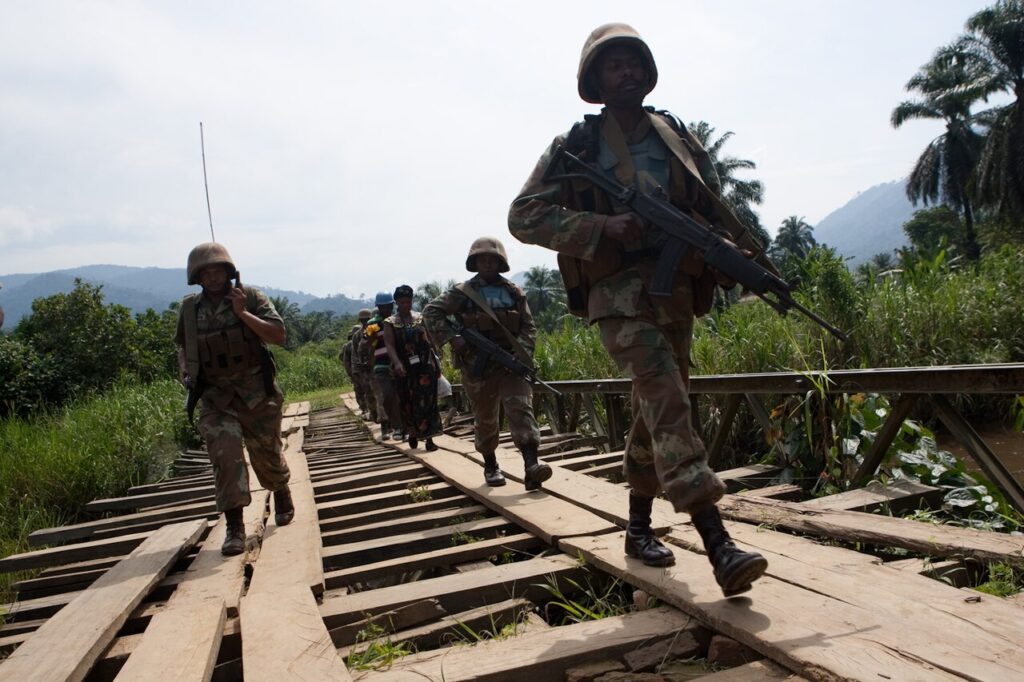
Member states volunteer troops; the UN does not have an army of its own. The countries that contribute most soldiers are often not the countries that write the mandates — a long-standing tension. Wealthy states tend to fund missions and provide equipment, while poorer states provide the bulk of the boots on the ground. Troops remain under their own national command for discipline but operate under a unified force commander. The bill runs to billions a year for large missions, and when contributing countries feel the mission is drifting, they quietly start pulling their soldiers out — which is how mandates die, not with a vote but with a trickle.
What does the mandate actually allow?
Everything turns on a few phrases. “All necessary measures” is the strongest language: it authorizes force. A mandate to “protect civilians” sounds clear until a patrol has to decide whether that means returning fire, raiding a militia base or standing between two armies. Mandates also set the mission’s lifespan — typically a year or two, renewable — and its tasks: securing borders, overseeing disarmament, protecting aid convoys, supporting elections. The broader the mandate, the more the force can do; the broader the mandate, the more it gets blamed for what it cannot do.
Why do they so often struggle?
Three reasons recur. First, consent: a force that deploys without genuine buy-in from the armed parties becomes a party to the conflict, and then it is a war, not a mission. Second, mission creep: a force sent to guard a ceasefire gets asked to rebuild a state, and rebuilding a state takes decades that contributing governments will not fund. Third, the exit: there is never a good moment to leave, because leaving is read as abandonment and staying is read as occupation. Missions that succeed — Bosnia’s NATO-led force after Dayton is the classic case — usually have overwhelming force at the start, a political deal that all sides actually signed, and a clear path to handing over to local institutions.
Why this matters now
Every ceasefire that holds for a week raises the next question: who holds it for a year? The Kherson ceasefire expired at the weekend with no extension and no mechanism to replace it. That is the gap stabilization forces exist to fill — and the reason they are so rarely agreed. A mandate is a bet that the war is over enough for soldiers to keep the peace rather than fight one. Getting that bet wrong costs lives, which is why the negotiations over the words on the page take as long as the negotiations over the war itself.