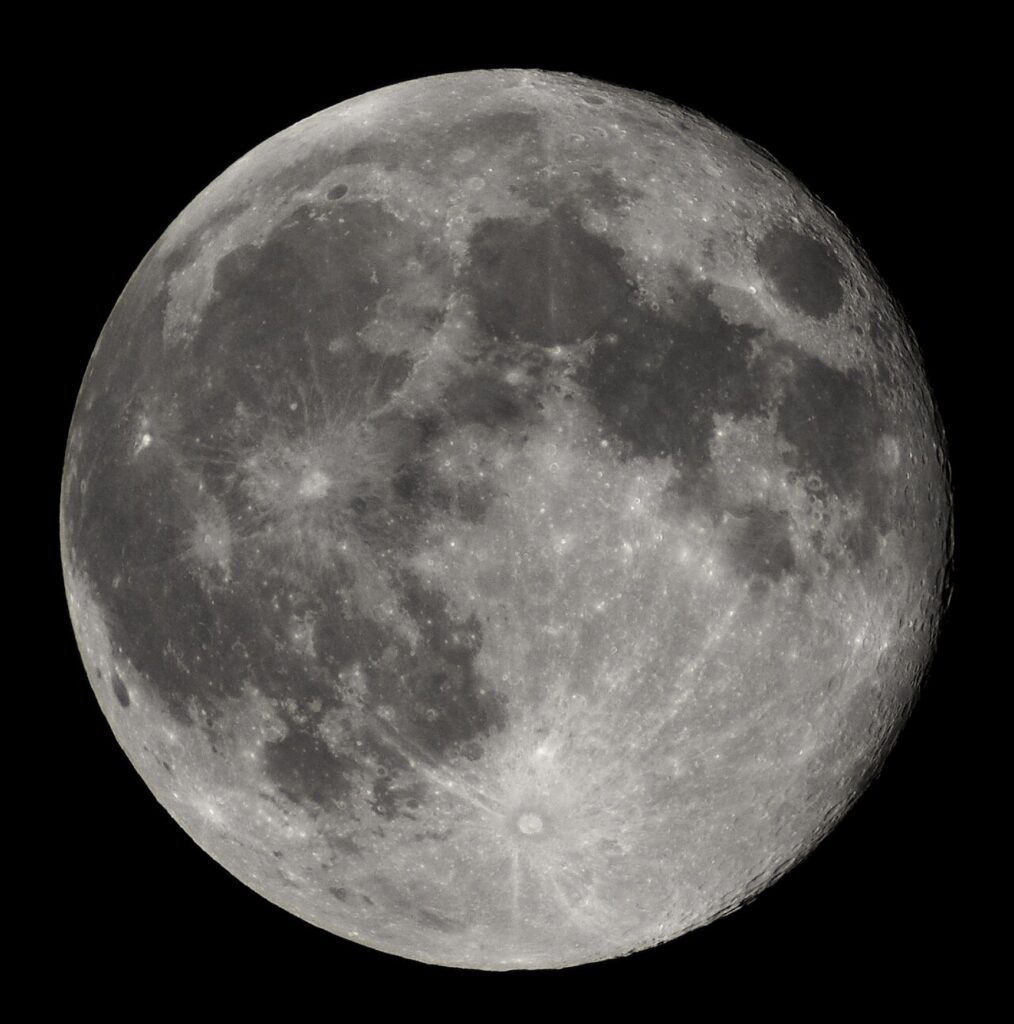
Informopedia Explains: there are mirrors on the Moon, left there by Apollo astronauts more than half a century ago, and scientists still fire lasers at them. The light comes back a little later each year. That is how we know, not by theory but by measurement, that the Moon is drifting away from Earth at about 3.8 centimetres a year — roughly the speed your fingernails grow. It sounds trivial. It is quietly reshaping your calendar.
The tide is a brake
The mechanism starts with something you can watch at any beach. The Moon’s gravity pulls Earth’s oceans toward it, raising a bulge of water on the side facing the Moon — and, because of the way gravity and inertia balance, another on the far side. Here is the twist: Earth spins on its axis much faster than the Moon orbits around it. So as the planet turns, it drags that bulge slightly ahead of the Moon, like a dog pulling its owner forward on a lead.
That bulge has mass, and mass has gravity. It tugs the Moon forward in its orbit, giving the Moon energy — and the energy has to come from somewhere. It comes from Earth’s spin. The tides act as a brake on our planet’s rotation, slowing it down by a tiny amount, while the Moon, gaining energy, spirals outward into a slightly larger orbit. It is a transfer, not a mystery: angular momentum moves from Earth’s rotation to the Moon’s orbit, and both bodies change.
How do we know?
Three independent lines of evidence agree. The Apollo laser reflectors give the modern rate directly: 3.8 centimetres a year. Ancient eclipse records kept by Babylonian and Chinese sky-watchers, going back to the 8th century BC, show the day has lengthened by about 2 milliseconds per century since then. And rocks remember even further back: tidal patterns preserved in 620-million-year-old sediments suggest a day back then lasted only about 21.9 hours, with roughly 400 days in a year. NASA puts the Moon’s average distance at about 384,400 kilometres — a number that grows by a few centimetres annually, every year, without pause.
So what happens in the end?
First, the counterintuitive part: as the Moon moves outward, it does not speed up — it slows down, taking longer to complete each orbit, while Earth’s days stretch. Run the clock forward and the consequences get dramatic. In roughly 600 million years, the Moon will be far enough away that its apparent size in the sky shrinks below the Sun’s, and total solar eclipses — the Moon exactly covering the Sun’s disc — will no longer be possible. We live, by cosmic luck, in the era when the two discs match almost perfectly.
But the Moon will not escape. Long before that, in about 1 to 1.5 billion years, the brightening Sun will boil away Earth’s oceans, and with them the tidal brake itself. The Moon’s drift will slow to a crawl. Eventually, if the Sun’s evolution allowed it, Earth and Moon would settle into a mutual lockstep, each always showing the same face to the other, the day as long as the month. The Sun will not allow it — it will swell into a red giant first — but the physics points that way.
Why this matters
It matters because it is the rare cosmic story that touches daily life. The length of your day, the rhythm of the tides, the existence of total eclipses — all of them are side effects of a slow gravitational negotiation between Earth and its companion, one that has been running for 4.5 billion years and is still running tonight. The Moon is not leaving us in any sense that matters to a human lifetime; it will be 3.8 centimetres further away next year, and 3.8 after that. But nothing in the solar system stands still, not even the clock on your wall. Your days are longer than your ancestors’ were, by a measurable amount, because the Moon is stealing a little of Earth’s spin every single day — and paying for it with distance.