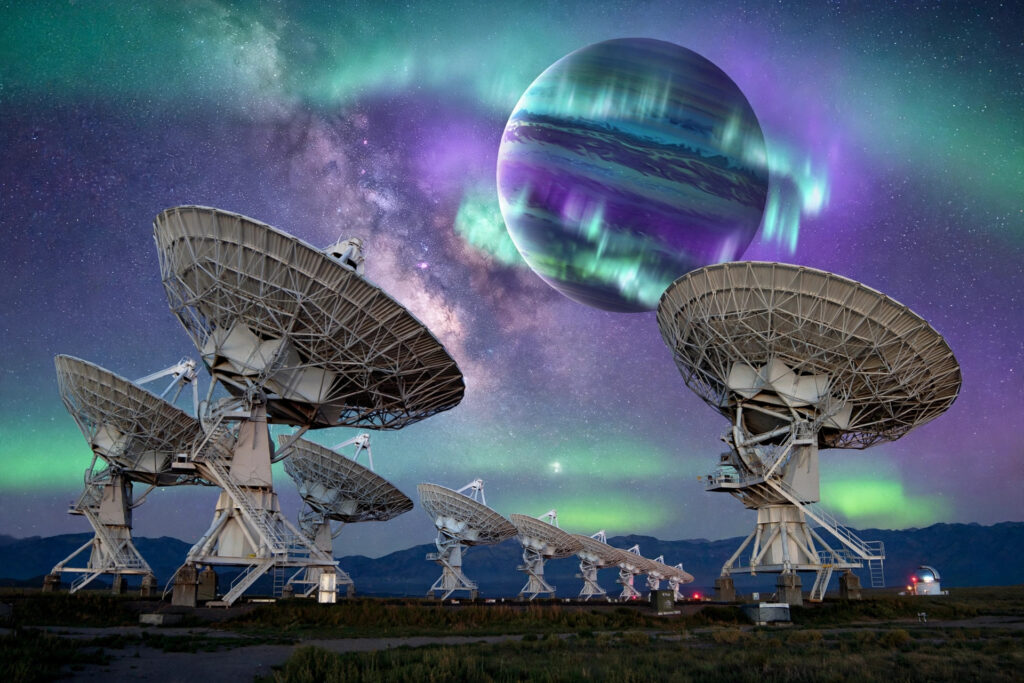
Sixty-three light-years from Earth, a planet twelve times heavier than Jupiter is putting on a light show — and for the first time, astronomers have heard it.
Using the MeerKAT radio telescope in South Africa, researchers detected bursts of radio emission coming directly from Beta Pictoris b, a giant exoplanet circling a young star. The signal, picked up between 0.85 and 3.5 gigahertz, repeated across multiple observations until the team could peel it away from the glare of the planet’s star. It’s the first time radio emission has been directly detected from a planet outside our solar system.
Auroras, but on a planetary scale
Before imaginations run wild: this is not a message. The strongly circularly polarized bursts carry the signature of auroras — the same phenomenon behind Earth’s northern lights, produced when charged particles slam into a magnetic field. On Beta Pictoris b, the physics appears to be operating at a staggering scale, driven by what researchers describe as an exceptionally powerful magnetic field.
That’s precisely what makes the detection thrilling. A planet’s magnetic field is one of the hardest things to measure from light-years away, yet it matters enormously. Magnetic fields shield atmospheres from stellar radiation; Earth’s is part of why our planet stayed habitable. Being able to “hear” a magnetic field through its auroral radio crackle hands astronomers a brand-new instrument for studying distant worlds.
Why it matters
Until now, exoplanet science has mostly been a game of shadows and wobbles — worlds found by the dimming of their stars or the gravitational tug they exert. Direct radio detection opens a different channel entirely: listening to planets rather than just watching them.
The finding still needs independent review, and the researchers are careful about their claims. But here’s the part that lingers: if it holds, Beta Pictoris b stops being a curiosity and becomes a proof of concept. The radio sky may be full of planetary auroras waiting to be found, each one carrying information about magnetic fields, atmospheres, and the conditions that make worlds livable or hostile.
Somewhere out there, auroras are crackling on a scale that would dwarf anything in our solar system. Until now, we didn’t even know we were allowed to listen.