Verdict: FALSE — The footage is real, but the words are not. Sergey Lavrov never said India was “just a trading partner” — the audio was replaced with AI-generated speech.
The claim
A video spreading on X since around 1 November 2026 appears to show Russian Foreign Minister Sergey Lavrov dismissing India in blunt terms. In the clip, he supposedly says: “India is our trading partner, nothing more. We supply oil and India pays for it. This commercial relationship does not give India the right to interfere in our foreign policy or advise us on issues involving Russia, Ukraine, United States, or any other country.” A second version has him adding that India is “neither our ally nor a superpower whose advice we are bound to follow.”
The clip travelled fast. It was shared by prominent accounts, including senior advocate Prashant Bhushan, who posted it with a caption asking what advice India’s foreign minister had been giving Russia. It kept circulating for days. On 4 November, Delhi Police registered a case (FIR No. 263/26) against Bhushan for allegedly sharing the doctored video. An FIR opens an investigation; it is not a finding of guilt.
The timing helped. India’s External Affairs Minister S. Jaishankar had met Lavrov in Atlanta on 31 October, on the sidelines of the G20 foreign ministers’ meeting — a real meeting, days before the clip appeared.
The facts
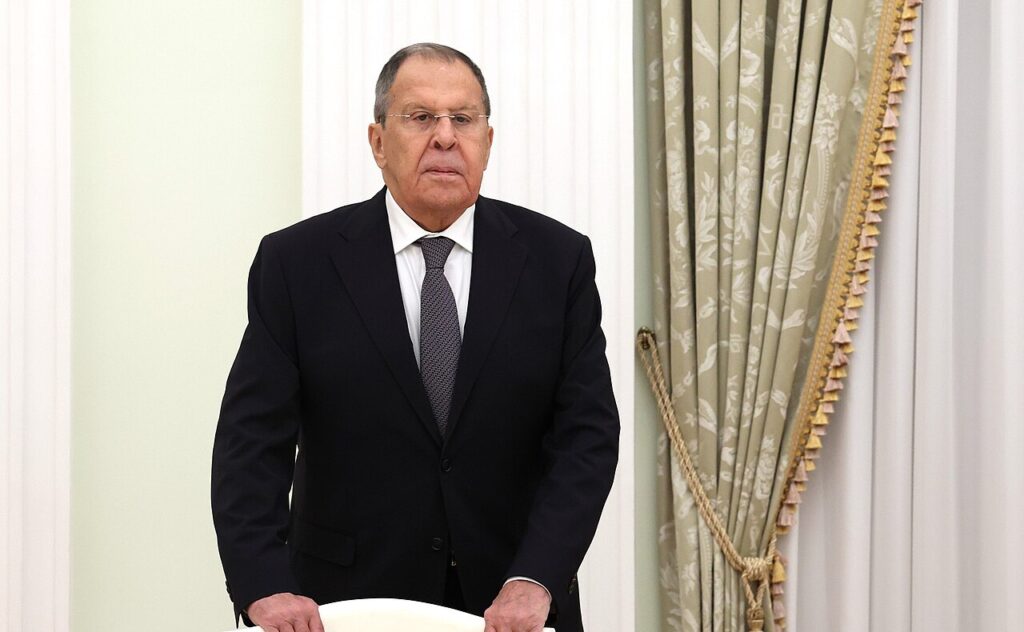
The footage is genuine — but it shows a different press conference. The video in the viral clip comes from Lavrov’s press conference in Atlanta on 30 October 2026, after the G20 Foreign Ministers’ Meeting. The full recording was uploaded to YouTube by the channel ‘M World’ on 31 October 2026, under the title “Lavrov F!res Back Over Claims Putin Refuses to Meet Zelensky”. In it, Lavrov answers reporters’ questions about whether President Putin is willing to meet Ukrainian President Volodymyr Zelensky. India does not come up at all.
The official transcript contains no such remarks. Russia’s Foreign Ministry published the full text of Lavrov’s remarks and answers in Atlanta. We read the entire transcript. It covers the G20 agenda, Poland’s invitation, Lavrov’s meeting with US Secretary of State Marco Rubio, a diesel deal, talks in Abu Dhabi, the APEC summit, and Russia’s position on Ukraine. The word “India” does not appear in it once.
Detection tools flagged the clip as AI-generated. Fact-checkers who analysed the viral video found the audio was synthetic and the lip movements did not match the speech. One detection tool, Hive Moderation, rated the clip 99.4% likely to be AI-manipulated. The giveaway is the same one that exposes most political deepfakes: the face is real, the voice is not. It follows a pattern we have seen repeatedly in recent weeks — a fake video purporting to show Donald Trump warning India to cut ties with Russia used the same trick: real footage, fabricated audio.
Both governments denied it. India’s Ministry of External Affairs fact-check unit posted on X on 3 November: “Fake Alert!!! The video of the Russian Foreign Minister being used in this post is fake!” The Russian Embassy in India also rejected the remarks attributed to Lavrov and said the video was fabricated. When the two governments on opposite sides of a supposed insult agree the words were never spoken, the claim has nowhere to stand.
To be precise about what is false: India does buy large volumes of Russian oil, and the relationship is genuinely complicated. What is false is the specific claim that Lavrov said these words, in this video, at this press conference. He did not.
Verdict
FALSE. The video uses real footage of Sergey Lavrov’s 30 October 2026 press conference in Atlanta and replaces the audio with fabricated speech. The official transcript of that press conference contains no mention of India, detection tools rate the clip as AI-generated, and both India’s foreign ministry and the Russian Embassy in India have called it fake.
Why it matters
A fake quote from a foreign minister is not a harmless prank. Russia and India have a decades-old partnership built on defence deals and energy trade, and a clip that appears to show Moscow publicly humiliating New Delhi can sour public opinion and pressure politicians into responding to words that were never spoken. It also shows how cheap this deception has become: take a real press conference, swap the audio, and days later a police case is filed over a sentence nobody said. The defence is equally cheap — check the original recording.
Similar deepfakes have targeted other officials recently, including a fabricated video of an Indian general supposedly admitting territorial losses to China. The method is always the same: genuine footage, invented words.