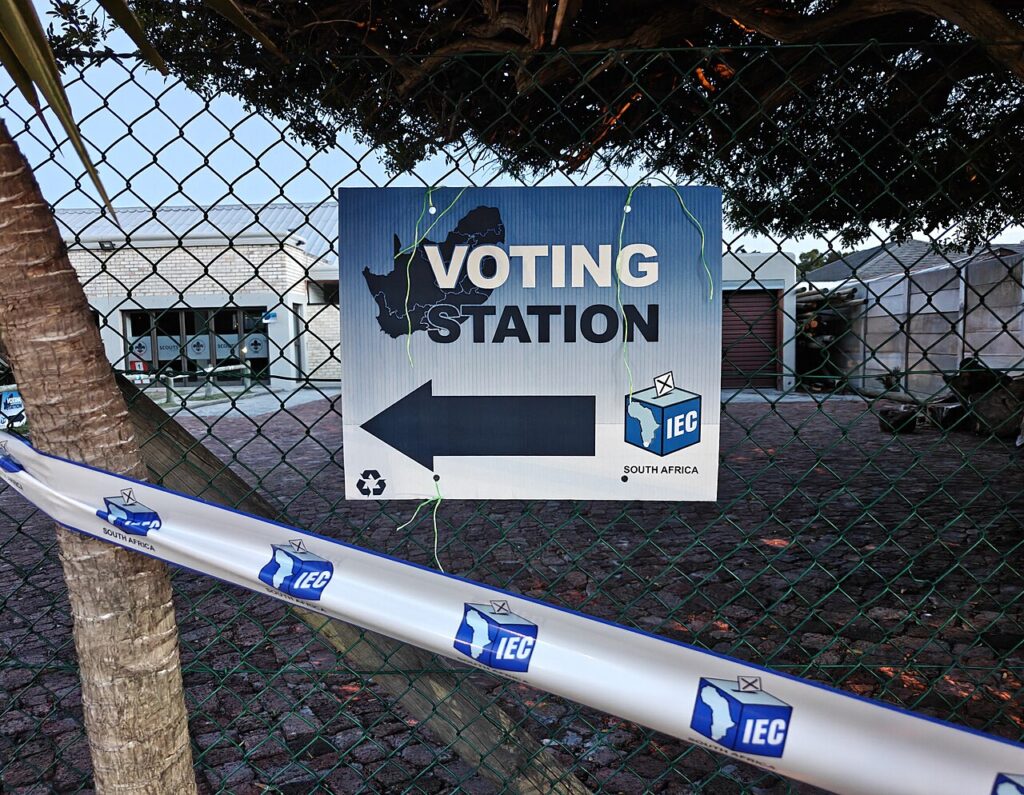
South Africa’s African National Congress, the party that has governed the country since Nelson Mandela led it out of apartheid in 1994, has suffered the worst election result in its history. Final results declared by the Electoral Commission of South Africa (IEC) on Sunday night put the ANC on just 30.76% of the vote in the 2026 local government elections — down almost 15 points from the 45.59% it won in 2021.
The scale of the fall is stark. In 2006, the ANC took nearly 65% of the municipal vote. In the 2019 national election it still won 57.5%. Now, with about 9.16 million votes against 10.70 million five years ago, it has lost more than 1.5 million voters — and with them, control of the country’s biggest cities.
The Democratic Alliance (DA), the liberal party that is the ANC’s main rival and its partner in the national unity government, finished second on 24.64%, up from 21.66% in 2021. Former president Jacob Zuma’s uMkhonto weSizwe (MK) Party, contesting its first municipal election, came third with 9.76%. The Economic Freedom Fighters took 6.22% and ActionSA 5.67%.
No outright majority in a single metro
The ANC failed to win an outright majority in any of South Africa’s eight metropolitan municipalities — the cities where most of the country’s economic life happens. The DA emerged as the largest party in five of them: Johannesburg, Tshwane (Pretoria), Ekurhuleni, Nelson Mandela Bay and Cape Town, where it kept an outright majority with 56.42%.
In Johannesburg, the country’s economic heart, the DA took 34.79% against the ANC’s 20.25%. In Tshwane the gap was similar: 34.37% to 20.22%. The sharpest collapse came in eThekwini, the municipality that includes the port city of Durban, where the ANC fell to 16.46% — down from 61.07% in 2011 — and Zuma’s MK Party led the count with about 41%.
The ANC held on to the lead in only two metros, Buffalo City and Mangaung, and neither result restores anything like its old dominance. Across the country it won outright majorities in 53 of 213 municipalities, while about 130 councils ended up hung — no party in control — compared with 70 after the 2021 vote.
Turnout told its own story. About 14.9 million of South Africa’s 29.2 million registered voters cast ballots, a turnout of roughly 52% — up from 45.9% in the pandemic-hit 2021 elections, and a sign that voters who stayed home five years ago returned to deliver a verdict.
“Catastrophic” — the ANC’s own verdict
ANC secretary-general Fikile Mbalula did not try to dress the result up. He described the outcome as “catastrophic” and acknowledged the party had been punished by voters. It was an unusually blunt admission from a party that, for three decades, treated electoral victory as a birthright.
The IEC declared the elections free and fair, with one exception: results in the Northern Cape town of Douglas were revoked after supporters stormed a vote-counting station and destroyed ballot papers before counting could begin. A revote will be held there.
What happens now is two weeks of coalition bargaining. Parties have 14 days to negotiate before city councils are formed, and with so many hung councils — including Johannesburg, Tshwane and Durban — the horse-trading will decide who actually runs South Africa’s cities. The DA, which governs nationally alongside the ANC in the Government of National Unity formed after the 2024 election, will be negotiating from strength in the metros while remaining the ANC’s partner in Pretoria — an awkward arrangement that will test both parties.
Why this matters
This was a local election, but its consequences reach far beyond town halls. The ANC’s decline is now a clear pattern, not a single bad night: 57.5% nationally in 2019, 40.2% in 2024 — when it lost its parliamentary majority for the first time — and now 30.76% in the municipalities. Each step down has been bigger than the last, and the next national election is in 2029.
For the rest of the world, the result matters because South Africa is Africa’s most industrialised economy and its most watched democracy. A country run increasingly by coalitions — in the metros now, and nationally since 2024 — governs differently: slower decisions, more compromise, and more room for smaller parties to set terms. That is the direction of travel in other democracies too, from New Zealand’s knife-edge election to Israel, where weeks of coalition bargaining follow every close result. South Africa has now joined them.
The immediate question is whether the ANC can recover. Its next elective conference is scheduled for December 2027, and the fight over who leads the party into the 2029 general election starts now — with the party at its weakest in 32 years.
Sources: Reuters; Electoral Commission of South Africa (IEC); Inside Politics; Daily Investor.