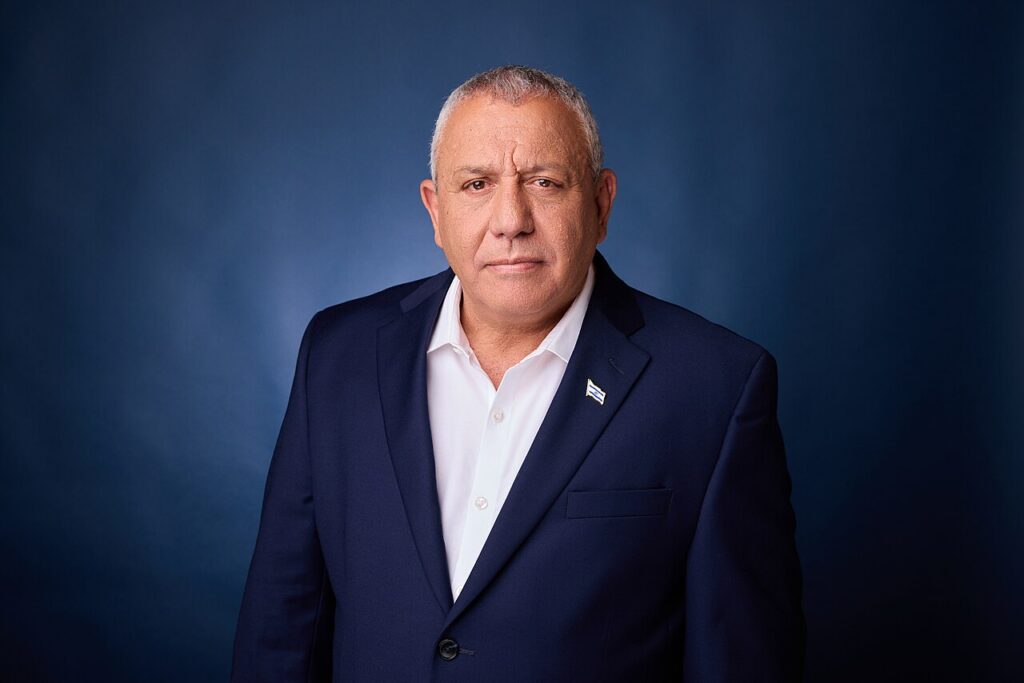
Israel’s president has handed the task of forming the country’s next government to Benjamin Netanyahu’s strongest rival, moving the prime minister — the longest-serving leader in Israel’s history — one step closer to losing office.
President Isaac Herzog chose Gadi Eisenkot, a retired military chief who leads the centrist Yashar party, after two days of consultations with every party elected to the Knesset, Israel’s 120-seat parliament. Herzog’s office announced the decision on Saturday, and the president will formally give Eisenkot the mandate on Sunday.
Eisenkot will have up to six weeks — 28 days, with a possible 14-day extension — to assemble a coalition that can win a confidence vote in parliament. Netanyahu remains prime minister in a caretaker role until a new government is sworn in.
The decision followed an election on October 27 that left neither man with a clear path to power. Netanyahu’s Likud won the most seats of any single party, 27, but his religious-nationalist alliance took only 53 of the 120 seats — short of a majority. Eisenkot’s four-party alliance won 48. Two Arab-led parties won 19 seats between them, a record, and both recommended Eisenkot during the consultations.
When the recommendations were counted, 67 of the Knesset’s 120 members had backed Eisenkot and 46 had backed Netanyahu. Seven recommended neither candidate. The abstention that hurt Netanyahu most came from United Torah Judaism, the seven-seat ultra-Orthodox party that has sat in his coalitions for years. It declined to recommend him after his government failed to pass legislation exempting ultra-Orthodox men from military service.
Herzog said the numbers alone did not settle the question. The recommendations were clear, he said, but “mutual vetoes between the blocs and within the blocs” made it hard to tell who could actually build a government that would hold together.
That warning points to the problem Eisenkot now faces. The 67 recommendations behind him include 19 seats from the Arab-led Joint List and Ra’am, parties he has ruled out bringing into government. Without them, his own alliance holds 48 seats — 13 short of a majority. Winning over the two ultra-Orthodox parties, United Torah Judaism and Shas, would give him exactly 61. Israeli law also allows a government to take office with fewer than 61 seats if it wins a confidence vote, which leaves open the possibility of a minority government relying on support from outside.
Eisenkot served as chief of staff of the Israel Defense Forces before entering politics. His Yashar party urged Herzog to give him the mandate “as soon as possible”, noting that 67 recommendations were the most any candidate has received since 2015.
Netanyahu has disputed the outcome of the October election, but Israel’s Central Election Committee has said the integrity of the vote was not compromised. The new Knesset is due to be sworn in on November 10, when it will also elect a new speaker — an early test of where the balance of power lies.
Why this matters: Netanyahu has led Israel for most of the past 17 years, interrupted only briefly in 2021–22, and a government led by Eisenkot would be the first sustained break with his era. It would also come at a moment when Israel’s alliances are under strain — the United States, its closest ally, has said it will end about $4 billion a year in military aid at the end of 2026 — and while the region is consumed by the war between the US and Iran. At the same time, Israel’s diplomatic standing has been shifting in both directions — Colombia reopened its embassy in Jerusalem in October after two years of broken ties. Whoever governs Israel in the coming weeks will shape its stance in that conflict, its relationship with Washington, and whether the country faces yet another election: if no government is formed, the Knesset is dissolved and voters return to the polls within 90 days.