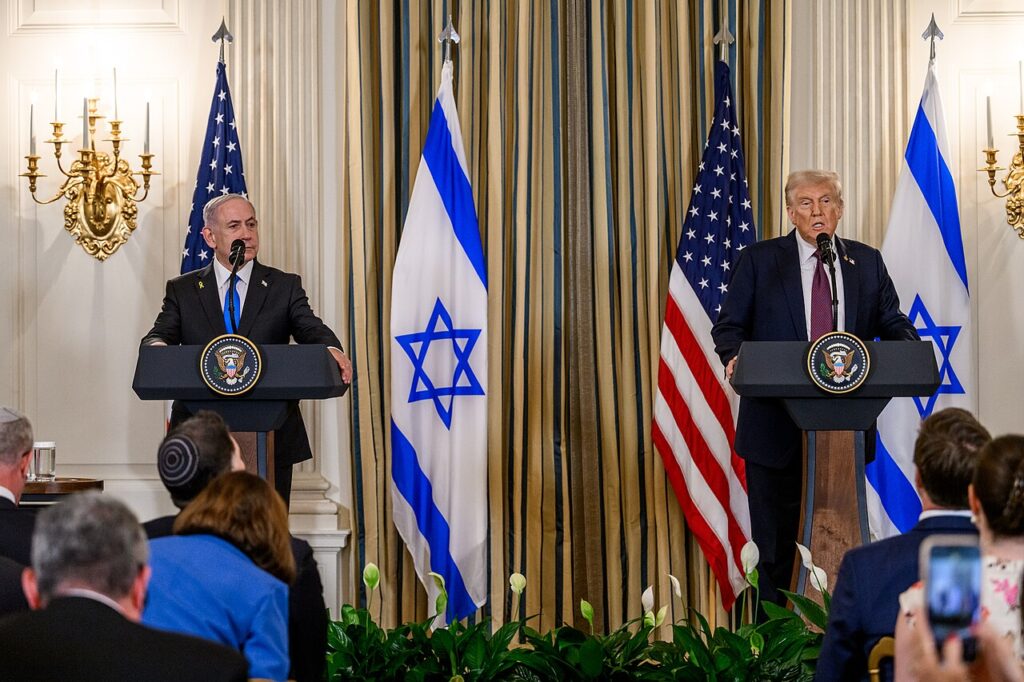
Donald Trump has said the United States will stop giving Israel roughly $4 billion a year at the end of 2026, announcing on the morning Americans voted in the midterm elections that he had already agreed the cutoff with Israeli Prime Minister Benjamin Netanyahu.
“We were giving them $4 billion — we are — but it gets cut off at the end of the year,” Trump told Fox News’ Fox & Friends on Tuesday morning. “They don’t need it. Israel is a very thriving country.”
Pressed on whether he meant military aid or a cash payment, Trump waved the distinction away. “Any way you want to define it,” he said. “You can consider it barter. You can consider military aid or cash. What we give them — $4 billion of things and money — and they don’t need it.”
Under a ten-year memorandum of understanding signed in 2016, the United States provides Israel with $3.8 billion in military assistance a year, covering the fiscal years 2019 to 2028. About $500 million a year of it is earmarked for missile defence, and most of the money is spent on American-made weapons, flowing back to US manufacturers.
Trump said the idea came from Netanyahu himself, and that the two men settled it months ago after talking about it for years. “I was approached by Bibi Netanyahu, and we’ve been talking about it for a couple of years because it’s a lot of money,” he said. “He brought it up.”
Netanyahu has left a trail in public all year. In January he told The Economist he hoped Israel could end its reliance on American military funding within a decade; days before Israel’s October 27 election, he told Channel 10 the aid “won’t keep coming because America has changed, not because Israel has. It’s over and it will be over.” Formal talks on a replacement agreement began in May, though no framework has been published.
What remains unclear is how a cutoff at the end of this year would actually work. The current memorandum runs to 2028, and Trump offered no mechanism — no executive order, no legislation, no revised agreement — for ending it early. He did add two qualifications: Israel will still be able to buy American weapons — “they can buy whatever they want” — and Washington would still help Israel if it needed it. Neither Netanyahu’s office nor the White House has published details of any agreement.
Trump was frank about the politics. He said American support for Israel had become Democrats’ best attack line against Republicans in the midterm campaign, singling out Abdul El-Sayed, the Democratic Senate candidate in Michigan, who has called for banning unconditional military aid to Israel and several other countries. In July, nearly half of House Democrats voted for an amendment that would have cut off aid to Israel through a State Department spending bill; the measure failed with Republican support.
“It’s a bad talking point,” Trump said, “because when you say, ‘Why don’t we give everybody $4 billion?’ Israel’s our number one; we give them more than anybody else, and they no longer need it.”
Reaction inside Israel split along familiar lines. Yair Golan, chairman of the Democrats party, wrote on X that the decision was “a severe blow” to Israel’s security, coming “precisely at a time when Israel’s defence expenditures have reached enormous proportions, when Israel needs to replenish its offensive weapons stockpiles, and when its air defence capabilities have eroded after such a prolonged war.” He warned the cost would now fall solely on the Israeli public.
Washington’s posture toward Israel has already produced sharp breaks this year, from American sanctions on the world’s war-crimes court to Colombia reopening its embassy in Jerusalem after two years of broken ties. But ending the aid would be different in kind: not a sanction or a gesture, but the unwinding of the financial backbone of the alliance.
Why this matters
Israel has been the largest cumulative recipient of American foreign aid since 1946, and the $3.8 billion package is Washington’s biggest standing commitment to any ally’s military. Ending it early would force Israel to fund a war-stretched defence budget out of its own revenues, test its self-reliance, and remove one of the main levers Washington holds over Israeli decision-making. For the rest of the world, the signal matters as much as the money: if Washington will wind down its most entrenched aid relationship in a television interview, with no published replacement, every other aid-dependent ally will be recalculating tonight. The question now is whether an agreement Netanyahu’s office has yet to confirm actually exists, and what replaces the deal that was supposed to run to 2028.
.@POTUS on aid to Israel: “It gets cut off at the end of the year… They don’t need it… Israel is a very thriving country.” pic.twitter.com/iIJbOv2kgU
— Rapid Response 47 (@RapidResponse47) November 3, 2026