The confirmed death toll from Russia’s bombing of a humanitarian aid centre in southern Ukraine has risen to 33, President Volodymyr Zelensky said on Tuesday, as rescuers kept digging for more than 50 people still feared trapped beneath the collapsed shelter.
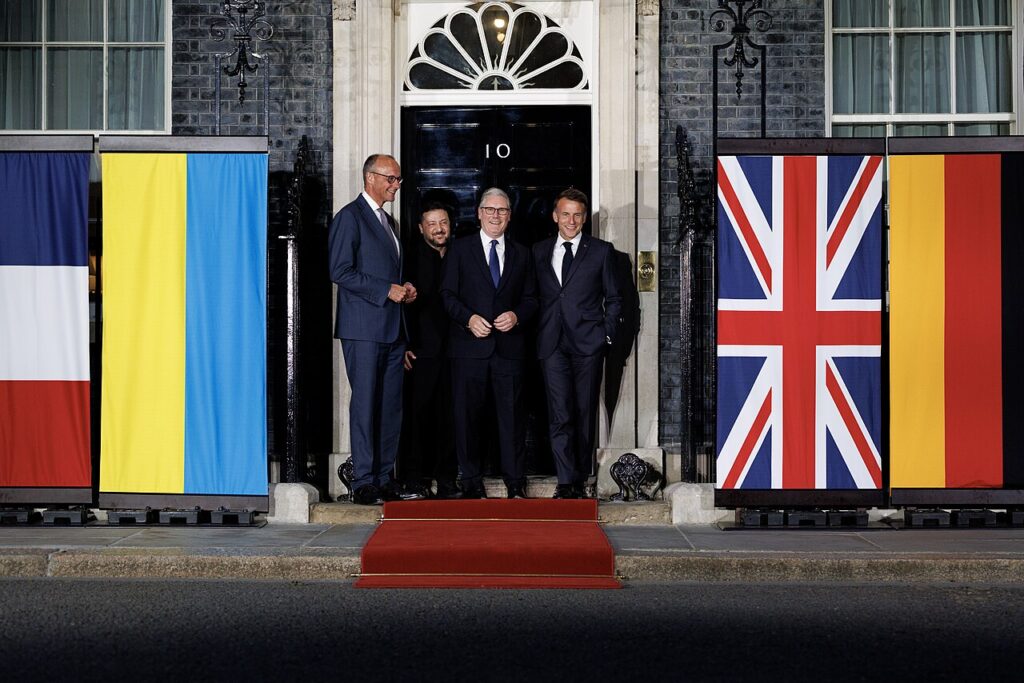
Zelensky gave the new figure at a press conference in Berlin, where he was meeting German Chancellor Friedrich Merz. It is two higher than the toll of 31 reported by regional officials earlier on Tuesday, and it turns what was already one of the deadliest single strikes of the war on a civilian gathering into something worse still.
“Just one strike killed 33 people. Five people were rescued and more than 50 may still be trapped under the rubble,” Zelensky said, describing the attack as “one of the largest Russian killings of this war” and “an exceptionally horrific Russian strike.”
The strike hit the village of Komyshuvakha, in Ukraine’s southern Zaporizhzhia region, on Monday, as local residents gathered at a school building to collect humanitarian aid — a weekly distribution the villagers had relied on as fighting closed in around them. According to Ukrainian officials, Russian forces dropped nine bombs on the site, then struck again precisely where people had sheltered, in a second wave aimed at the basement refuge itself.
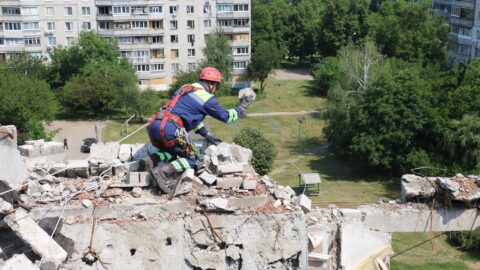
That basement had been built with European Union funding as a reinforced shelter so classes could continue during wartime, and was meant to withstand most strikes. Instead, officials said, the force of the blasts collapsed the concrete structure and set it on fire, burying the people inside.
Among the dead are four police officers and two rescue workers, Denys Konovalenko and Oleksiy Sushchevsky, both 44, who were killed after rushing to the scene of the first strike. Rescue teams have been working through smoke and rubble while Russian drones circle overhead, and officials have warned the toll may rise further as more of the wreckage is cleared.
The update follows a day in which the official count climbed steadily — from 18 dead on Monday night to 31 by Tuesday afternoon — as bodies were recovered from the site. Zelensky’s announcement in Berlin is the first figure to come from the president himself, and it reframes the attack from a regional tragedy into a set-piece of his diplomatic tour: he is in Berlin consulting European leaders ahead of US-mediated talks between Russia and Ukraine scheduled for November 10–11 in Abu Dhabi.
The United Nations Human Rights Monitoring Mission in Ukraine has raised legal concerns about the strike, noting that the timing and location of the aid distribution were well publicised. Its head, Danielle Bell, said the attack appeared to target a known civilian gathering. Russia’s defence ministry, for its part, said its forces had targeted Ukrainian military units deployed around Komyshuvakha and two neighbouring settlements, and claimed up to 25 Ukrainian servicemen were killed. It has not addressed the civilian casualties directly.
The bombing came hours before a huge overnight barrage across nine Ukrainian regions, in which Russia launched 289 drones and dozens of missiles at power plants and other infrastructure, triggering emergency power cuts. Zelensky has pointed to the timing — the strikes coincided with US election day — and used it to press Washington for stronger air defences, arguing that Ukraine cannot protect its cities, let alone its aid queues, without them.
Why this matters beyond Ukraine: aid distribution points are among the few places where civilians in front-line villages still gather in numbers, and a strike on one — especially a repeated strike on the shelter where survivors fled — tests the boundary between warfare and a war crime in full view of the world. Whether the Abu Dhabi talks produce anything more than another round of recriminations may depend on whether attacks like Komyshuvakha are treated as background noise or as the reason the talks exist at all.