The death toll from Russia’s bombing of a humanitarian aid centre in southern Ukraine has risen to 37, officials said on Wednesday, as rescuers entered a third day of digging through the rubble of a village school for dozens of people still unaccounted for.
Mykhailo Semikin, acting head of the Zaporizhzhia Regional Military Administration, gave the new figure on Wednesday. It is four higher than the toll announced a day earlier, and officials warned it could climb further: Ivan Fedorov, co-head of the Zaporizhzhia Regional Defense Council, said 59 people were listed as missing, while regional officials believe as many as 38 could still be trapped beneath the collapsed building.
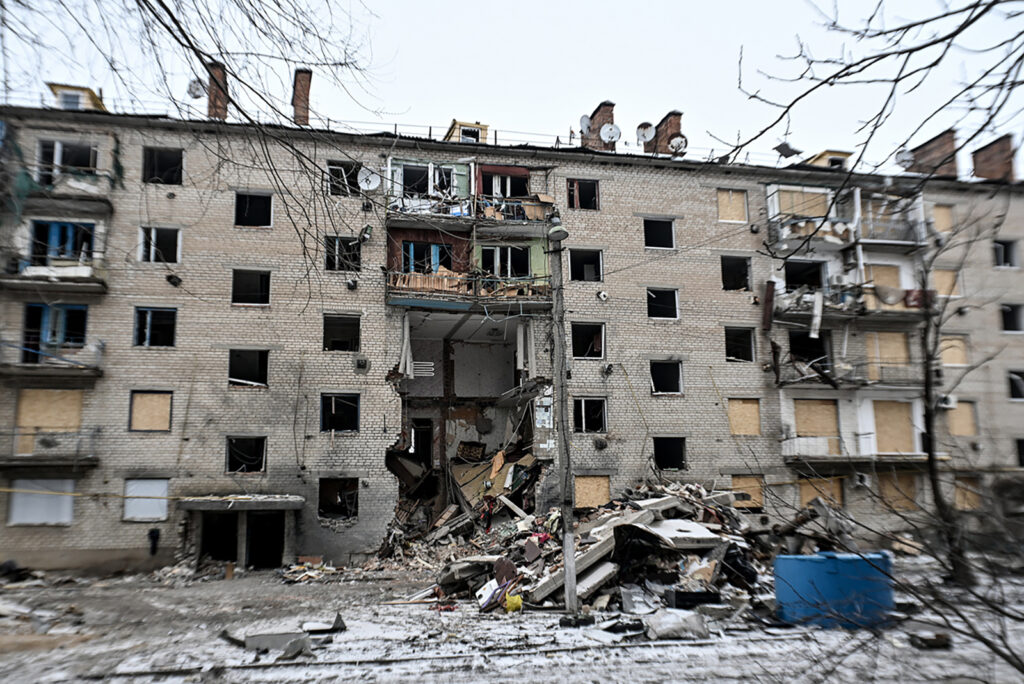
Twelve bodies pulled from the wreckage had been identified by Wednesday, Fedorov said. Rescue crews were still working the site in Komyshuvakha, a village south-east of the city of Zaporizhzhia, close to the front line, picking through concrete where the school’s shelter once stood.
The strike hit on Monday, when residents had gathered at the former school for the weekly distribution of humanitarian aid. Classes at the school had long been suspended because of its proximity to the fighting, but the building still served as a shelter and handed out aid every Monday. Ukrainian officials say Russian aircraft dropped guided aerial bombs on the building as people arrived to collect aid, then struck the shelter itself with more bombs.
Among the dead are two members of a rescue crew and four police officers, emergency services said. They were killed after the follow-up strikes hit the same location while responders were already at work — a pattern that has made rescue operations at the site perilous from the first hours.
The toll had risen to 33 by Tuesday evening, when President Volodymyr Zelensky announced the figure at a press conference in Berlin. Wednesday’s update, reported by Reuters and the Associated Press, moves the count again — from 31 in the first regional reports, to 33, and now to 37 — as more bodies are recovered from the rubble. The full story of how the toll climbed is covered in our earlier updates: the toll reaching 33 and the first reports of the strike.
Russia’s Defence Ministry said its forces had targeted Ukrainian military units around Komyshuvakha and two other settlements, and claimed up to 25 Ukrainian servicemen were killed. That account has not been independently verified, and it does not explain the civilian toll at a site that was publicly known as an aid distribution point. Both Russia and Ukraine deny deliberately targeting civilians.
The United Nations’ top aid official in Ukraine condemned the attack. Matthias Schmale, the UN Resident and Humanitarian Coordinator in Ukraine, said: “Subsequent strikes at the same location killed two rescuers and four police staff who responded to the first attack.” The UN’s human rights monitors have noted that the aid distribution at the school had been highly publicised — the people gathered there were not hidden, and they were not soldiers.
Zelensky has called the strike “one of the largest mass killings committed by Russia during this war.” Semikin has described it as the deadliest Russian strike on the Zaporizhzhia region since the full-scale invasion began in February 2022. Reuters calls it one of the deadliest strikes on civilians anywhere in Ukraine this year.
That is why this toll matters beyond the numbers. Aid distribution points are supposed to be among the few places in a war zone where civilians can gather in relative safety — they are advertised precisely so that people in need can find them. When a known aid site is hit, and then hit again while rescuers are working, it does more than kill the people in the building: it tells every other village weighing whether to queue for food and medicine next Monday that the queue itself may be the danger. If that lesson spreads, the damage is measured not only in the dead, but in the aid that never gets collected.
The strike also lands days before US envoy Steve Witkoff is due to bring Ukrainian and Russian delegations together in Abu Dhabi on November 10-11 to discuss ending the war. Each new civilian toll makes that table harder, not easier, to sit at — and each day rescuers are still pulling bodies from Komyshuvakha is another day the war’s cost is counted in a village schoolyard rather than in a negotiating room.
For now, the search goes on, and the toll is not final. With 59 people still missing and as many as 38 feared under the rubble, Wednesday’s figure of 37 may yet rise again.