Informopedia Explains: On Friday, November 6, Taiwan’s foreign ministry announced it was closing its own office, pulling every member of staff out of Papua New Guinea and cutting off the medical missions, scholarships and training programmes that went with it. The Port Moresby office was never an embassy — which is exactly what makes its closure worth understanding.
Taipei called the move a decision taken “in consideration of national dignity, diplomatic autonomy, and overall national interests.” The blunter version came later in the statement: Papua New Guinea’s actions, the ministry said, “reflect China’s continued use of political pressure and economic influence to interfere in other nations’ diplomatic decisions and suppress Taiwan’s international participation.”
The announcement ended months of friction. In July, Papua New Guinea’s foreign minister said his government had decided to close the office immediately — a move China praised and the United States said it was deeply concerned about. Taipei refused, and the office stayed open. Then Port Moresby renewed the demand with a deadline for the staff to leave. On November 6, Taipei closed it itself — “proactively,” in the ministry’s word — ending the cooperation programmes and halting spot gas purchases at the same time.
Neither Papua New Guinea’s nor China’s foreign ministry immediately responded.
So what is a representative office?
Start with the awkward fact at the centre. Taiwan is a self-governed island of about 23 million people, with its own government, military, currency and elections. China claims it as its territory and insists no country can have formal relations with both Beijing and Taipei. Almost every country has chosen Beijing; only 12 still recognise Taiwan.
That leaves a practical problem. Taiwan does roughly $900 billion a year in trade, and its companies build the chips inside most of the world’s phones and data centres. A country in that position cannot have no presence abroad — so it invented one.
A representative office is the workaround: a mission that does nearly everything an embassy does — visas, help for citizens in trouble, trade talks, scientific and cultural cooperation — without calling itself an embassy. Taiwan runs about 111 of them in 57 countries, under names like Taipei Economic and Cultural Representative Office, or TECRO. The name is the point: almost all use “Taipei” instead of “Taiwan,” because the island’s name would force the host into a row with Beijing. Lithuania broke that rule in 2021, and China downgraded relations and blocked its goods.
The arrangement runs both ways. Countries that recognise Beijing keep a presence in Taipei under equally careful names: the American Institute in Taiwan, the Canadian Trade Office in Taipei, the Japan–Taiwan Exchange Association. None are embassies either. Everyone pretends, politely and precisely, that the building is something slightly less than what it plainly is.
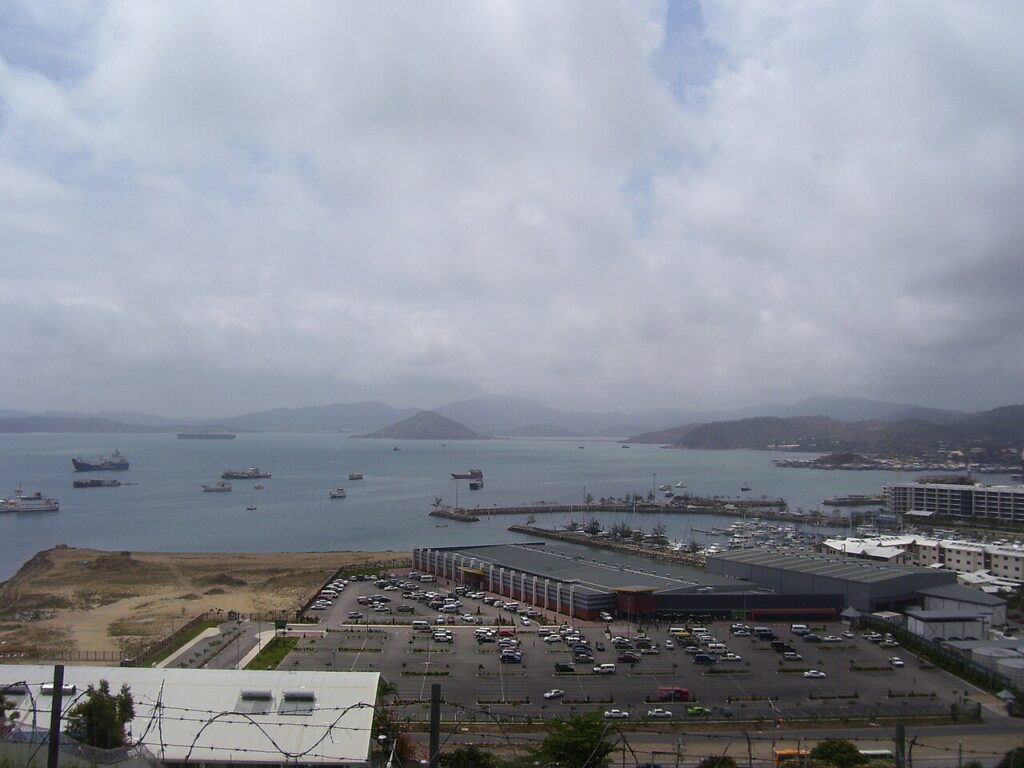
The Port Moresby office worked the same way. Formally the Taipei Economic Office, on paper a trade mission, in practice it was Taiwan’s address in Papua New Guinea — running technical cooperation, medical missions, scholarships and training. Closing it removes the channel through which all of that happened.
Why Papua New Guinea, and why now?
Papua New Guinea is not a random pin on this map. The largest Pacific island nation, just north of Australia, rich in gas and minerals, it sits where China, the United States and Australia compete for influence. It has formal relations with China, like most countries — but for years it also let Taiwan keep its office open. That dual arrangement is precisely what Beijing objects to.
The two sides have history: Papua New Guinea briefly recognised Taiwan in 1999, then switched back to Beijing within weeks. The office survived and carried on for more than two and a half decades. July’s closure order ended the exception; November’s announcement ended the argument.
There is money in the story too. Taiwan had already stopped buying liquefied natural gas from Papua New Guinea on the spot market and will sign no new spot contracts; spot purchases had been planned at about 500,000 metric tons for the first half of 2026. Taiwan takes roughly a third of its LNG exports, the ministry said, warning the change “will inevitably have a substantial impact” on gas exports and foreign-exchange earnings. Taipei has lined up alternative sources. The message cuts both ways: Port Moresby loses a customer, Taipei loses nothing.
Dollar diplomacy: how recognition gets bought and sold
The closure fits a decade-old Pacific pattern. Since 2016, ten countries have ended formal relations with Taiwan for Beijing; in the Pacific, the Solomon Islands and Kiribati switched within a week of each other in 2019, and Nauru followed in January 2024, days after Taiwan’s presidential election.
The mechanism is rarely secret. China offers what Taiwan cannot match: infrastructure spending, grants and loans, packaged as development assistance. Kiribati took a $66 million Chinese grant in 2019, Nauru was reportedly offered around $100 million in aid in 2024, and the Solomon Islands was promised about $500 million. Taiwan says openly it will not try to outbid Beijing — it cannot. Its foreign ministry budget for 2026 is about NT$41.5 billion, roughly $1.35 billion. The scale of the contest is not close.
That is why the remaining Pacific allies matter. Palau, Tuvalu and the Marshall Islands are three of Taiwan’s last 12 formal partners, and all three have faced pressure. Palau’s president has described Chinese envoys offering a million tourists and luxury hotels for switching recognition, and a 2017 tourism ban that halved visitor arrivals. Palau said no. Whether others keep saying no is the open question over every Pacific capital — and Port Moresby is Beijing’s latest evidence that patience and pressure work.
What Taiwan actually loses
It is tempting to treat the closure as symbolic — one small office in a country most readers could not place on a map. The loss is concrete. The medical missions are gone, the scholarships are gone, the training programmes are gone. For the Papua New Guineans who used them, the change is not diplomatic at all: a doctor who no longer visits, a funded university place that no longer exists. Taiwan loses something strategic too: an office is a listening post — contacts and goodwill where Taipei has few friends left. Its other Pacific foothold, an office in Fiji, remains open, but the map is thinning, and every closure makes the next easier for Beijing to demand.
Papua New Guinea pays a price too. A third of its LNG exports went to a buyer that has walked away, and the technical assistance went with it. China may fill some of the gap — that is how this game is played — but its assistance arrives on Beijing’s terms, and it does not come with Taiwanese doctors.
Why this matters
What happened in Port Moresby is a small event with a large meaning. The rules of who gets to be a country are written by recognition, decided by governments weighing money, pressure, fear. Taiwan spent fifty years building a workaround — more than a hundred offices that are embassies in everything but name — and China spent the same fifty years trying to close the loophole. It still works in Washington, Paris and Tokyo. It failed in Port Moresby, where the stakes were lower and the pressure was enough. The lesson for other small countries: the price of keeping Taiwan’s door open keeps rising, and Beijing will wait until a government decides it is not worth paying.
What happens next
Taipei says it will redirect the freed resources to its formal allies and “other regions with potential for cooperation” — places where the welcome is warmer. Watch Fiji, home to Taiwan’s remaining Pacific office, and Tuvalu and Palau, where pressure is most visible. If either wavers, Port Moresby will look less like an isolated row than the start of a run. For Papua New Guinea, the test is whether Chinese investment arrives fast enough to cover the gas revenue and aid programmes that just left. If it does, others will conclude switching costs nothing. And for Taiwan, the long game continues: twelve allies, a hundred-plus offices that dare not speak their name, one less Pacific address — but no intention of going away.
Taiwan’s defence planners, meanwhile, are preparing for a harder version of the same contest: record defence spending aimed at deterring the war diplomacy is meant to prevent.