Informopedia Explains: what happens when a city built by a Hellenistic king, ruled in turn by Romans, Byzantines, Seljuks and Ottomans, decides in the space of a single generation to become the place the whole of northern Europe goes on holiday. On 2 August 2025, 105,284 international tourists arrived in Antalya in a single day — the most the city had ever seen. Two weeks earlier, its airport had handled 1,201 flights and more than 216,000 passengers in 24 hours, one plane landing roughly every 80 seconds. Antalya is no longer a resort town that got lucky. It is a machine for receiving the world, and it was built on purpose.
The scale is hard to overstate. In 2024 Antalya welcomed 17.28 million visitors, a record for the city and an 8 percent rise on the year before, according to the provincial directorate of culture and tourism. The biggest groups came from Russia (3.9 million), Germany (3.5 million) and the United Kingdom (1.6 million). A year earlier, Euromonitor International ranked it the fourth-most visited city on Earth, ahead of Paris, with 16.5 million foreign arrivals. Istanbul is the only Turkish city that draws more people. Antalya’s own nickname, in Turkish, is Turizmin Başkenti — the Capital of Tourism. It is not modesty. It is a job description.
A port older than the empires that ruled it
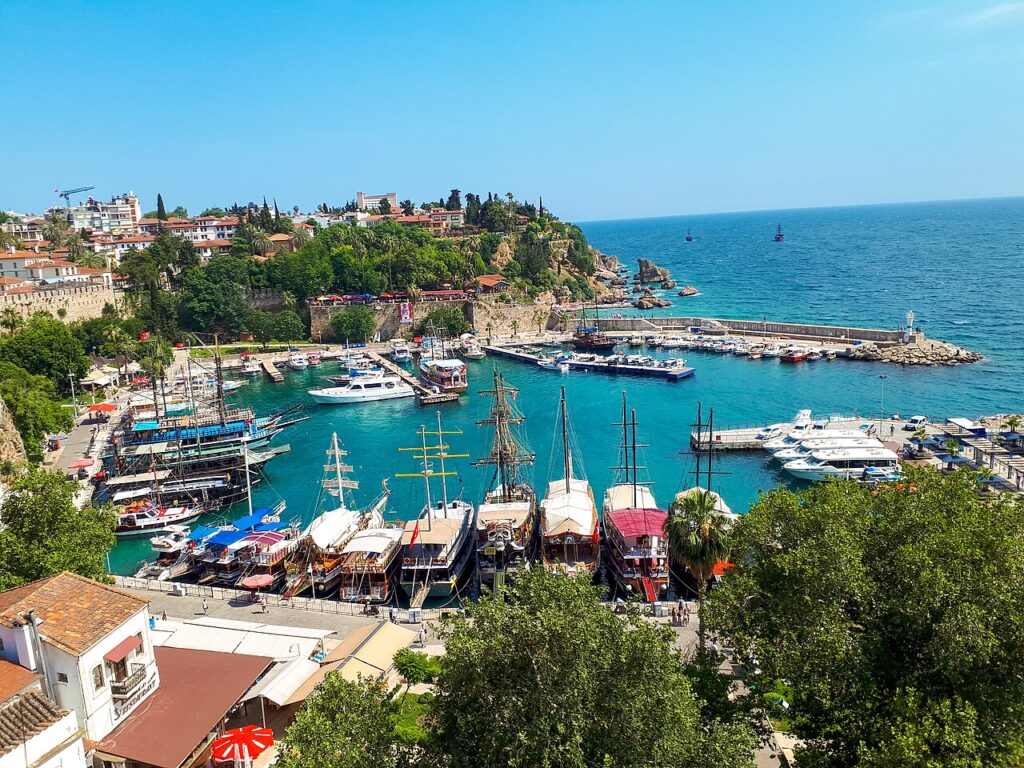
None of this was inevitable. Antalya began as Attaleia, founded around 200 BC by Attalus II, king of Pergamon, as a naval base on a sheltered bay at the foot of the Taurus Mountains. The Romans took it, and the city flourished: Hadrian’s Gate, the triple-arched entrance to the old town, was built around AD 130 to honour the emperor Hadrian’s visit. Around the city, the ancient world left a ring of sites that most countries would build an entire tourism industry around on their own — Perge, Aspendos with its theatre from AD 161–180, Termessos high in the mountains, Side, Myra and Xanthos along the coast.
Walk through Kaleiçi, the walled old town, and the layers stack up within a few minutes: Roman walls, the Hıdırlık Tower, the fluted Yivli Minaret from the 13th century — 38 metres high and on UNESCO’s tentative list for World Heritage status since 2016 — and Ottoman houses turned into small hotels. For most of its history, though, this was a working Mediterranean port of modest size, not a destination. The transformation came late, fast, and by design.
The 1980s bet that changed everything
In the 1980s, Turkey’s government decided tourism would be an engine of the economy, and Antalya was the place to prove it. The state offered incentives and subsidies for developers to build hotels along the beaches east and west of the city, and the model they chose was the all-inclusive resort: flights, transfers, food, drink and entertainment in a single package price, aimed squarely at budget-conscious package holidaymakers from Germany, Britain and Scandinavia. Belek, a fishing village about 30 kilometres east of the city, was rebuilt almost from scratch as a planned resort zone of five-star hotels on a 17-kilometre strip of sand.
The bet had an obvious weakness: a beach resort is empty for half the year. The answer was golf. Belek’s flat coastal plain, pine forest and mild winters made it plausible, and the government set aside land on 99-year leases for courses designed by names like Nick Faldo, Colin Montgomerie and Perry Dye. The first course, the National Golf Club, opened in the mid-1990s. Today the area has 10 golf clubs and 14 courses, 47 five-star hotels and holiday villages, and more than 200 tennis courts, according to the regional development agency BAKA. Belek was named Europe’s best golf destination by the International Association of Golf Tour Operators in 2008 and hosted the Turkish Open in 2013. The season that used to end in October now runs almost all year.
An airport built like a bet on the future
None of it works without the airport. Antalya Airport handled a record 39.2 million passengers in 2025 — up 3 percent on 2024 and 10 percent on pre-pandemic 2019 — its fifth consecutive year of growth, despite losing significant traffic from its two biggest markets, Russia and Ukraine. The operator, Fraport TAV Antalya Airport, has spent more than €865 million on the airport in the last three years, and the expansion completed in April 2025 lifted annual capacity to 65 million passengers — the scale of a European mega-hub, for a city of about 2.7 million people in its metropolitan area.
That capacity is the point. Antalya’s growth was never really about a beach. It was about logistics: an airport that can absorb a plane every 80 seconds at peak, a coastline of resorts within an hour’s transfer, and a price point that undercuts Spain and Greece for the same sun. Germany remains the largest source market by passenger numbers, and the airport now connects to more than 230 destinations in over 50 countries. When the city hosts the COP31 climate summit this month, the delegates will land at an airport that was rebuilt, in large part, to keep the holiday machine running.
Why this matters
Antalya is a case study in how a place can be deliberately engineered into a global destination — and in what that engineering costs. Tourism now dominates the local economy to a degree few cities of its size can match: when Russian arrivals fell after the invasion of Ukraine, and when German bookings wobbled, the whole province felt it within weeks. The 2025 numbers show the city has spread its risk — Britain, Poland, Kazakhstan and the Netherlands all send large numbers now — but two countries still account for more than four in ten visitors. A destination built on package holidays is a destination exposed to exchange rates, geopolitics and the holiday budgets of northern Europe.
There is a quieter pressure too. Seventeen million visitors a year in a city of under three million people means water demand, waste, traffic and a coastline where resort strips keep pushing into farmland and pine forest. The golf courses that solved the winter problem are thirsty by design. And the heat that makes Antalya attractive is itself rising: the Mediterranean is warming faster than the global ocean average, and the summers that draw the crowds are getting longer and hotter. The city that markets roughly 300 days of sunshine a year will have to manage the summers that sunshine now brings.
What happens next
The plan, for now, is more of the same — only bigger and less seasonal. The airport’s 65-million capacity is headroom for growth the city has not yet used, and the tourism authorities are pushing culture, archaeology, health tourism and winter golf to fill the months the beach cannot. The COP31 summit in Antalya this November is part of that pitch: a city that wants to be seen as more than sunbeds. Whether it works will show up in the same numbers that built the story — not just how many people arrive in August, but how many come in February, and from how many countries. Antalya spent forty years learning how to receive the world in summer. The next test is whether it can keep the world coming all year.
For the background on the summit itself, see our earlier piece on COP31 opening in Antalya.