Informopedia Explains: why the driest place on the planet outside the poles is suddenly pink, yellow and purple as far as the eye can see — and what seeds that slept for decades can tell us about a changing climate. Moisés Grimberg has spent 18 years managing protected land in Chile, the last three running Llanos de Challe National Park on the Atacama coast. This spring he has been walking through something he has never seen in his career: a desert floor covered in wildflowers, in places where no flower has ever been recorded growing before.
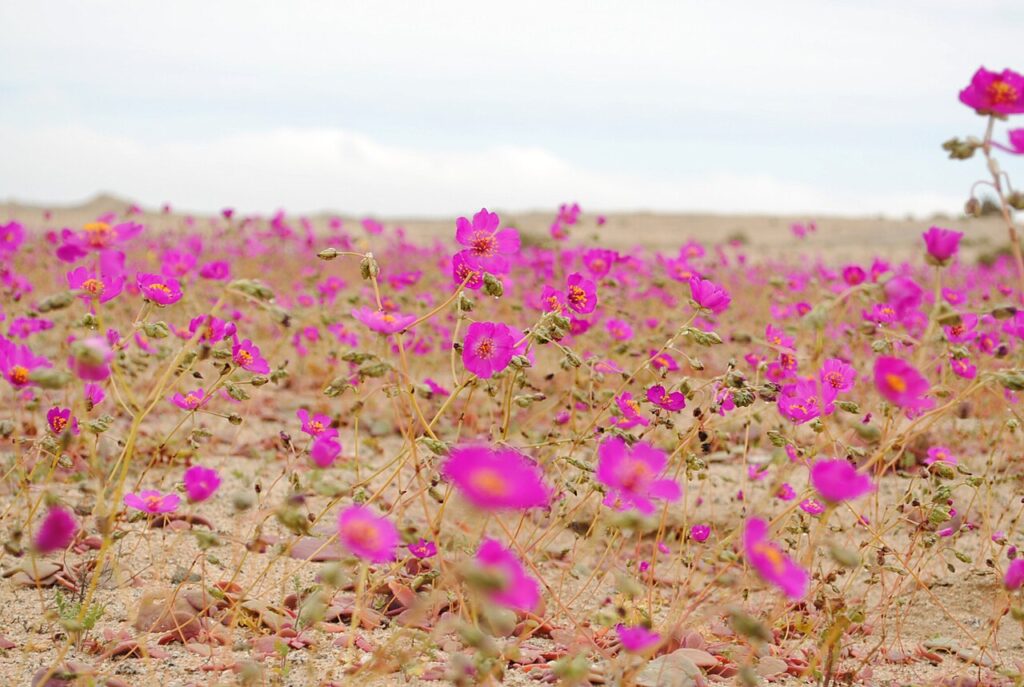
The Atacama Desert in northern Chile is the driest nonpolar desert on Earth. Parts of it can go years without a measurable drop of rain, and its bone-dry soils are so barren that space agencies have used them to test equipment meant for Mars. Yet this year, nearly 7,000 square miles of it are carpeted in flowers. Chile’s National Forest Corporation says it is the desert’s most spectacular flowering in almost 30 years — and it may be the biggest ever seen.
A winter that broke the desert’s own rules
The story starts with rain that should not have fallen, at least not in these amounts. Heavy winter rain linked to the El Niño cycle swept across the Atacama in July and August 2026, setting off flash floods. In some areas it was the heaviest rainfall since records began in the 1950s. Grimberg puts the scale of it plainly: more than 150 millimetres of winter rain fell in his part of the desert, something the region had not seen since 1997.
That number matters because of what rain does in the Atacama — or rather, what it usually fails to do. A light shower wets the top few centimetres of soil and evaporates within days. This winter’s water sank deeper than it has in decades, reaching the buried layer where the desert keeps its real treasure: millions of seeds, bulbs and tubers that have been sitting dormant underground for years, in some cases for decades, waiting for exactly this kind of soaking.
El Niño is the same Pacific climate pattern that has been pushing global temperatures to records in recent years. Readers who want the background can find it in our earlier explainer on how El Niño drove temperature records before its peak. What happened in the Atacama is the other side of that coin: the same warm Pacific waters that heat the planet can also dump extraordinary rain on places built to survive without it.
The seed bank under your feet
A desert bloom — the Desierto Florido, or Desert Bloom — happens every few years in the Atacama, whenever the rain is heavy enough. What makes this one different is scale and surprise. More than 200 species are in flower at once: pinks, yellows, lilacs and purples spread across the craggy desert floor. Among them is the Garra de León, or lion’s claw, an endemic plant with crimson flowers and flame-like green leaves that grows nowhere else on Earth.
Scientists studying the bloom have found patches of desert flowering where flowers were never previously recorded. That suggests the bulbs beneath them had been lying dormant since before the phenomenon was first studied in detail in 1997 — nearly 30 years underground, waiting out drought after drought. The desert, it turns out, is less a dead place than a vault. Its seeds are a living archive, and a single wet winter is the key.
The plants are on a deadline. Each one has roughly two to three months to complete its whole life cycle — grow, flower, set seed — before it dries out and drops its seeds back into the soil. The display is expected to fade by mid-November. Biologists from INIA, Chile’s national seed bank, are out in the field now collecting specimens to analyse in the laboratory before the season ends, trying to learn whether any of the plants now flowering are species never recorded in the region before.
A national park built for a flower show
Chile saw this coming, in a sense. In June 2023 the country created Llanos de Challe National Park, a 113,000-acre reserve along the arid coastline where white-sand beaches meet the Pacific, specifically to protect the ground where the flowers return every few years. It was an unusual piece of foresight: a national park designated not for a mountain or a forest, but for an event that might not happen for years at a time.
That protection is being tested by the bloom’s success. Thousands of visitors have travelled to northern Chile to see it, and a carpet of flowers is fragile in ways a forest is not — a single footstep can crush the seed bank a plant spent years building. Park staff are trying to steer visitors onto paths while still letting them see the show. Miguel Vargas, governor of the Atacama region, has gone further: he is beginning the process of seeking UNESCO World Heritage recognition for the desert bloom phenomenon, a bid that would put a fleeting, rain-driven event on the same list as permanent monuments.
Why this matters
A flower show in a desert is easy to file under pretty curiosities. It is more than that. The Atacama bloom is a live demonstration of how climate works at the edges — not as a slow average warming, but as a lurch: years of nothing, then a season that breaks every record in the book. Scientists studying the phenomenon say such blooms could become more frequent as climate change makes weather more unpredictable, with unseasonal rains arriving in places built for drought.
That cuts both ways. More blooms would mean more chances for the desert’s hidden seed bank to renew itself — and more chances for scientists to study plants that have evolved to survive decades of drought, knowledge that matters for agriculture in a warming world. But the same unpredictability that brings the flowers can also bring the flash floods that tore through the desert this winter, and a bloom that arrives at the wrong time, or too often, could exhaust seeds that need long quiet stretches to build up their numbers.
What happens next
The flowers will be gone within weeks. What remains is the science: INIA’s laboratory analysis of the collected specimens, and the longer question of whether this was indeed the most extensive flowering in almost 30 years, or something without precedent. The UNESCO bid will take years, if it proceeds at all. And the desert will go back to looking dead — which is the point. The Atacama never was dead. It was waiting, as it has waited for decades at a time, for the sky to change its mind. This winter, for the first time in a generation, it did.