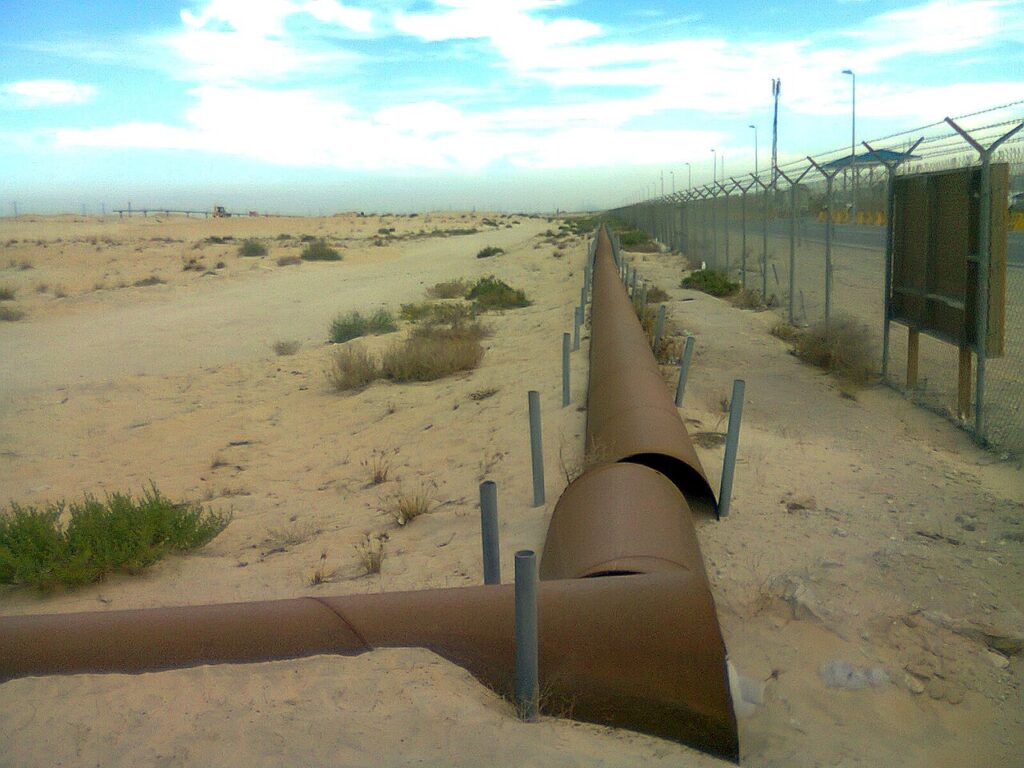
Saudi Arabia said on Monday that its East-West crude oil pipeline was attacked in the Medina region, causing a limited fire that emergency crews extinguished. No one was hurt, and the pipeline kept pumping, the Energy Ministry said — but the strike hit the kingdom’s main workaround for the blocked Strait of Hormuz.
An official at the ministry told the state-run Saudi Press Agency that the pipeline had been targeted on Monday, and that the fire was brought under control without any injuries or deaths. “Pipeline operations were unaffected,” the report said.
The ministry did not say who was responsible, and no group had claimed the attack by the time the statement was carried by Saudi state media. It also did not say whether a drone or a missile was used — or whether the strike hit a pumping station or the pipe itself, a distinction that matters because pumping stations take considerably longer to repair than a breached section of line.
The kingdom’s Hormuz bypass
The East-West pipeline, also known as Petroline, runs about 1,200 kilometres from Abqaiq in the Eastern Province to Yanbu on the Red Sea. Saudi Aramco rates its capacity at seven million barrels a day, and about 5.8 million barrels a day were flowing through it in October.
Since the war with Iran largely closed the Strait of Hormuz to Gulf shipping, the line has become Saudi Arabia’s main route to market. Loadings at Yanbu have averaged above four million barrels a day since June, against fewer than one million a day a year earlier.
That is what makes Monday’s attack significant even though nothing stopped flowing. It is the second time the line has been hit in two months: drone attacks forced a shutdown of the same pipeline in September. The Houthis claimed drone strikes on pumping stations along the line on October 24 and October 26, but Riyadh never confirmed those claims. Monday’s statement is the first time the kingdom has publicly acknowledged a strike on the pipeline since September.
A week of fire on western Saudi Arabia
The pipeline attack caps a week in which the war has pressed hard on the kingdom’s west. On November 5, Saudi civil defence issued emergency alerts for Yanbu, the Red Sea oil hub, and the coalition said its air defences had destroyed a ballistic missile fired toward the Medina region. On November 8, debris from missiles intercepted over Riyadh damaged the Aramco Tower in Riyadh‘s financial district. On Monday, the coalition said it had destroyed a missile factory and a solid propellant plant in Houthi-held territory.
The Houthis, for their part, said on Monday that they had targeted King Khalid International Airport and facilities belonging to Aramco, and their media said the death toll from weekend Saudi strikes on a village in Sanaa province had climbed to 44, including more than 20 children. The group also said 103 airstrikes had hit areas under its control.
Saudi Arabia has faced near-daily strikes from the Houthis for weeks, since a truce in their long-running conflict unravelled in July. The Houthis have repeatedly targeted Saudi oil infrastructure with drones and missiles, and the fighting intensified after they advanced in September toward the Bab el-Mandeb Strait, the chokepoint at the southern end of the Red Sea.
Why it matters
With the Strait of Hormuz effectively closed, the East-West pipeline and Yanbu are now the two pillars of Saudi oil exports — and both sit within reach of Houthi missiles and drones. Crude piped west from Abqaiq avoids Hormuz, but tankers loading at Yanbu must still sail south through Bab el-Mandeb, past Houthi-held Yemen, to reach Asian buyers.
A strike that shut the pipeline, or a blockage at Bab el-Mandeb, would squeeze both of the kingdom’s remaining export routes at once — pushing up oil prices, freight rates and insurance costs across the region. Monday’s attack did none of that. But the fact that Riyadh confirmed it at all, after weeks of silence about earlier pipeline claims, suggests the kingdom now expects the line to be hit again.