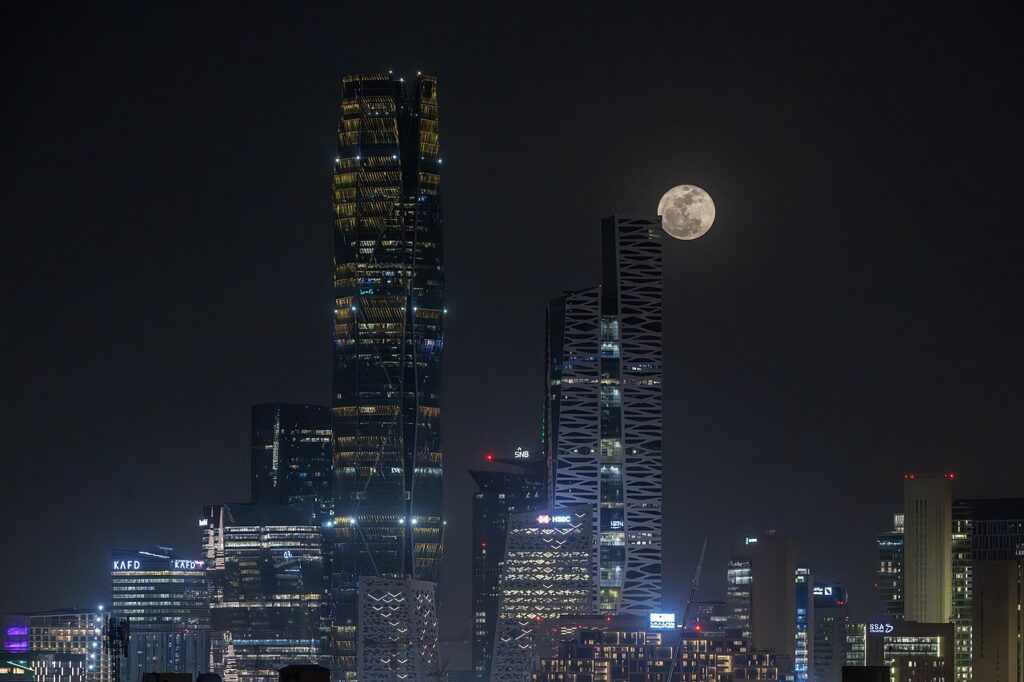
Loud explosions rolled across Riyadh before dawn on Sunday, and by mid-morning Saudi Arabia had confirmed what residents could already see from the streets below: the Aramco Tower, the oil giant’s office block in the capital’s King Abdullah Financial District, had windows blown out across several floors.
The damage came from falling debris, not a direct hit. Saudi air defences had intercepted the missiles overhead, and it was the wreckage that rained down on the tower, one of the tallest buildings in a district of glass towers built as the showcase of the kingdom’s economic reform plans.
Saudi Arabia’s Energy Ministry described the incident as an attempted attack on an administrative building belonging to Aramco. In a statement carried by the Saudi Press Agency, an official source said the building “was subjected to an attempted attack” and that “falling shrapnel caused minor damage to the building, with no injuries or fatalities reported.” The ministry added that the relevant authorities had responded promptly and taken the necessary measures. Aramco itself did not immediately comment.
The Saudi-led coalition said its air defences had intercepted two ballistic missiles fired by Yemen’s Houthis toward Riyadh, and destroyed two cruise missiles over the capital and the southern region. The coalition later said it had also brought down a drone heading for the south. Saudi civil defence had issued an early-warning alert for the Riyadh region shortly before residents heard the blasts, and later announced that the danger had passed. Warnings were also issued and then lifted in the oil-rich Eastern Province, including Dhahran, where Aramco has its headquarters.
The Houthis said the strikes were retaliation. Their military spokesman, Yahya Saree, said on Saturday that the group had carried out six missile and drone operations against Saudi targets, including King Khalid International Airport and Aramco oil facilities in Riyadh, the Khurais oil field and a pumping station at Dawadmi, as well as military positions in Najran, al-Jawf and Marib. He claimed the operations had “successfully achieved” their objectives and alleged casualties among Saudi military personnel, claims that have not been independently verified. The Houthis issued no immediate claim of responsibility for Sunday’s attack itself.
Sunday’s attack came a day after Saudi airstrikes near the Yemeni capital, Sanaa, killed 33 people, including 13 children, according to Yemen’s Houthi-run health ministry. The Houthis blamed Riyadh for those deaths and said their campaign against the kingdom would continue for as long as Saudi airstrikes and the blockade on Houthi-held territory go on.
The exchange is the latest turn in a war that has flared back to life. The Houthis, an Iran-aligned movement that has controlled Sanaa since 2014 and fought a Saudi-led coalition since 2015, have stepped up missile and drone attacks on Saudi airports, ports and oil facilities since fighting resumed in July, shattering a 2022 United Nations-brokered truce that had largely held. An attack on Riyadh’s King Khalid International Airport on 10 October killed 13 people and wounded more than 300, according to Saudi authorities, and Aramco’s headquarters in Dhahran was damaged in an attack in October.
The immediate disruption from Sunday’s attack was limited. Nobody was hurt, no halt to oil operations was reported, and the tower’s damage was confined to its facade. But the geography of the attack is the story. The King Abdullah Financial District is the physical symbol of Saudi Arabia’s attempt to build a post-oil economy, and Aramco is the world’s largest oil company. Missiles reaching that district, even ones that are shot down, tell the markets and the region that the war in Yemen can now touch the centre of Saudi economic power. It also comes as the United States extends its pressure campaign on Iran, the Houthis’ backer, from the sea onto land, standing up a new task force to choke off Tehran’s supply routes. Each side is raising the stakes, and the space for the truce that held for three years keeps shrinking.
For now, both sides are counting the same exchange differently. Riyadh points to its interceptors and an empty casualty list. The Houthis point to a tower with its windows blown out in the capital’s financial district and promise more. What is not in dispute is that the missiles reached Riyadh, and that the war both sides had paused is now being fought in the open again.