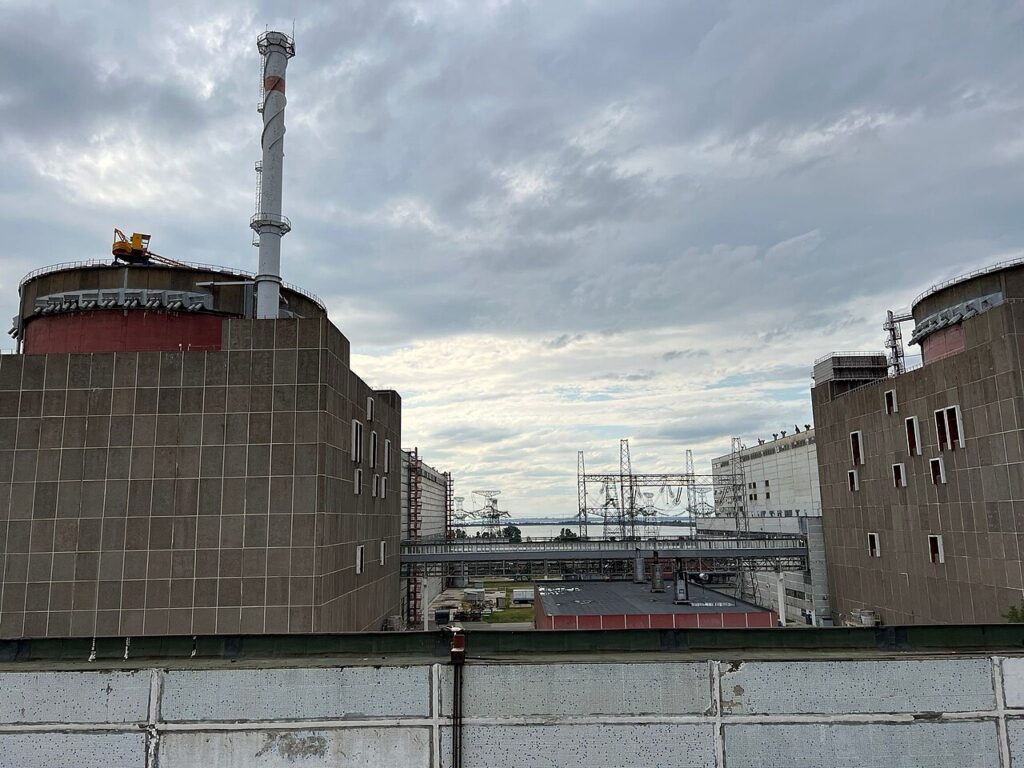
Europe’s largest nuclear power plant lost its last connection to the electricity grid in the early hours of Sunday, leaving its six shut-down reactors and spent fuel pools to be cooled by emergency diesel generators.
The 330-kilovolt Ferosplavna-1 line — the plant’s only remaining link to the grid — went offline at 02:36 local time on 8 November. An automatic attempt to reconnect it failed, and the cause of the outage has not been reported. The Russian-installed management of the plant said its protective systems had disconnected the line because of damage.
Backup diesel generators started as designed and are now powering the equipment needed to keep the plant safe, the management said in a statement posted on the Russian state-backed messenger app MAX. Radiation levels at the site and in the surrounding surveillance zone were normal, it added.
Ukraine’s state nuclear operator, Energoatom, said this is the 16th time the Zaporizhzhia plant has completely lost external power since the start of 2026, and that the blackouts are becoming more frequent. “Operating in blackout mode creates a direct risk of failure of the life-support and nuclear fuel cooling systems if the diesel generators fail or their fuel runs out, which could lead to a radiation accident,” the company said.
The plant, on the occupied southern bank of the Dnipro river in south-eastern Ukraine, has been under Russian control since the first weeks of the full-scale invasion in February 2022. All six of its reactors have been in cold shutdown since that year and it generates no electricity — but the fuel inside them, and in the spent fuel pools, still needs constant cooling, and that cooling runs on electricity. Drones hit two facilities at the plant in October, killing one worker, and the surrounding region has come under repeated attack.
A team from the International Atomic Energy Agency (IAEA) is permanently stationed at the plant. In its latest update on Ukraine, published on 6 November, the agency said the plant had been relying on that single external line, and warned that diesel supplies there “remain critically important for nuclear safety”. The IAEA has not been told of any diesel delivery to the site since March 2026. “Stocks must be increased ahead of winter, both to strengthen the plant’s ability to cope with further losses of off-site power and to maintain suitable temperatures for personnel and equipment,” the agency’s director general, Rafael Mariano Grossi, said.
The IAEA team at the plant has been told the site holds enough fuel to run a limited number of its emergency diesel generators for two weeks, Reuters reported. No timeline has been given for restoring the line.
Sunday’s blackout is not the first time the plant has had to live on its generators. In August and September it ran on diesel for 18 days after losing the same line, cutting back from seven running generators to two to stretch the fuel, and at times running its cooling pumps only intermittently. Power was restored on 7 September only after Ukrainian technicians repaired the line under a local ceasefire brokered by the IAEA. The agency said in October that the plant had already lost off-site power 10 times since June alone.
Repairs are rarely quick. The other main line into the plant, the 750-kilovolt Dniprovska line, has been down for months, and the IAEA says attacks on the Dniprovska substation have made reconnecting it harder. Each repair needs technicians to reach damaged equipment on or near the front line, which has repeatedly required a locally agreed halt in the fighting. Zaporizhzhia city itself was hit by glide bombs last month, a reminder of how exposed the whole area remains.
Why this matters: a reactor in cold shutdown still produces heat. The fuel in its core and in the spent fuel pools needs water circulating over it, day and night, for years after the reactor stops generating power. Cut that cooling for long enough and the water heats, evaporates, and exposes the fuel. That is why the IAEA treats every loss of off-site power at this plant as a serious event, even when the generators work as designed: each blackout burns through a finite stock of diesel that has not been replenished since March, and each one narrows the margin between a managed outage and a station blackout. With winter approaching, that margin matters more, not less — the plant also needs diesel to heat its buildings and to treat radioactive wastewater.
For now, the plant is stable, the generators are running, and radiation levels are normal. The open questions are how long the line stays down and how much diesel is left when it comes back. Restoring it will almost certainly need the same ingredients as last time: repair crews willing to work near the front line, and a pause in the fighting long enough to let them. The IAEA says it is still pushing for a local ceasefire to repair the Dniprovska line as well. Until both lines are back, Europe’s largest nuclear plant will keep hanging on a single cable — and, when that cable fails, on its diesel tanks.