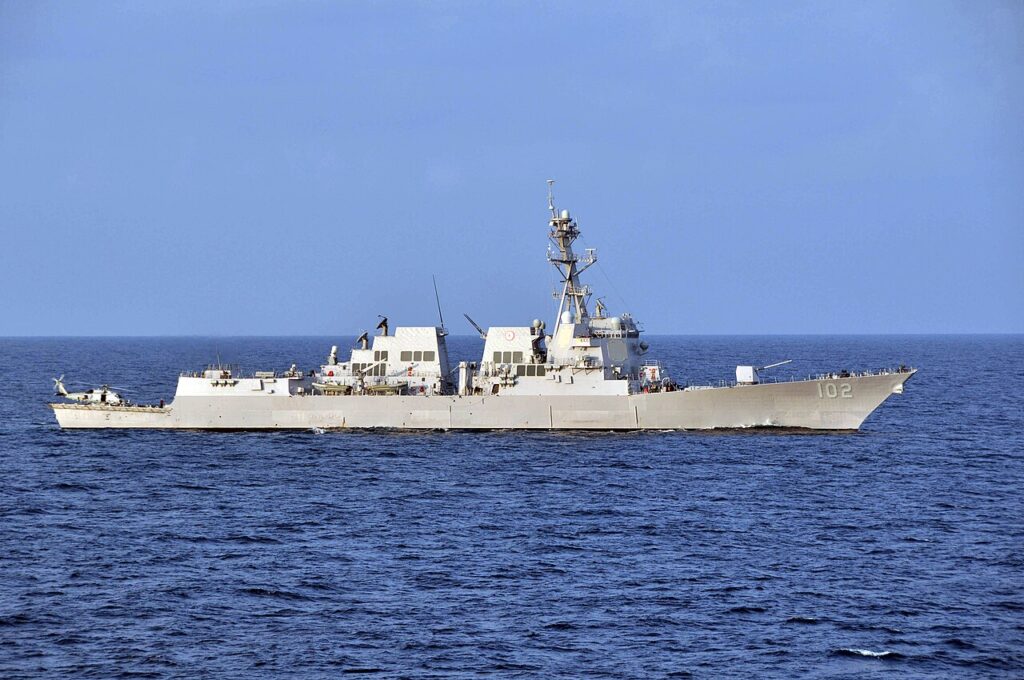
For months, the war between the United States and Iran has been fought mostly at sea: a naval blockade around the Strait of Hormuz, tankers seized or sunk, oil piling up in Iranian ports. On Saturday, Washington moved the fight onto land.
US Central Command, known as CENTCOM, announced a new unit — Task Force Iron Gate — whose job is to stop Iran using ground routes to move advanced weapons and other materials. The 20-member task force will, in the words of CENTCOM commander Admiral Brad Cooper, reinforce “the success of our ironclad blockade against Iran at sea”. It is the clearest sign yet that Washington believes Tehran has been working around the naval blockade, and intends to close the loophole.
The sea blockade is already biting hard. CENTCOM says it has bottled up $25 billion worth of Iranian crude oil. On Saturday, a US warplane disabled the cargo vessel Huda in the Gulf of Oman after the ship ignored warnings and tried to leave the region after visiting an Iranian port — the fifth vessel disabled in the blockade, and the first confirmed strike on a cargo ship in nearly a month. Britain’s maritime trade agency says at least 11 ships have been attacked in and around the strait over the past week, and three have sunk.
The escalation is running in both directions. Iran’s state media reported the sound of explosions on Qeshm Island on Saturday evening, and in the port cities of Jask, Sirik and Bandar Abbas. The cause was not immediately clear, and the US military did not immediately respond to questions. A day earlier, President Donald Trump confirmed that American forces had carried out limited strikes on an Iranian air-defence site on Qeshm, saying the system had been knocked out in about 15 minutes. Iran’s Revolutionary Guard said late on Saturday that two oil tankers had struck mines near the strait and caught fire, and that the vessels had tried to transit a route Tehran had not authorised.
What makes Iron Gate different is what it implies about the war’s direction. A naval blockade can be evaded by land — through Iraq, through the Gulf states’ back roads, through the smuggling networks that have moved goods across the region for decades. A task force dedicated to ground routes suggests the Americans have intelligence that Iran is doing exactly that, moving the weapons and components the sea blockade was meant to stop. It also suggests the conflict is settling into something longer and more grinding than the exchange of strikes: a slow strangulation, fought as much by logistics officers as by pilots.
Diplomacy, meanwhile, has not stopped. Qatar’s prime minister, Mohammed bin Abdulrahman Al Thani, said mediation between Washington and Tehran remained active and that the US was still willing to seek a solution. A reported proposal would have the US lift the Hormuz blockade and release some frozen Iranian assets, while Iran allowed international nuclear inspectors back into its bombed nuclear sites. Neither side has confirmed the terms, and nothing has been agreed. Iran, for its part, has spent the week signalling defiance rather than concession: it dropped its self-imposed 2,000-kilometre missile limit and vowed to prove the new reach on the battlefield.
The question now is whether the blockade — sea and land together — can force a deal before the shooting escalates further. The pattern of the last week says both sides are still raising the stakes: new strikes, new task forces, new red lines. The strait that carries a fifth of the world’s seaborne oil has already seen oil surge past $100 a barrel. If Iron Gate works as intended, Iran’s options narrow. If it does not, the war finds a new road — and a new front.


One Comment