Iran’s Revolutionary Guard said on Saturday that it has lifted a self-imposed limit of about 2,000 kilometres on the range of its ballistic missiles — ending a restraint that has shaped Tehran’s arsenal for nearly a decade, and signalling that weapons able to reach deeper into Europe may now be on the table.
Brigadier General Hossein Mohebbi, spokesman for the Islamic Revolutionary Guard Corps (IRGC) — Iran’s powerful parallel military force, separate from the country’s regular army — made the announcement at a press conference in Tehran marking the force’s Aerospace Week.
Asked whether the Supreme Leader’s latest directive meant the range limit was gone, Mohebbi answered plainly: “This restriction has been lifted for us.” But he added a caution of his own. Iran, he said, must demonstrate any expanded capability in practice rather than merely announce it. “Our duty is to show our capabilities on the battlefield,” he said.
The cap dates from 2017, when it was set by then-Supreme Leader Ali Khamenei as a deliberate ceiling. At 2,000 kilometres — about 1,240 miles — Iranian missiles could already reach Israel and every American base in the Gulf, as well as the eastern edge of south-eastern Europe. The limit was widely read as reassurance to European governments that they would not be targeted. Lifting it removes that reassurance.
The announcement followed an order from the current Supreme Leader, Mojtaba Khamenei, for an immediate and effective response to any threat “without geographical limits”. According to Tasnim, the Iranian news agency that first reported the remarks, Khamenei also ordered a comprehensive review of the military’s target lists to cover the assets of the United States and Israel.
Mohebbi went further in the same appearance, saying the Guard would prepare for a change in Iran’s nuclear doctrine if the leadership ordered one. That is a conditional statement, not a decision — and it stops well short of any announcement that Iran intends to build a nuclear weapon. But in a week when Washington and Tehran have been trading blows, even a conditional warning lands heavily.
The timing is no accident. The announcement comes amid stalled talks between the United States and Iran and a sharp escalation around the Gulf. American forces have struck Iran’s Qeshm Island in the Strait of Hormuz, and Iranian forces have claimed a string of mine and drone incidents against tankers passing through the waterway that carries a fifth of the world’s seaborne oil. A BBC investigation published on Friday, drawing on satellite imagery, found excavation or construction under way at two Iranian missile sites and signs of repair at at least a dozen other military installations.
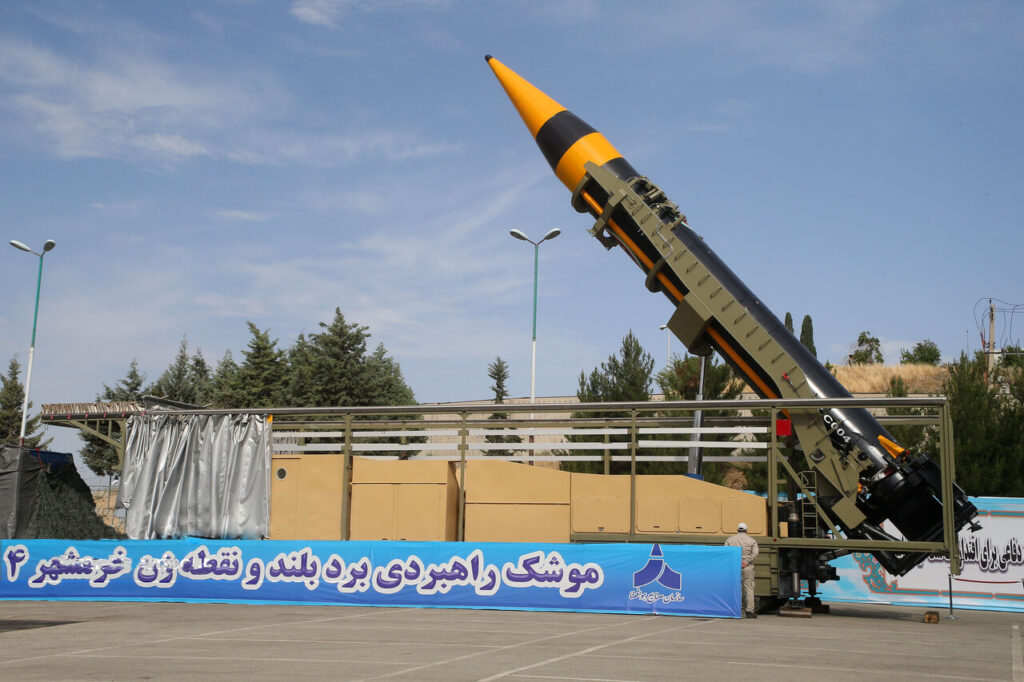
What remains unproven is whether Iran actually has missiles that can fly farther than 2,000 kilometres. No such weapon has been publicly demonstrated, and several of Iran’s longest-range systems — the Khorramshahr and the solid-fuelled Sejjil — were built to the old ceiling. Mohebbi’s own insistence that the capability must be shown, not stated, is a tacit admission of that gap. His claims of advances in air defences and underground missile production, including the downing of enemy aircraft and drones, could not be independently verified.
Why this matters beyond Iran: for Europe, the announcement redraws a line that has held since 2017. A missile that can fly 3,000 kilometres from western Iran reaches Berlin, Paris and London — and European capitals will now have to plan as if that were the direction of travel, whether or not the hardware exists yet. For the Gulf states and the tens of thousands of American troops stationed there, it is a reminder that the conflict already under way around the Strait of Hormuz could widen without warning. And for diplomacy, the move reads as leverage: Tehran is telling Washington that every strike on Iranian soil will be answered by an Iran with fewer self-imposed limits than the one it faced a week ago.