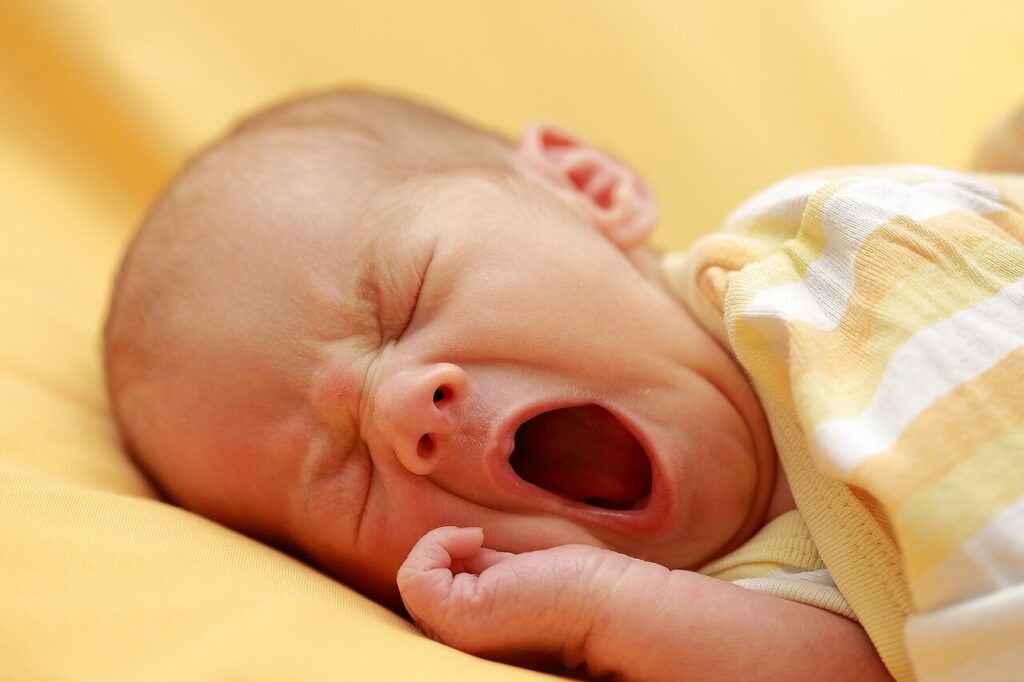
Informopedia Explains: you are going to yawn while reading this article. Not maybe — probably. The odds are roughly even that the mere mention of yawning, let alone a description of one, will set one off within the next few minutes. That is the first clue that yawning is stranger than it looks. It is a reflex you cannot control, that spreads from person to person like a rumour, that babies perform before they are born — and that science, after more than a century of study, still cannot fully explain.
The average person yawns somewhere between 5 and 20 times a day. Each one lasts about five seconds: the jaw stretches wide, the eyes water, a deep breath rushes in, and then it is gone, leaving you fractionally more awake than you were. We yawn when we are tired, when we are bored, when we wake up, when we are nervous before an exam, and sometimes for no reason at all. The question is why any of that should trigger the same elaborate piece of choreography — and what the choreography is for.
The oxygen story is wrong
For most of the twentieth century, the standard answer was simple: you yawn to take in extra oxygen. Your brain is tired, oxygen is low, a yawn tops it up. It sounds plausible, and it is wrong. In 1987, the psychologist Robert Provine and his colleagues tested it directly, having volunteers breathe pure oxygen, carbon-dioxide-rich air and ordinary air. None of it changed how often they yawned. Exercise intense enough to double breathing rate had no effect either. Yawning and breathing, the experiment showed, are controlled by separate mechanisms entirely. The oxygen theory has been dead for nearly forty years. It just never got the memo in most classrooms.
Your brain has a radiator
The explanation with the strongest support today is stranger and more elegant: yawning cools your brain. The idea, developed most forcefully by the psychologist Andrew Gallup, is that the wide jaw stretch increases blood flow to the skull and face, while the deep inhalation draws cooler air past the nasal cavity and sinuses — which sit close to the brain’s blood supply. The yawn works, in effect, like flushing a radiator.
The evidence comes from several directions. In one study, rats fitted with temperature probes showed their brain temperature rising by about 0.11°C in the seconds before each yawn, then dropping by up to 0.5°C in the minute after — a small study, only four rats contributed yawning data, but the pattern was exactly what the cooling theory predicts. In human experiments, people sitting in warm air wanted to yawn about 85% of the time and yawned roughly three times more often than people in cooled conditions. And yawning has a thermal window: it works best when the air is cooler than the body. When the air outside is as hot as you are, a yawn cannot cool anything; when it is freezing, no cooling is needed. In both extremes, yawning drops off.
That also explains why yawns cluster where they do. Fatigue and drowsiness come with small shifts in brain temperature as the brain switches between states — waking up, getting sleepy, losing focus. The yawn, on this account, is not a symptom of tiredness. It is the brain’s attempt to reset itself toward its optimal temperature as it changes gear. The hypothalamus, the small structure deep in the brain that regulates temperature, hunger and sleep, is where the reflex originates, with dopamine helping to drive the chain of events.
Why yawns spread
Then there is the contagion. Roughly 40 to 60% of people will yawn within a few minutes of watching someone else yawn — or reading about it, or even thinking about it. The phenomenon shows up in humans, chimpanzees, bonobos, wolves and dogs, and dogs can catch a yawn from watching a human.
Brain imaging points to the mirror neuron system, a network that fires both when you perform an action and when you watch someone else perform it. Watching videos of people yawning lights up the right inferior frontal gyrus, a region tied to motor empathy — the ability to physically feel what someone else is doing. Contagious yawning emerges in children around the ages of four to six, at the same time as self-awareness and the understanding that other people have minds of their own. Children younger than four rarely catch yawns. And it spreads most easily between people with close emotional bonds — family, friends, even pets and their owners.
It is tempting to turn that into a simple test of empathy: catch a yawn, prove you care. The research is more cautious than that. How easily a person catches yawns stays remarkably stable over time, and recent studies find that empathy explains only a small part of the differences between people. Some of us are simply yawn-catchers and some of us are not, and nobody fully knows why. People catch fewer yawns as they get older, but age explains only about 8% of the variation. The rest is still a mystery.
When yawning means something is wrong
Most yawning is harmless — the brain doing routine maintenance. But yawning far more than usual, especially alongside drowsiness that will not lift, is worth mentioning to a doctor. Certain medications, sleep disorders and, rarely, neurological conditions can drive excessive yawning, and it is one of those symptoms that is easy to dismiss for months. The line between a reflex and a warning sign is simply a matter of frequency.
What remains remarkable is how much of the ordinary this reflex contains. A yawn is a temperature gauge, a state-change signal and a social broadcast all at once — a piece of behaviour so old that it predates birth itself, and so deeply wired that no amount of willpower can stop it. Hiccups, the body’s other involuntary reflex, have a similarly tangled story, and what dreams are actually for turns out to be just as unsettled. The body, it seems, keeps its oldest habits the most mysterious — and the yawn, five seconds of stretched jaw and stolen breath, is the one you notice every single day.