Informopedia Explains: the USS Theodore Roosevelt has just joined two other American carriers near Iran — the first time three have been in the region since April. But what is an aircraft carrier, really? Not a ship with planes on it. A floating airbase, a small city and a statement of intent, all welded into one hull.
Picture the problem first. A fighter jet needs a runway of around two kilometres to take off and land. A warship is a few hundred metres long. The entire history of the aircraft carrier is the engineering answer to that mismatch — and the answer turns out to be one of the most complex machines humans have ever built.
The runway that moves
A modern American carrier, like the Roosevelt, is a Nimitz-class ship: roughly 333 metres long, displacing around 100,000 tonnes, powered by two nuclear reactors that let it sail for more than twenty years without refuelling. About 5,000 people live aboard, including the air wing. It carries 60 to 70 aircraft.
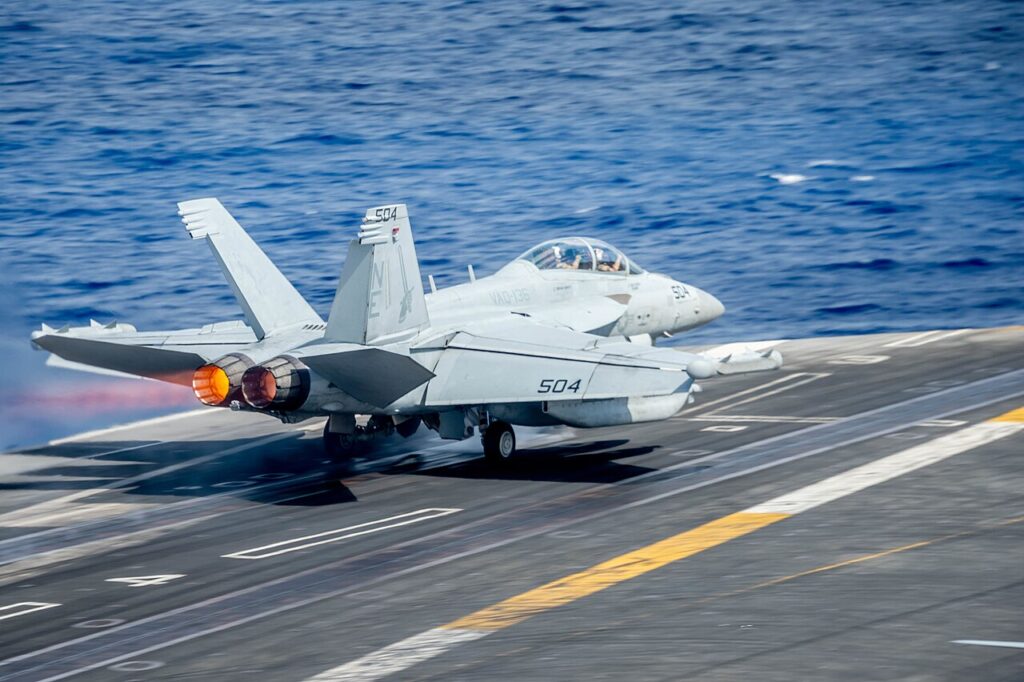
Getting a 30-tonne jet airborne from a deck barely 300 metres long takes a catapult. A steam or electromagnetic catapult grabs the aircraft’s nose gear and hurls it from zero to around 260 kilometres per hour in about two seconds — faster than a Formula 1 car, with the pilot pressed into the seat at several times their own body weight. Landing is the reverse trick: the jet catches one of four steel arresting wires stretched across the deck with a hook on its tail, and is yanked from 240 km/h to a stop in about 100 metres. Miss the wires and the pilot must immediately throttle up and go around — there is no gentle second chance on a carrier deck.
The deck itself is angled, so that aircraft landing and aircraft taking off do not share the same strip of steel. It works, but only because several hundred sailors in colour-coded jerseys — yellow for aircraft handlers, red for ordnance, green for catapult crews, purple for fuel — choreograph every launch and recovery like a ballet performed next to spinning jet engines.
The strike group: the carrier never sails alone
A carrier by itself is a big, slow target. So it never sails alone. It travels at the centre of a carrier strike group: a guided-missile cruiser, two or three destroyers, sometimes an attack submarine below, and a supply ship trailing behind with fuel, food and ammunition. The escorts carry the Aegis air-defence system, which can track hundreds of targets at once; the submarine hunts other submarines; the destroyers shoot down incoming missiles. The carrier provides the aircraft; the group provides the shield.
That shield matters because carriers are not invulnerable. They are slow to turn, they cannot hide, and in an age of long-range anti-ship missiles — the subject of our explainer on how hypersonic missiles actually work — admirals argue constantly about whether the carrier’s day is ending. So far, no navy has found a better way to put air power anywhere on Earth within days, without asking any other country for permission to use its airfields.
Three carriers, one message
That last point is why the number matters. One carrier in a region means the US can fly missions there. Two means it can fly them around the clock. Three — the Roosevelt joining the George H.W. Bush and the George Washington near Iran — means it can sustain a full air campaign, absorb damage, and still keep flying. It also means something that has nothing to do with engineering: intent. Moving a carrier takes weeks of planning and costs millions of dollars a day. You do not send three of them by accident.
Carriers are, in the end, diplomacy with a flight deck. They let a country threaten war without starting one, reassure allies without signing a treaty, and park a small air force off a coastline — in the Strait of Hormuz or anywhere else — while the politicians decide what happens next. The Roosevelt’s arrival tells Iran, and everyone watching, that the option to use force is real, crewed and already in position. What it does not tell anyone is whether it will be used.