Benjamin Netanyahu stood near the ruins of the Tulkarm refugee camp on Tuesday and promised that the Israeli military would remain in control of the West Bank — “from the Jordan River to the sea” — on the same day Israeli forces raided Palestinian NGO offices, entered a hospital courtyard, and wounded a child and several journalists in Ramallah.
The prime minister’s video statement, released by his office after a tour of the West Bank “seam zone” with Defence Minister Israel Katz and senior military commanders, was his bluntest yet on the territory’s future. “There will be no Arab army west of the Jordan River; there will be the IDF,” Netanyahu said. “The one who will control this territory and remain in it is the IDF.”
He was speaking directly to an Israeli High Court order from Sunday requiring the government to provide a timetable for measures enabling displaced Palestinians to return to the Jenin, Tulkarm and Nur Shams refugee camps. More than 33,000 Palestinians remain displaced from those three camps after Israeli military operations that began in January 2025, according to the United Nations. Netanyahu rejected the premise outright, calling the camp’s displaced residents terrorists rather than residents and vowing that displaced Palestinians would not return to Tulkarm, which he described as a terrorist stronghold cleared by IDF troops.
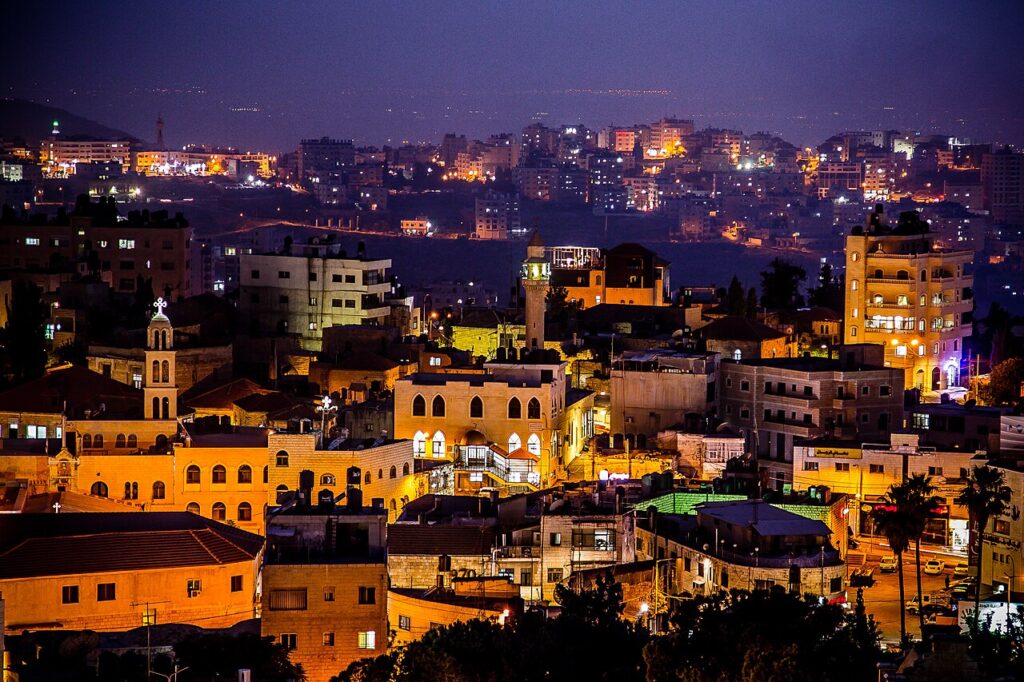
The timing was pointed. Netanyahu’s visit came less than two weeks before Israel’s October 27 elections, and he used it to warn Israel’s adversaries against attacks during the campaign. It also landed on the same day Israeli forces carried out one of the most disruptive West Bank operations in recent memory — in Ramallah, the seat of the Palestinian Authority.
On Tuesday, Israeli forces searched the offices of the Addameer Prisoner Support and Human Rights Association and the Union of Palestinian Women’s Committees in central Ramallah, seizing documents, furniture and equipment. Soldiers entered the courtyard of the Palestine Medical Complex — the West Bank’s largest government hospital — and deployed snipers around its entrances, according to the Palestinian news agency Wafa. AFP journalists filmed soldiers loading office equipment onto a trailer attached to a military vehicle outside Addameer’s former headquarters. The operation lasted nearly four hours.
The Palestinian Health Ministry said a 14-year-old boy was hit in the upper thigh by live ammunition and a young man took a serious gunshot wound to the lower back; several others suffered tear-gas suffocation. Four journalists were caught in the operation: Palestine TV correspondent Khaled Mattawa was wounded in the hand by a sound bomb and Sky News Arabia correspondent Firas Lutfi in the leg by shrapnel, Wafa reported, while four photojournalists were detained in Hebron. The Israeli army did not respond to AFP’s request for comment.
Israel shut Addameer’s office in August 2022 along with six other Palestinian civil society groups after designating several organizations as terrorist entities in 2021 — a move critics say relied on evidence withheld from the groups and their lawyers. Al Jazeera’s Nida Ibrahim, reporting from Ramallah, described the raid as “yet another step to undermine the Palestinian Authority.”
Netanyahu leaned into that framing himself. He said Israel was preparing for a scenario in which Palestinian Authority security forces — which have coordinated with Israel on West Bank security for years — turn their guns against Israel, and warned that any such move would be met with overwhelming force.
In Gaza, meanwhile, the ceasefire that began in October 2025 kept fraying. An Israeli airstrike on a vehicle in the Tuffah neighbourhood of Gaza City killed one person and wounded several on Tuesday, emergency services told Al Jazeera. A four-year-old boy, Osama Ahmed Abed, died of wounds from an attack three weeks earlier in az-Zawayda, central Gaza, Wafa reported. More than 74,382 Palestinians have been killed in Gaza since October 7, 2023, and at least 1,400 since the truce began. Al Jazeera’s maps show nearly two-thirds of the territory now under Israeli military control or subject to access restrictions, with troops seizing more ground beyond the “Yellow Line” set under Donald Trump’s 20-point ceasefire plan.
Why this matters: Netanyahu’s statement does three things at once. It publicly rules out the return of more than 33,000 displaced Palestinians in defiance of his own country’s highest court. It converts the West Bank security question from one of Palestinian Authority cooperation into one of permanent Israeli military control — “from the Jordan River to the sea” is language with a long political afterlife. And it arrives days before an election, which is when such promises tend to stick. The Ramallah raids show what that control looks like in practice: NGO offices emptied, a hospital courtyard entered, journalists wounded for covering it. The West Bank is increasingly being run as a front, not an administration.



3 Comments