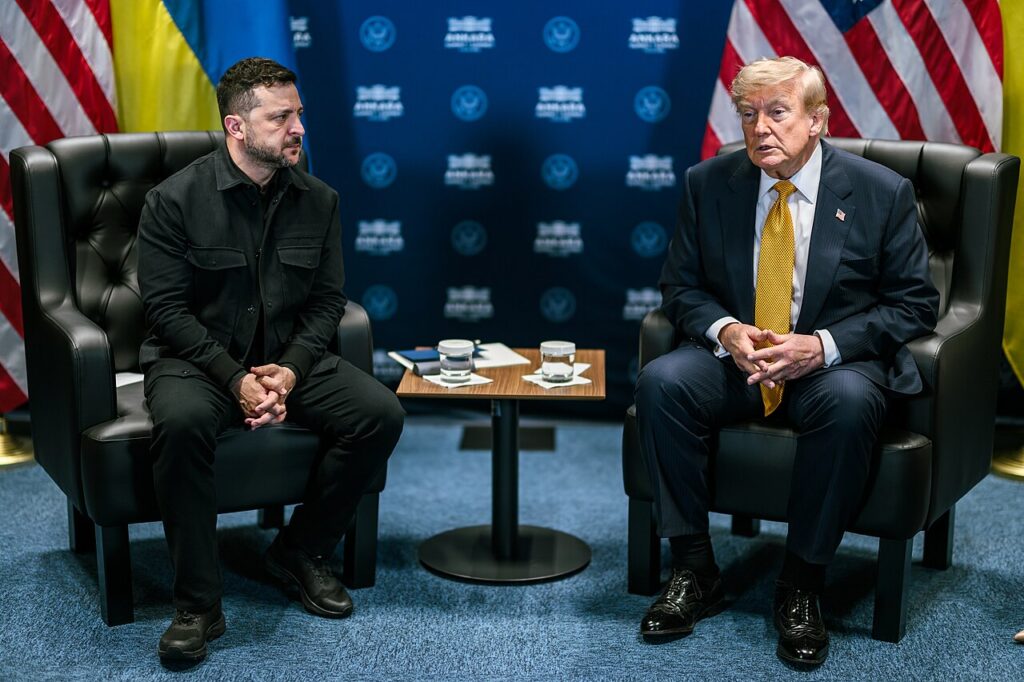
Volodymyr Zelensky delivered his bluntest public criticism of Washington yet on Monday, telling a visiting delegation of American senators that recent US decisions on Ukraine — delayed arms shipments, unexplained limits on satellite communications, and missed missile warnings — are “hard to explain.”
“Because it all comes down to [Russian President Vladimir] Putin’s refusal to end this war, and to decisions on the American side that are hard to explain between friends,” Zelensky said, in remarks that marked the sharpest rupture yet between Kyiv and the Trump administration.
Speaking directly to the US lawmakers, Zelensky said the Pentagon is holding up missile deliveries that Ukraine’s European partners have already paid for under the PURL programme — the Prioritised Ukraine Requirements List, a scheme under which NATO allies fund weapons purchases from American stockpiles for Kyiv. One missile package, he said, is sitting on a desk waiting for the signature of US Defense Secretary Pete Hegseth.
“We also know that, unfortunately, the Pentagon is delaying the delivery of missiles that our partners have already paid for through the PURL programme. All of this suggests that some political decision has been made to slow down support for us.”
The missiles that “could already be in Ukraine”
Zelensky added a detail with immediate practical stakes: several European countries are ready to transfer Patriot interceptor missiles from their own stockpiles to Ukraine — and are only waiting on Washington’s approval.
“The missiles are ready, and they could already be in Ukraine,” Zelensky said, according to remarks released by the Ukrainian presidency. “But unfortunately, there is still no approval.”
The shortage matters on the ground. Russia has been pummelling Ukraine’s cities and energy grid through the autumn, and Kyiv’s air-defence batteries are burning through interceptors faster than they can be replaced. This weekend’s attack on Kyiv — 16 ballistic missiles and 269 drones overnight — came with no advance warning at all, the second such blind night in a week.
Three missed warnings — and the Starshield cap
Zelensky told the senators that on three occasions in the past week, Ukraine received no early warning of incoming Russian attacks — warnings its Western partners normally provide. He said Ukraine has also never received a full explanation for limits placed on Starshield, the military-grade version of Elon Musk’s Starlink satellite system, which Ukrainian units use to guide interceptor drones against Russia’s jet-powered Shahed drones.
The restrictions cap satellite connectivity for equipment moving faster than about 160 kilometres per hour, a limit that effectively grounds Ukraine’s fastest interceptor drones — the very weapons built to chase down the jet-powered threats. Washington has said no changes were made to intelligence sharing; Secretary of State Marco Rubio has publicly insisted “there has been no pause.” Zelensky’s Monday remarks make clear Kyiv does not believe that account.
A 30-day offer: refineries for Patriots
Alongside the criticism came a concrete proposal. Zelensky said Ukraine is willing to halt its strikes on Russian oil refineries — the campaign Trump has publicly blamed for pushing up American fuel prices — for 30 days, if Washington supplies the Patriot interceptors Kyiv needs to defend its cities.
The offer connects the war’s two pressure points. Trump, facing midterm elections next month, has accused Ukraine’s refinery campaign of squeezing fuel supplies and raising prices at the pump. Zelensky is now offering to trade that leverage directly for the defensive weapons Washington has been slow to deliver: stop hitting Russia’s refineries, and Kyiv’s own cities get the air defences they are missing.
Norway next
Zelensky said he hopes a Ukrainian delegation will meet in the coming days with Steve Witkoff and Jared Kushner — Trump’s envoys — in Norway, keeping the diplomatic channel open even as the public rhetoric hardens. The meeting would follow a bruising weekend in which Trump accused Zelensky of not wanting to end the war, while Putin floated a summit with Trump and China’s Xi Jinping that would leave Ukraine out of the room.
What happens in Norway now depends on the same question Zelensky put to the senators: whether Washington’s slowdown is a bureaucratic snag — a signature awaiting Hegseth’s pen — or, as he put it, “some political decision” to hold Ukraine’s lifelines hostage to the refinery strikes and the midterms.
Why this matters
Ukraine’s war effort runs on three American pipelines: early-warning intelligence, the satellite network, and US-made missiles bought by European partners. Zelensky is now saying, in public, that all three are being throttled — and naming the political pressure behind it. With the midterms two weeks away and Trump blaming Ukrainian strikes for fuel prices, Kyiv’s fate is being negotiated in the open for the first time. The 30-day offer is Zelensky’s attempt to turn a public fight into a transaction. Whether Washington takes the deal — or whether Hegseth’s signature stays unsigned — will decide how many more Ukrainian cities face the next Russian barrage without warning.