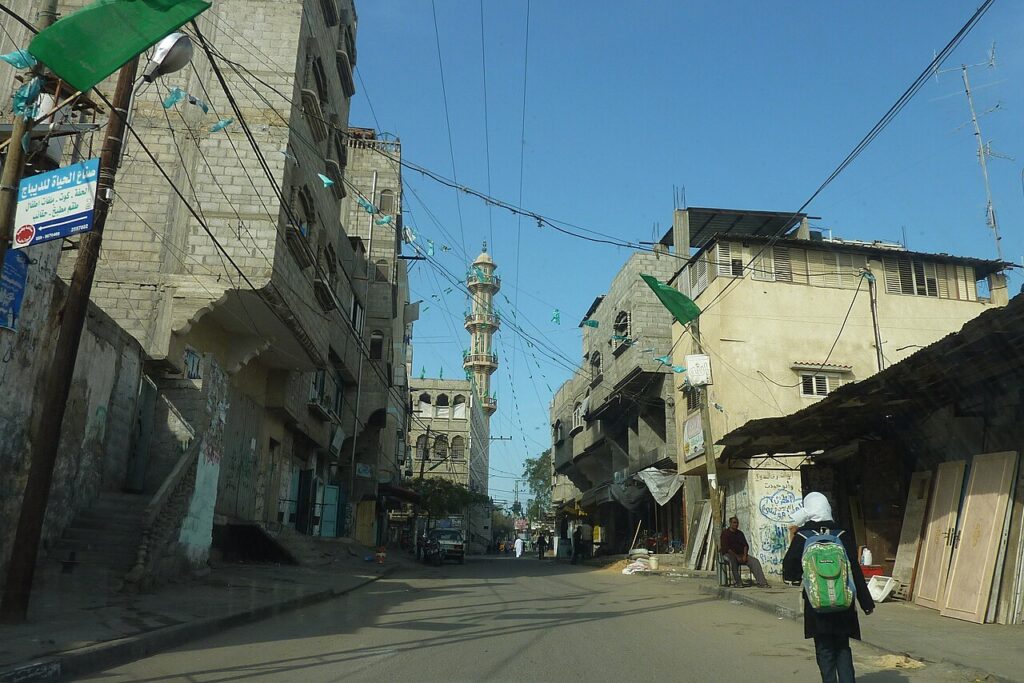
Israeli tanks rolled across the Yellow Line in central Gaza on Wednesday, advancing into territory held by Hamas for the first time since the ceasefire took effect more than a year ago.
The Israeli military described the action as a “targeted” operation, carried out jointly with the Shin Bet security service, to destroy a tunnel it said posed an immediate threat to its troops. Witnesses reported tanks and bulldozers advancing east of the Nuseirat refugee camp and north of the Bureij camp, moving onto the Salah al-Din road — Gaza’s main north-south route — under artillery fire.
Hamas condemned the advance as a “flagrant violation” of the ceasefire agreement brokered by the United States, which came into force in October 2025. Al Jazeera described it as the first major Israeli ground operation since the truce began.
The line that was supposed to hold
The Yellow Line is the withdrawal boundary agreed under the ceasefire: the line to which Israeli forces pulled back in the first phase of President Donald Trump’s plan, leaving them in control of just over half of Gaza. It is marked on the ground by yellow concrete blocks and signs. Since then, Israel has moved the line gradually, and it now encompasses around two-thirds of the enclave.
Wednesday’s operation went beyond it. Early in the afternoon, the Arabic-language spokesperson for COGAT — the Israeli military body that oversees civilian affairs in the occupied Palestinian territory — announced the start of the incursion and told Palestinians living north of the Nuseirat and Bureij camps to leave the area. The army said the stretch of Salah al-Din road would be closed until further notice. It has not said how long the operation will last.
Gaza’s Hamas-run Civil Defence said at least three people were killed in Israeli strikes on Wednesday. The Israeli military said it had struck several operatives. Families who had already been displaced more than once packed what they could carry and fled again, many of them on foot and donkey carts.
A truce under strain
The operation lands on a ceasefire that was already fraying. The US-backed Board of Peace — the body set up to oversee the agreement — has warned that the 13-month-old truce risks collapse, and both sides have accused each other of violations for weeks.
The human cost of that fragility is measured in the camps. 150,000 tents are sitting at Gaza’s border while families flood in the winter rain, with four countries demanding they be allowed in. The UN’s humanitarian office for the occupied Palestinian territory has warned repeatedly that shelter, food and medical care are running short as winter sets in.
The political backdrop is unsettled too. In Israel, a new government is still being negotiated after an election that left no bloc with a majority — how Israel forms a government when nobody wins the election is a question with no answer yet, and the caretaker government in Jerusalem is operating under the shadow of that deadlock.
What happens next
The immediate question is whether Wednesday’s operation stays limited to a single tunnel or becomes something larger. The Israeli military has framed it as a one-off response to a specific threat. Hamas has framed it as a breach of the agreement itself. The difference between those two readings is the difference between a ceasefire that survives and one that does not — and the families fleeing Nuseirat will not wait for the diplomats to decide which one it is.