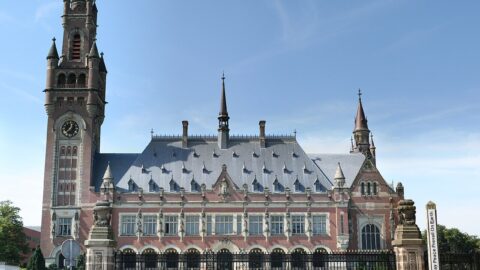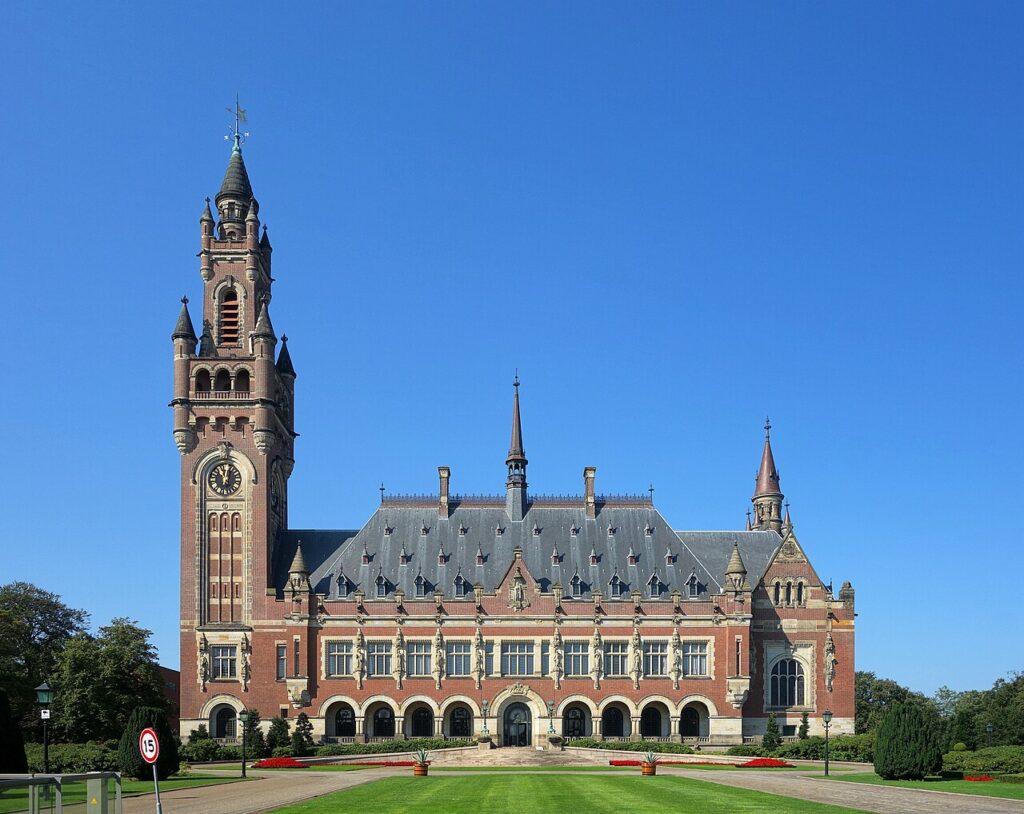
Informopedia Explains: at ten o’clock this morning in The Hague, fifteen judges in black robes filed into a courtroom in the Peace Palace and began reading a judgment that could make legal history. The question: did the state of Myanmar commit genocide against the Rohingya people? It is the kind of question the International Court of Justice was built to answer — and, in eighty years, it has answered it in full only twice.
The court that judges countries, not people
The International Court of Justice — the ICJ, or the World Court — is the principal judicial organ of the United Nations. It was established in 1945, alongside the UN itself, and has sat in the Peace Palace in The Hague since 1946. Its fifteen judges are elected by the UN General Assembly and Security Council for nine-year terms, and they are meant to represent the world’s principal legal systems between them.
The first thing to understand is what the ICJ does not do. It does not try individuals. That is the job of its younger, noisier neighbour — the International Criminal Court, the ICC, which prosecutes people for war crimes, crimes against humanity and genocide. The ICJ settles disputes between states. When one country accuses another of breaking international law, this is where the case is heard. The distinction matters: Can the ICC survive Washington’s sanctions? is a story about a court that puts individuals in the dock; the ICJ puts an entire state there.
The court hears two kinds of cases. Contentious cases are lawsuits between states — one state against another. Advisory opinions are answers to legal questions asked by UN bodies, such as the General Assembly. The Myanmar case is a contentious case, and it is binding: whatever the court decides today, both sides are legally obliged to comply, and there is no appeal.
How a state ends up in the dock
The case began on 11 November 2019, when The Gambia — a small West African country of about 2.7 million people, acting with the backing of the Organisation of Islamic Cooperation — filed an application against Myanmar. The legal hook was Article IX of the 1948 Genocide Convention, which lets any state party to the Convention bring a dispute about its interpretation or fulfilment before the court. The Gambia had no direct connection to the Rohingya; under the Convention, any member state can act, because the obligation not to commit genocide is owed to the international community as a whole.
The allegation concerned the Myanmar military’s “clearance operations” in Rakhine State in 2016 and 2017, which drove more than 730,000 Rohingya Muslims into Bangladesh amid allegations of mass killings, widespread sexual violence and the burning of whole villages. Myanmar has denied throughout that genocide was committed, describing the operations as legitimate counter-insurgency measures.
The case moved in stages that will be familiar to anyone who has watched a major trial: preliminary objections from Myanmar, rejected by the court in July 2022; provisional measures ordered in January 2020, requiring Myanmar to prevent acts prohibited under the Convention and preserve evidence; and hearings on the merits from 12 to 29 January 2026, with oral arguments and witness evidence. Eleven countries formally intervened in support of The Gambia’s position. The court’s own case page for The Gambia v. Myanmar carries the full procedural history.
Why genocide is so hard to prove
Here is the crux of the case, and the reason the judgment has taken so long. Genocide is not a synonym for mass killing. Under the 1948 Convention, it means acts — killing, causing serious bodily or mental harm, deliberately inflicting conditions of life calculated to bring about physical destruction, imposing measures to prevent births, forcibly transferring children — committed “with intent to destroy, in whole or in part, a national, ethnical, racial or religious group, as such.”
That last phrase is everything. The court must find not just that terrible acts happened, but that they were done with the specific intent to destroy the group — what lawyers call dolus specialis. And the court’s own standard is forbidding: where intent is inferred from a pattern of conduct, genocide must be the “only reasonable inference” that can be drawn from the evidence. If another explanation fits — ethnic cleansing, forced displacement, counter-insurgency — the court has, in the past, refused to find genocide.
That standard is why genocide has been established in court so rarely since the Holocaust. International tribunals convicted dozens of individuals for the 1994 genocide in Rwanda and the 1995 Srebrenica massacre in Bosnia. But the ICJ itself has ruled on the merits of only two genocide cases between states, both from the Balkan wars. In 2007, it found that Serbia had not committed genocide, but had violated the Convention by failing to prevent the genocide at Srebrenica. In 2015, it found that genocide had not been committed in Croatia. If the court finds against Myanmar today, it would be the first time any state has been held responsible for committing genocide.
What happens after the judgment
Three things are worth knowing about what a ruling can — and cannot — do.
First, it is final. ICJ judgments cannot be appealed. Myanmar would be legally bound to comply, including with any reparations the court orders. The Gambia has asked for reparations including full citizenship for the Rohingya — a demand that goes to the heart of the case, since Myanmar has long denied the Rohingya citizenship and calls them illegal immigrants from Bangladesh.
Second, the court has no way to enforce its own rulings. It has no police force, no army, no bailiffs. Enforcement falls to the UN Security Council, which can take measures to give effect to a judgment — but any permanent member can veto that. The Rohingya have already waited almost nine years in overcrowded camps in Bangladesh; a judgment in their favour would be a legal fact of enormous weight, not a plane ticket home.
Third, the ruling will echo. Cases are already pending behind this one — South Africa’s case against Israel, filed in 2023, and Ukraine’s case against Russia — and the court’s reasoning on intent will shape all of them. A finding of genocide would also sharpen the political pressure on governments that still deal with Myanmar’s military rulers, and on the companies that do business with them.
The judges in the crosshairs
The court does not operate in a vacuum, and this case has shown it. Navi Pillay, who won the Nobel Peace Prize last month, sits on the case as the ad hoc judge chosen by The Gambia. A Washington think tank close to the White House has predicted that a genocide finding would lead the United States to sanction the court’s judges — the same treatment already applied to judges of the ICC. It is an extraordinary position for a court to be in: asked to deliver the most consequential judgment in its history while one of the world’s great powers signals that it may punish the judges for the answer.
That is, in the end, what the ICJ is for. It was created in the wreckage of the Second World War on the premise that even the gravest disputes between states should be settled by law rather than by force. The International Court of Justice delivers its judgment today in The Gambia v. Myanmar. Whatever it says, the judgment will be read, argued over and cited for decades — because for the first time, the court is being asked to say, in law, whether a state set out to destroy a people.