Informopedia Explains: in the Bay of Fundy, on Canada’s Atlantic coast, the sea can rise and fall by 16 metres in a single day — the height of a five-storey building. Fishing boats that floated at dawn sit on the seabed by afternoon, and anyone who walks out across the exposed ocean floor has about six hours before the water comes back for them. The locals print the tide times in the newspaper the way other towns print the weather. They have to: the difference between high tide and low tide is the difference between a harbour and a mudflat.
Most coasts are gentler — a metre or two — but the mechanism is the same everywhere on Earth, and it is driven by an object 384,000 kilometres away that never touches the water at all.
The Moon pulls the ocean toward it
The tide begins with gravity. The Moon’s gravity tugs on everything on Earth, but it tugs hardest on the side of the planet facing it — including the ocean on that side. The water is pulled slightly toward the Moon, piling up into a bulge on the near side of the planet. That bulge is high tide.
Here is the part that surprises people: there is a second bulge on the exact opposite side of the Earth, facing away from the Moon. It exists because the Moon’s gravity also pulls the solid Earth itself toward it, slightly more strongly than it pulls the far-side ocean — the Earth is drawn away from its own far-side water, leaving a bulge behind. Two bulges, on opposite sides of the planet, and the Earth spinning through them.
That spin is the clock. As your coastline rotates through the near-side bulge, the water rises; as it rotates out, the water falls; then it meets the far-side bulge and rises again. Most coasts therefore get two high tides and two low tides every lunar day — about 24 hours and 50 minutes, the time it takes the Earth to rotate back to the same position relative to the Moon, which has moved on in its orbit meanwhile. That is why high tide arrives roughly 50 minutes later each day, and why tide tables are printed at all.
When the Sun joins in — and when it fights back
The Moon is not the only body pulling on the sea. The Sun’s gravity matters too, though less: the Sun is vastly more massive, but it is also vastly further away, and tidal force falls off with the cube of distance. The Sun’s pull on the oceans is roughly half the Moon’s.
Twice a month, at the new moon and the full moon, the Sun, Moon and Earth line up, and their pulls add together. The result is the spring tide — the highest high tides and the lowest low tides of the month. (The name has nothing to do with the season; it comes from an old word meaning to leap or surge.) At the quarter moons, the Sun and Moon pull at right angles to each other, partly cancelling out, and the result is the neap tide — the smallest range of the month. Sailors, fishermen and anyone building a harbour wall plan their lives around this fortnightly rhythm.
Local geography then takes over. The shape of a coastline, the depth of the water and the width of a bay can amplify a tide enormously — the Bay of Fundy is a natural funnel that resonates with the Atlantic’s tidal rhythm, which is why its range is the largest on Earth — or damp it down almost to nothing. The Mediterranean, nearly enclosed, barely notices the Moon at all.
Why this matters
Tides are not just a curiosity for beachcombers. They are one of the most predictable forces on the planet, and engineers are learning to harvest them: tidal turbines in narrow channels can generate electricity as reliably as the Moon itself, and several countries are now building them at scale. Coastal cities, meanwhile, are discovering the other side of that predictability — as sea levels rise, the same tides that have always come and gone now reach further inland, turning what used to be a once-a-decade flood into a monthly one.
And the Moon is slowly letting go. The friction of the tides drags on the Earth’s rotation, lengthening our days by about two milliseconds every century — and in exchange, the Moon drifts about 3.8 centimetres further from us each year. Hundreds of millions of years ago, when the Moon was closer, the tides were far larger, and the days were shorter. Hundreds of millions of years from now, the Moon will be further away, the tides smaller, and the days longer still.
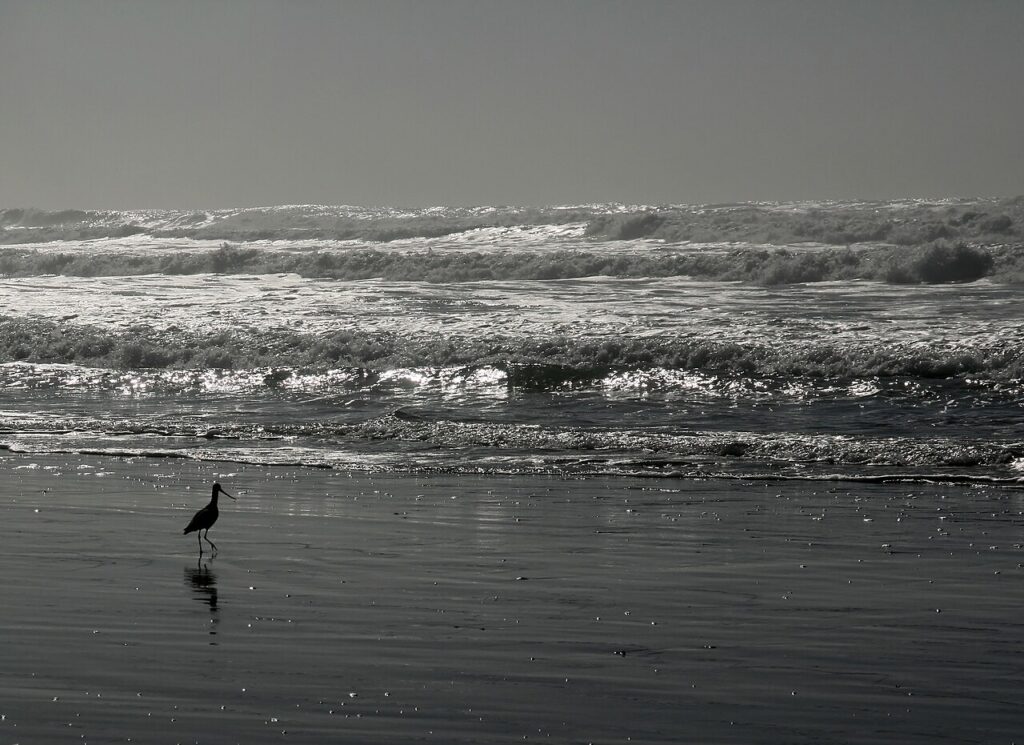
For now, the rhythm holds: two bulges, one spinning planet, and a sea that rises and falls on a schedule set by the Moon. The next time you stand on a beach and watch the water creep up the sand, you are watching gravity at work across 384,000 kilometres of empty space — the same force that holds the Moon in the sky, tugging at the ocean at your feet. The sea is salty for reasons of its own — why the ocean is salty is a story of rivers and rocks — but it rises and falls because of the Moon, twice a day, every day, without fail.
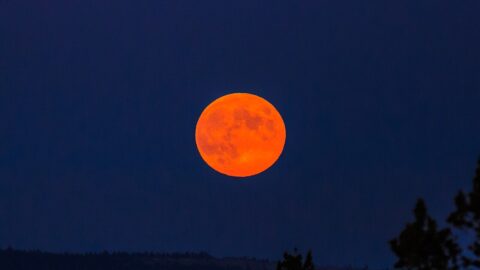
It is also worth remembering that the Moon plays tricks on us in other ways — the Moon illusion makes it look enormous at the horizon for reasons no one has fully explained. The tides, at least, we understand. And understanding them is the first step to living with them — whether you are a fisherman in Fundy, a city planner in a sinking delta, or just someone who likes to know when the beach will be there.
Further reading: NOAA’s tides tutorial.