On Friday afternoon, the ground moved under southern Panama. A magnitude 7.7 earthquake tore through the Azuero Peninsula at 12:56 local time, toppling a historic church tower in Penonome, cracking buildings in Herrera and Los Santos, and sending tsunami warnings out across a dozen Pacific coastlines from Mexico to Peru. About 200 kilometres away in Panama City, people poured out of swaying buildings. “We felt it very strongly. It knocked things over in the kitchen, but we’re okay, though we’re very scared,” Rosendo Dominguez, 60, from Herrera province, told the Associated Press by phone. “Everyone is outside, scared.”
Welcome to Informopedia Explains, where we take apart the questions that keep nagging at you. And after every big quake, this is the one: how is it possible that humanity can photograph galaxies and edit genes, yet nobody saw a magnitude 7.7 coming until the lamps started swinging?
First, what would a “prediction” even look like?
The US Geological Survey is blunt about its position: “Neither the USGS nor any other scientists have ever predicted a major earthquake. We do not know how, and we do not expect to know how any time in the foreseeable future.” A genuine prediction must name three things: the date and time, the location, and the magnitude. Anything vaguer is not a prediction; it is a guess dressed up in seismology.
That definition matters, because there are plenty of people selling the vague kind. One widely followed online forecaster warned that a big quake would hit “sooner or later” — a statement so elastic it can never be wrong and never helps anyone. The USGS counters that its scientists can do something more honest and more useful: calculate the probability that a significant earthquake will strike a particular area within a given number of years. That is forecasting, not prediction, and the distinction is the whole story.
The Earth starts every quake the same way
Here is the physical problem, and it is worse than most people realize. A magnitude 3.0 tremor and a magnitude 7.8 catastrophe begin in exactly the same way: a patch of fault deep underground suddenly slips. In the first fractions of a second, the rupture that will fizzle out after a few hundred metres looks indistinguishable from the rupture that will cascade across hundreds of kilometres.
Researchers at the University of Tokyo tested this directly, comparing 1,654 large earthquakes with 95,000 small ones recorded off Japan’s east coast. They found 390 pairs — one large, one small, nearly co-located — whose first 0.2 seconds of seismograms were practically identical. As Caltech seismologist Men-Andrin Meier put it, the simplicity of the comparison “is as simple as it gets.” Seismologist Rachel Abercrombie of Boston University likens it to dominoes: once the first one falls, the outcome depends on how the rest are arranged, and that arrangement is invisible to us.
There is a genuine scientific debate at the edges — some recent studies argue that the very first displacement might carry a hint of final size, which could help early-warning systems — but nobody claims it gives us days or weeks of notice. The fault’s stress state, the friction on its surfaces, the geometry of cracks at depth: all of it sits kilometres below us, beyond any instrument we can build, and it is the difference between a tremor nobody feels and a disaster.
The prediction that humiliated seismology
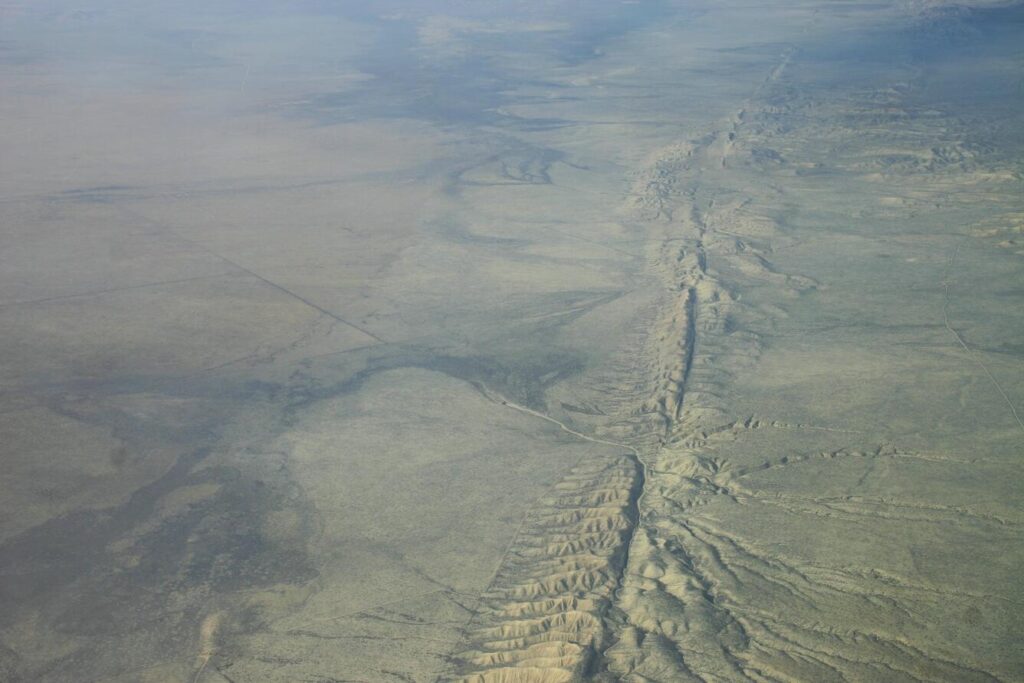
Scientists once thought they had a crack at it. On the San Andreas Fault near Parkfield, California, five magnitude 6 quakes had struck at eerily regular intervals — roughly every 20 years from 1881 to 1966 — and the 1934 and 1966 events were both preceded by tiny foreshocks exactly 17 minutes beforehand. In 1985, the USGS stuck its neck out and predicted the next Parkfield magnitude 6 quake would arrive before 1993.
Then nothing happened. And nothing. The town was wired with scores of sensors — seismometers, strain meters, magnetic-field monitors, creep gauges — waiting for a quake that refused to come on schedule. When the Parkfield magnitude 6.0 earthquake finally struck on September 28, 2004, it did so with no warning whatsoever: no foreshock, no strain buildup, no signal of any kind. The quake arrived 11 years late and the elaborate prediction experiment that was supposed to crack earthquake forecasting had produced its most damning result instead. A study in Nature put it plainly: the 2004 Parkfield earthquake, with its obvious lack of precursors, showed that reliable short-term prediction “is still not achievable.”
The wish list that keeps failing
Nature has never been short of supposed warning signs, and every generation of earthquake enthusiasts has had its favourite. Strange animal behaviour. Radon gas in groundwater. Glowing “earthquake lights” in the sky. Clouds, bodily aches, planetary alignments.
The USGS keeps a gloriously impatient list of the non-causes: “earthquakes have nothing to do with clouds, bodily aches and pains, or slugs.” The agency’s case against the rest is not snobbery but track record. Some quakes are preceded by foreshocks, radon anomalies, or odd animal behaviour — and many are not. Without consistency, a signal is not a signal; it is noise with a good publicist. As seismologist Hough told NPR, “nobody has established a track record of reliable predictions. If something were panning out, the proof would be in the pudding. Someone would be able to predict earthquakes reliably with a track record, and the whole world would take notice if somebody could do that. Nobody has.”
What science can actually do
Prediction is out. But it turns out that everything else seismology has built is quietly heroic.
Early warning. Systems like ShakeAlert on the US West Coast work on a beautiful trick of physics. When a quake begins, it sends out fast, weak P-waves and slower, destructive S-waves. Because radio signals travel almost instantly and seismic waves do not, sensors near the epicentre can detect the P-waves, estimate the quake’s size and location, and get a warning out ahead of the shaking. The alert can be seconds to minutes ahead — enough to duck under a desk, slow a train, open elevator doors, or shut off a gas line. ShakeAlert has been public in California since 2019 and now serves more than 50 million people across California, Oregon, and Washington. Japan’s system, running on a network of over a thousand seismometers, stops bullet trains automatically. This is not prediction. It is a race between waves, and we win it every time the epicentre is far enough away.
Hazard maps and probabilities. California’s UCERF3 model — the Uniform California Earthquake Rupture Forecast, built by the USGS with state and university partners — cannot tell you when the next big one hits. What it can tell you is that the state faces roughly a 7% chance of a magnitude 8 or larger earthquake in the next 30 years. That number sounds abstract until a city uses it to write building codes. Insurance, zoning, retrofitting schools: all of it runs on probabilities, not predictions, and probabilities have saved more lives than any prophecy ever did.
Aftershock forecasting. After a big quake, the USGS now issues operational forecasts of what comes next: the chances of aftershocks of various sizes over the coming day, week, month, and year. The workhorse is a statistical model called ETAS — epidemic-type aftershock sequence — which treats earthquakes like contagion: every quake spawns its own offspring according to patterns learned from decades of catalogues. Within half an hour of the 2019 Ridgecrest earthquake in California, UCERF3-ETAS simulations were already answering the question every survivor asks: is this it, or is a bigger one coming? Forecasting aftershocks is not the same as predicting the main shock, but for emergency managers deciding where to put field hospitals, it is close enough to matter.
Why this matters
The Panama quake will fade from the headlines, but its physics will not change: a magnitude 7.7 struck a known seismically active region, along a fault system geologists have mapped, at a depth of about 12 kilometres, and nobody — no agency, no app, no self-styled forecaster — had any idea it was coming that day. Venezuela and Colombia suffered devastating earthquakes earlier this year too. The ring of fire does not send invitations.
So here is the honest verdict, and it is worth sitting with. Earthquake prediction may never become possible, because the information that decides a quake’s size may be fundamentally locked inside the Earth until the rupture itself reveals it. That is not a failure of science; it is a fact about the planet. The money, the research, and your attention are better spent on what actually saves lives: early warning, hazard maps, buildings that stay standing, and drills practiced before the ground moves — not on anyone promising to tell you the date.
The question after a quake will always be “why didn’t they warn us?” The truer question is what we build with the warnings we already have.