Informopedia Explains: how a weapon that flies at five times the speed of sound — and steers — is quietly rewriting the rules of war.
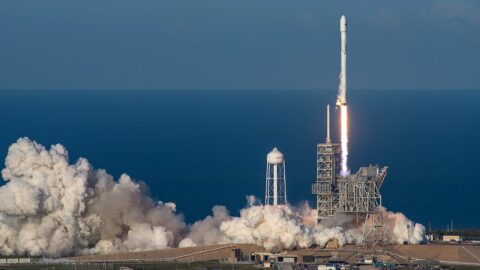
On the morning of October 8, 2026, on a windswept test range at Taean, about 130 kilometers south of Seoul, South Korea lit the fuse on a new kind of weapon. A rocket booster thundered upward; at the planned altitude, it fell away. What happened next was the part that mattered. Instead of arcing through space like an ordinary missile, the vehicle tipped over, dove back into the upper atmosphere, and began to maneuver — vertically and horizontally — at more than five times the speed of sound, before slamming into its test target.
Watching was President Lee Jae Myung. South Korea had just flight-tested its first domestically developed hypersonic weapon, and Lee called it a major step for the country’s defenses. “We must secure our security through our own strength,” he said. The timing was impossible to miss: a week earlier, North Korea had test-fired a missile it described as hypersonic, the projectile splashing down in waters near Japan.
So what exactly did South Korea just prove it can do — and why does it matter? The short answer is speed plus steering. The long answer is a story about physics so punishing that it took the world’s biggest militaries decades to master, and about a strategic logic that has arms-control experts genuinely worried.
What “hypersonic” really means
Start with the word. “Hypersonic” means anything traveling at Mach 5 or faster — five times the speed of sound, roughly 6,170 kilometers per hour. That sounds extraordinary, and it is. But here is the twist most coverage skips: speed alone is old news. Ballistic missiles have traveled at hypersonic speeds since the 1950s; an intercontinental ballistic missile’s warhead screams back into the atmosphere far faster still.
A hypersonic weapon, then, is not defined by how fast it goes. It is defined by how it flies. A ballistic missile is a thrown stone: once launched, it follows a predictable arc, and a good radar can calculate its landing point minutes before arrival. A hypersonic weapon refuses to behave. It stays inside the atmosphere, skimming its upper layers, and it steers — changing direction mid-flight the way a surfer cuts across a wave. Speed plus maneuverability: that combination is what makes it a different animal. As the U.S. Congressional Research Service puts it, unlike ballistic missiles, hypersonic weapons “do not follow a ballistic trajectory and can maneuver en route to their destination.”
The two machines that do the job
Engineers have settled on two fundamentally different designs, and the distinction matters.
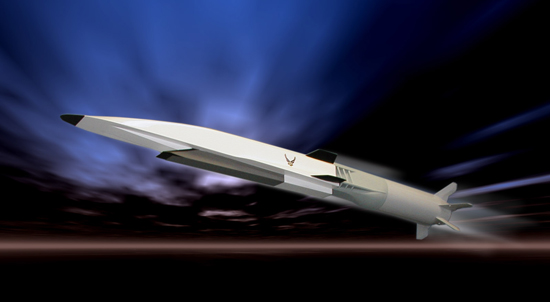
The first is the hypersonic glide vehicle, or HGV. Picture a dart-shaped craft riding atop a rocket booster. The booster hurls it toward the edge of space, then drops away. The vehicle tips over and glides — unpowered, the way a paper plane glides, except at Mach 5 and above — riding its own shock wave and steering with small control surfaces all the way down to the target. South Korea’s October test was this kind of system. So is Russia’s Avangard, and the glide vehicle China mounts on its DF-17 missile.
The second is the hypersonic cruise missile. This one stays powered the entire way, breathing air like a jet — except no ordinary jet engine can survive these speeds. It uses a scramjet, short for supersonic combustion ramjet: an engine with essentially no moving parts that burns fuel in air rushing through it faster than the speed of sound. America’s X-51A Waverider, which flew at Mach 5.1 off the California coast in 2013, was the famous proof the concept could work. Its successor, the Pentagon’s Hypersonic Attack Cruise Missile, is being designed small enough to be carried by fighter-sized aircraft.
The trade-off is clean. A glide vehicle gets one enormous push and then coasts — simpler in concept, unforgiving in practice. A cruise missile keeps its engine lit all the way — sustained power, but only after solving one of the hardest propulsion problems in aerospace.
Why building one is brutally hard
This is where the romance of Mach 5 meets physics that does not care about your defense budget.
Heat. At hypersonic speeds, air stops behaving like air. It piles up ahead of the vehicle, compresses, and superheats. Friction and compression can drive surface temperatures past 2,000 degrees Celsius — well above the melting point of titanium, which gives up at 1,670 degrees. The vehicle must survive that inferno while sheltering guidance electronics inside that would fry at a fraction of those temperatures. Building heat shields that are light, tough, and thin enough not to wreck the aerodynamics is one of the central engineering battles of the field.
Silence. That superheated air becomes plasma — a sheath of electrically charged particles wrapped around the vehicle. Plasma blocks radio waves. So at the exact moment the weapon most needs guidance, it can go deaf: GPS signals and radio commands cannot punch through, the same blackout spacecraft endure during re-entry. The missile must find its own way with pre-programmed inertial navigation, which is why hitting a moving target, like a ship at sea, remains enormously difficult.
The engine that only works once it is already working. A scramjet cannot start from a standstill. It functions only after the vehicle is already traveling at hypersonic speed, which means every hypersonic cruise missile needs a rocket booster just to light its engine — and then fuel must ignite and keep burning in airflow that spends less than a millisecond inside the combustion chamber. Engineers call it lighting a match in a hurricane.
Accuracy — the American problem. Most U.S. hypersonic weapons are being built to carry conventional warheads, not nuclear ones — unlike Russian and Chinese systems, which are believed to be nuclear-capable. A nuclear warhead forgives a miss; a conventional one does not. A conventional hypersonic weapon kills with kinetic energy alone — the sheer violence of impact at Mach 5 — which means it must strike almost exactly the right spot. The Congressional Research Service notes this makes American designs more technically demanding than their Russian and Chinese counterparts.
All of this explains the timeline. Washington has pursued hypersonic weapons since the early 2000s and asked Congress for $6.9 billion in hypersonic research for fiscal 2025 — yet it still has no operational hypersonic weapon in service. Its truck-launched Army system, the Long-Range Hypersonic Weapon (“Dark Eagle,” with a reported range of 1,725 miles), has slipped years past its original fielding target. The Air Force shelved its ARRW glide weapon after test troubles, then abruptly revived it this year and now plans to buy it.
Who has what
Russia got there first, at least on paper. Moscow declared its Avangard glide vehicle operational in December 2019, mounted on intercontinental ballistic missiles. Its air-launched Kinzhal has been fired repeatedly in the war in Ukraine. And its Zircon naval cruise missile was deployed aboard the frigate Admiral Gorshkov in 2023.
China showed its hand in 2019, rolling the DF-17 — a medium-range missile carrying the DF-ZF glide vehicle — through Tiananmen Square in a military parade. Western analysts believe the system entered service around 2020, aimed squarely at American ships and bases in the western Pacific.
The United States is still in testing, but the programs are moving: the Army’s Dark Eagle, the Navy’s Conventional Prompt Strike (which shares the same glide body), the resurrected ARRW, and the scramjet-powered HACM, for which the Air Force requested more than $800 million in fiscal 2026 alone.
Beyond the big three, the club is filling up. North Korea has tested missiles it calls hypersonic. South Korea’s October 8 flight puts a conventional deterrent for the peninsula on the table. And the Congressional Research Service lists Australia, India, France, Germany, and Japan as developing hypersonic technology too — India in partnership with Russia, Australia with the United States.
One caveat belongs here. Much of what the world “knows” about Russian and Chinese systems comes from state announcements and parades, not independent verification. The Congressional Research Service carefully says both countries have “likely” fielded operational glide vehicles. Treat claimed figures — Moscow says Avangard tops Mach 20 — as claims, not measurements.
Why generals are obsessed: the clock
So why does any of this matter? Because hypersonic weapons attack time itself.
Take missile defense. Systems like THAAD and Aegis were built to kill ballistic missiles: spot the launch, compute the arc, intercept along a predictable path. A glide vehicle breaks every assumption in that chain. It flies lower, inside the atmosphere, so ground-based radar cannot see it until late — the Congressional Research Service notes terrestrial radar cannot detect hypersonic weapons “until late in the weapon’s flight.” And because it maneuvers, the predicted impact point keeps shifting. As former U.S. Strategic Command chief General John Hyten put it: “If you can’t see it, you can’t defend against it.”
The deeper problem is decision time. A weapon that crosses a theater in minutes and can change course until the final seconds compresses the window leaders have to understand what is happening — and decide what to do — to almost nothing. Worse, it injects a terrible ambiguity: a hypersonic glider looks identical on a radar screen whether it carries a conventional warhead or a nuclear one. In a crisis, the side under attack must guess. Guessing wrong, in either direction, is catastrophic.
Why this matters
That ambiguity is what keeps arms-control specialists awake — especially now. The last U.S.-Russian nuclear arms treaty, New START, expired in February 2026 with no replacement in sight, leaving the world’s two largest arsenals unconstrained for the first time in decades. There is no treaty covering hypersonic weapons at all: no agreed rules, no test-notification requirements, no shared understanding of what counts as escalation.
The Congressional Research Service has been blunt about the unanswered questions: what missions are these weapons actually for, are they worth the cost, and what does fielding them do to strategic stability? Critics argue the weapons lack clear mission requirements and add little to deterrence — an expensive answer to a question nobody has properly asked.
The backers’ reply is that precision conventional strikes delivered in minutes — against a mobile launcher, a command bunker, a warship — give leaders options between doing nothing and starting a much bigger war. Whether that logic survives contact with a real crisis is untested. Deterrence theories always look cleaner than the wars they are meant to prevent.
What happens next
South Korea’s test will not transform the military balance of Northeast Asia tomorrow. What it changes is the membership list. Hypersonic technology is leaking outward from the great powers to regional rivals, each with its own flashpoints and its own shorter decision timelines — and the Korean Peninsula has among the shortest of all.
Three things are worth watching. First, whether Seoul moves from a successful test to a deployed weapon, and how Pyongyang answers. Second, whether the United States finally fields an operational system — the Army’s Dark Eagle battery and the Air Force’s HACM flight tests are the milestones to track. Third, whether anyone starts writing rules: hotlines, launch notifications, even informal understandings about what these weapons will and will not be used for.
The physics took decades to master. The diplomacy has not begun. At Taean, South Korea proved it can build the missile. Nobody has yet proved they can manage what the missile does to a crisis — and that was always the harder problem.