Informopedia Explains: the nuclear power plant with no engine — and why tugboats are hauling it to the top of the world.
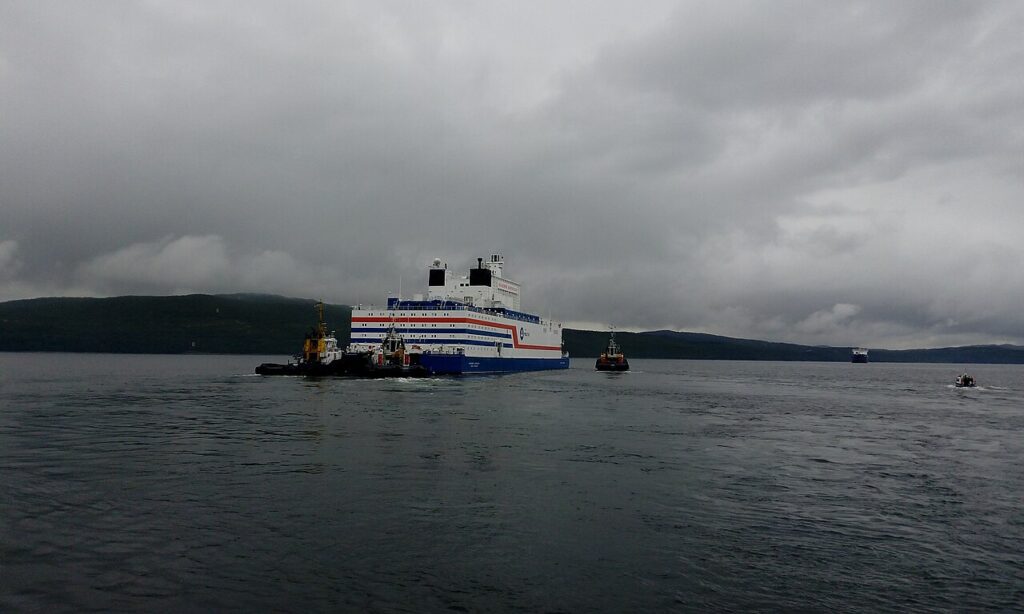
Somewhere in a St. Petersburg shipyard sits a 140-metre steel barge that weighs 19,000 tons, has no engine of its own, and carries two nuclear reactors. When it is finished, tugboats will tow it thousands of kilometres across the Arctic Ocean to a spot on the Siberian coast where it will spend the next several decades doing something no barge has ever done: powering a copper mine.
In September, Russia’s state nuclear corporation Rosatom announced it had completed both reactors for the lead vessel — two 58-megawatt units built at the ZiO-Podolsk plant. It is the opening move in one of the most ambitious energy projects on the planet: a fleet of floating nuclear power plants for the Russian Arctic.
Wait — floating nuclear plants already exist?
Yes, and this is the part most people miss. Russia has been operating one commercially for years. The Akademik Lomonosov, moored at the Arctic port of Pevek, has been feeding a small grid in the Chukotka region since May 2020, running on two older 35-megawatt reactors for a combined 70 megawatts. It is the only floating nuclear power plant in service anywhere in the world.
The new vessels are its bigger, tougher successors. Each carries two RITM-200 reactors — compact pressurized-water units adapted from the ones that power Russia’s nuclear icebreaker fleet, including the Arktika, Sibir, Ural and Yakutia. The design is battle-tested in the worst conditions on Earth: icebreakers have been smashing through Arctic ice with nuclear power for decades.
How it actually works
A floating nuclear plant is, at heart, an ordinary nuclear plant that someone put on a boat. The physics is the familiar pressurized-water reactor loop:
Inside each reactor, uranium fuel rods sustain a controlled chain reaction, releasing heat. That heat is carried by pressurized water — kept liquid at enormous pressure — to a steam generator, where it boils a separate loop of water into steam. The steam spins a turbine, the turbine drives a generator, and electricity flows ashore through high-voltage cables. The steam then condenses back to water and the cycle repeats.
The “floating” part is engineering, not physics. The barge hull is divided into compartments: reactor halls, turbine rooms, control systems, radioactive waste storage, living quarters for the crew. Everything a land-based plant needs, compressed into a vessel 140 metres long and 30 metres wide.
Refueling happens roughly every five years — and here the floating design shows its real advantage. Instead of building a specialized facility at the mine site, operators can simply tow the barge back to a shipyard, swap it with a spare unit, and do the delicate work where the tools and expertise already are.
Why put a reactor on a barge at all?
The customer explains everything. The Baimskaya project in Chukotka — across the Bering Strait from Alaska — sits on one of the largest untapped copper deposits on the planet. Developing it needs around 300 megawatts of steady, year-round power. The site has brutal winters, permafrost, and no electrical grid to plug into. Building a conventional power plant there would mean constructing everything — foundations in thawing ground, fuel supply chains across thousands of kilometres of wilderness — from scratch.
A floating plant sidesteps all of that. It is built in a proper shipyard, tested, fueled, and then delivered like cargo. Four identical barges are planned for Cape Nagloynyn: three to run the mine and its new port, and a fourth as a dedicated spare that rotates in whenever one unit shuts down for its five-year maintenance. The whole energy investment exceeds 1.1 trillion rubles, synchronized with a new year-round road, a 330-kilovolt power line stretching 400 kilometres, and port construction.
Rosatom is blunt about the ambition. “This project begins the history of a whole family of floating nuclear power plants,” said Andrey Nikipelov, head of its engineering division — Arctic versions and tropical versions, offered on the export market for remote industrial projects. The company calls the Chukotka project “the world’s first green energy project for industrial production based on a floating power unit” — a description that leans heavily on nuclear’s low carbon emissions and that critics would dispute on other grounds.
Keeping it in place — and keeping it safe
Mooring a 19,000-ton reactor barge where the sea freezes solid is a serious engineering problem. Traditional anchor chains would snap under shifting ice or drag the vessel off station. Rosatom’s answer is a hybrid system: the barge is held by heavy-duty rigid mooring devices — articulated steel arms anchored to onshore or seabed columns that work like vertical sliders, letting the vessel ride up and down with the tides while preventing horizontal drift. That stability matters because some 50 high-voltage cables run from the barge to the shore grid; they must never stretch, twist or snap.
The berth itself is protected by a reinforced rock-and-concrete breakwater that deflects drifting ice floes. Even so, the sea freezes around the hull each winter, so the plants carry countermeasures against crushing ice pressure — including piping reactor heat into the ballast tanks to keep ice from gripping the hull.
The safety case rests on containment, redundancy and the icebreaker record. The skeptic’s case is straightforward: a nuclear accident at sea, in one of the most remote and ecologically fragile regions on Earth, would be extraordinarily hard to clean up. Spent fuel and waste accumulate on board. And a reactor towed through contested Arctic waters raises security questions no land-based plant faces.
Why it matters
Floating nuclear is a bet that the future of heavy industry in remote places — Arctic mines, island nations, disaster zones — will need power that arrives by sea. Small modular reactors are the nuclear industry’s great hope for a comeback, and Russia is currently the only country actually deploying them on water.
The Baimskaya fleet is the proof of concept. If three barges can keep a copper mine running through Arctic winters for decades, the export pitch writes itself: cheap, carbon-free baseload power, delivered by tugboat, for any coastline that needs it. If something goes wrong, the industry’s critics will have their cautionary tale. Either way, the experiment is already underway — and the tugboats are waiting.
Related: Why the world is fighting over the lightest metal on Earth