LONDON — Britain has formally accused Iran’s Islamic Revolutionary Guard Corps of directing a suspected terror plot against RAF Fairford, the airbase in Gloucestershire that the United States used to launch bomber strikes on Iran.
Prime Minister Andy Burnham told the House of Commons on Monday that the government’s assessment was that the September operation against the base was “highly likely to have been coordinated in Iran, almost certainly directed by Iran’s Islamic Revolutionary Guard.”
“We will not tolerate these threats on our soil,” Burnham told MPs, promising to “crack down on Iran’s use of criminal networks, using our full range of powers to target them and their funding streams” and to bring further sanctions “to restrict the capacity of Iran and the IRGC to do us harm.”
Within hours, Foreign Secretary Ed Miliband announced sanctions against two Iranians for what he called their “role in facilitating or engaging in hostile activity on behalf of the Iranian regime.” Britain also summoned Iran’s ambassador in London to protest what officials described as Tehran’s attempts to undermine British security.
The announcement came alongside a joint statement from 29 countries — including the United States, most of Europe, Canada, Australia and New Zealand — backing Britain’s attribution of the attempted infiltration.
What happened at Fairford
The alleged plot came to light in the early hours of September 27, when counter-terrorism police arrested five British men in their twenties near the perimeter of the base on suspicion of terrorism and explosives offences. Three vans were seized. Investigators found a supply of petrol in the vehicles but no explosives.
All five were later released without charge on police bail “under stringent conditions.” Last week, counter-terrorism officers arrested a 22-year-old British national on suspicion of a terror offence linked to the security incident. A 25-year-old British-Iranian man was also detained in London earlier this month.
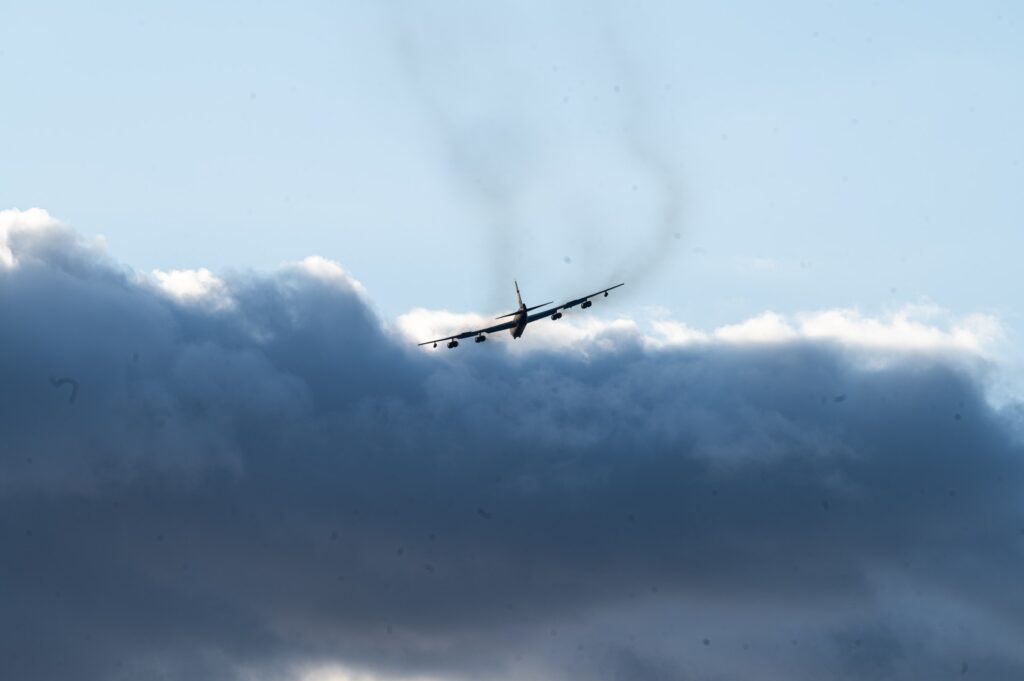
The base at the centre of all this is no ordinary installation. RAF Fairford was the forward home of America’s bomber fleet in the war against Iran — the B-52s and B-1s that flew long-range strike missions from the English countryside. Last week, the Pentagon pulled every bomber out of the base, redeploying the aircraft to their home stations in the United States after what officials described as a credible Iranian threat. US officials told Reuters at the time that investigators suspected a plan to hit the base with drones, and President Donald Trump said those behind it had planned to cause “big damage.”
That withdrawal — which Informopedia reported last week — left the airbase at the centre of a mystery: who was really behind the September scare? Monday’s statement is Britain’s answer.
Tehran denies everything
Iran has rejected the accusation outright. Iran’s ambassador to Britain, Seyed Ali Mousavi, said Tehran had “had no involvement in this matter” and challenged London to produce its evidence: “if the British government possesses any documents or evidence to support its claims, it should present them.” Iranian state media called the allegations “unfounded and malicious speculations.”
Tehran has offered to assist in the British investigation — a gesture London plainly does not intend to take up.
Why this matters
This is no longer a policing matter. It is a diplomatic confrontation, and an unusually public one.
Intelligence services rarely name a foreign state as the sponsor of an attempted attack on home soil with this level of confidence, let alone in parliament. For London to say a plot against a British airbase was “almost certainly directed” by the IRGC — while sanctioning named Iranians and summoning the ambassador — is the language of governments preparing for a long argument, not closing a case file.
The 29-country joint statement is the tell. Britain has spent the war with Iran complaining that its allies were slow to recognise Tehran’s reach into Europe. A coalition of nearly thirty nations signing the same attribution in a single day is the broadest show of Western unity against Iran in months — and a signal to Tehran that its denials are being priced in, not believed.
There is also the question of timing. The war between the United States, Israel and Iran is now in its eighth month. Oil has pushed past $100 a barrel, the Strait of Hormuz remains a tinderbox, and the airbase that just lost its bombers has now been officially declared a target of Iranian intelligence. That turns Fairford from an investigative footnote into a front line — and makes every future incident near a Western military installation a potential international crisis.
For Iran, the sanctions and the public naming are meant to raise the cost of deniable operations. For Britain’s government, the risk runs the other way: it has now committed itself to an accusation it may be pressed to prove. The five men arrested in September remain on bail. The investigation continues. And the question of what, exactly, those three vans were for still has no public answer.