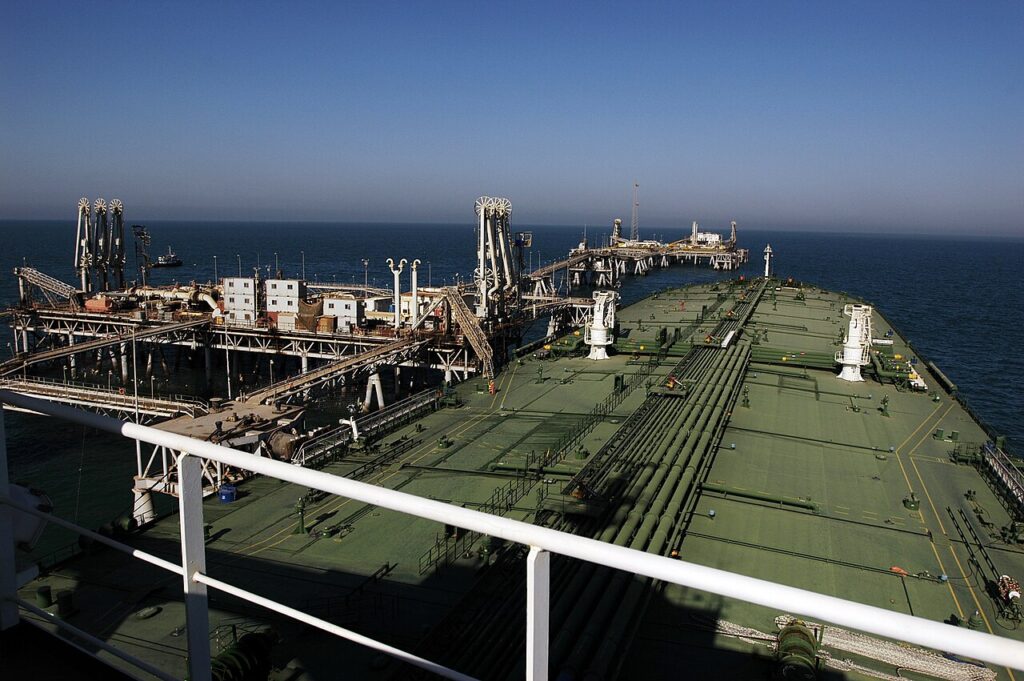
Two separate strikes on oil tankers off Saudi Arabia’s Gulf coast in a single day have deepened the sense that the war at sea is moving into new waters.
The United Kingdom Maritime Trade Operations — UKMTO, the Royal Navy unit that acts as the main clearinghouse for security reports from commercial shipping — said on Saturday that a tanker was struck by an “unknown projectile” about 68 nautical miles northeast of Al Jubail on Friday. All crew were reported safe and evacuated, and there was no environmental damage at the time of the report.
Then came a second report, also issued on Saturday. In it, UKMTO said that a tanker had been attacked by a rocket-propelled grenade fired from a small boat roughly 78 nautical miles northeast of Jubail — also on Friday. The blast damaged the vessel’s aft port quarter, but again the crew were reported safe. Whether the two reports describe the same ship or two different ships is not yet clear; Reuters said it could not immediately establish the connection.
One maritime security firm, Vanguard, has identified the struck vessel as the Safeen Principal, a crude oil tanker sailing under the flag of the Marshall Islands — a common “flag of convenience” used by commercial ships worldwide. Vanguard reported that the ship lost power and suffered a fire in its engine room.
Why Al Jubail matters
Al Jubail, on Saudi Arabia’s eastern coast, is the kingdom’s largest industrial city and one of the busiest petrochemical ports in the world. Attacks this close to its coastline are notable because most of this year’s shipping strikes have clustered around the Strait of Hormuz — the narrow waterway between Iran and Oman through which roughly a fifth of the world’s oil used to flow before the current Iran-US conflict erupted.
UKMTO’s weekly review counts 135 such incidents around Hormuz so far. Six more ships have been attacked in the Red Sea. Friday’s strikes push the danger zone south into the Persian Gulf itself, inside Saudi Arabia’s own maritime approaches.
The agency warned other vessels to “transit with caution and report any suspicious activity to UKMTO while authorities are investigating.”
What this means for oil — and for you
The timing could hardly be worse for energy markets. Brent crude closed Friday above $109 a barrel and briefly touched $110 for the first time since May, as traders priced in the risk that the waterways of the world’s biggest oil-producing region are no longer safe for commercial traffic. It was the same day tech stocks lost more than $1 trillion on Wall Street — partly on the back of the oil surge.
Earlier on Saturday, Iran’s Islamic Revolutionary Guard Corps claimed that a supertanker carrying two million barrels of crude had exploded on a sea mine while crossing the Strait of Hormuz on what Tehran called an “unauthorized” route — a claim Informopedia covered here.
That matters far beyond the Gulf because higher shipping risk shows up everywhere oil is bought and sold. Marine insurers raise war-risk premiums the moment tankers come under fire; those premiums flow into the price of crude, then into petrol at the pump and the cost of moving goods by road, rail and air. When one of the world’s great oil corridors becomes a combat zone, the bill eventually reaches people who have never heard of Al Jubail.
What we don’t know yet
No group has claimed responsibility for either strike, and no state has been officially blamed. Whether Friday’s projectile and the RPG attack were aimed at one ship or two — and who fired them — remains unanswered. Investigations by maritime authorities are ongoing.